
 E-Paper


The leather jacket era ends: How Jensen Huang's exit could reset the AI chessboard
Jensen Huang's exit marks the end of a 33-year leadership era at Nvidia, but its impact could extend far beyond the company.

 Prefer HTon Google


For years, Jensen Huang's black leather jacket became one of the most recognisable outfits in technology. It appeared at product launches, developer conferences, COMPUTEX and major industry events, usually alongside announcements about chips that promised to make artificial intelligence faster and more powerful. Huang had turned Nvidia into much more than a semiconductor company. He had made it one of the central players in the global AI race. Now, that familiar figure is out of the picture for now.

On November 12 (yesterday), Nvidia announced that Huang had resigned as president, CEO and a member of its board, effective immediately. The company appointed its chief financial officer, Colette Kress, as interim CEO while it begins looking for a permanent successor. Harvey C. Jones was also appointed as Nvidia's first-ever board chair. The announcement brought an end to Huang's 33-year run at the company he co-founded in 1993.
The circumstances surrounding his departure have attracted enormous attention, but the bigger story lies ahead. Nvidia's influence extends across the AI industry, from the chips used to train large language models to the data centres powering AI services. Huang was not just running the company. He was its chief strategist, public face, dealmaker and one of the most prominent advocates for the AI boom.
His exit therefore creates an unusual situation. Nvidia's technology does not disappear with its CEO, but the person who connected its products, customers, political relationships and long-term ambitions is no longer steering the business. And that could give several other players an opportunity to change the rules of the game.
Nvidia's biggest advantage was never just its chips
To understand what could change, it is important to look at what Huang actually built. Nvidia began in 1993 with a focus on graphics processing, particularly for computers and gaming. Its GeForce GPUs helped establish the company in that market, but Huang had a much bigger idea for the technology. In 2006, Nvidia introduced CUDA, a software platform that allowed developers to use GPUs for general-purpose computing rather than limiting them to graphics.
That decision would eventually become one of the company's most important advantages. When researchers began using GPUs to train increasingly complex AI systems, Nvidia already had the hardware and software ecosystem to support them. As generative AI took off, demand for its processors surged.
But Nvidia's strength is not simply that its chips are powerful. It has built an entire environment around them, including networking technology, software libraries, developer tools and complete computing systems. For companies building AI models, switching to another chipmaker is therefore not always as simple as placing a different order. They may also need to adapt software, infrastructure and existing workflows.
This is the advantage Huang leaves behind. It is also why his departure does not automatically mean Nvidia will lose its position. However, maintaining that ecosystem and continuing to expand it will require a leadership team capable of making the same kind of long-term bets.
The first big shift could come from Nvidia's rivals
One of the most immediate consequences of Jensen Huang's exit could be a change in how customers approach their chip suppliers. For years, major technology companies have relied heavily on Nvidia to build their AI infrastructure. But dependence on one supplier comes with risks, particularly when demand is high and access to advanced processors can influence how quickly a company develops new products.
This is where competitors such as AMD, Broadcom and Marvell could find an opening. AMD has been building its AI accelerator business, while Broadcom and Marvell have been involved in the growing market for custom silicon. Major cloud companies are also developing their own chips to reduce their dependence on external suppliers.
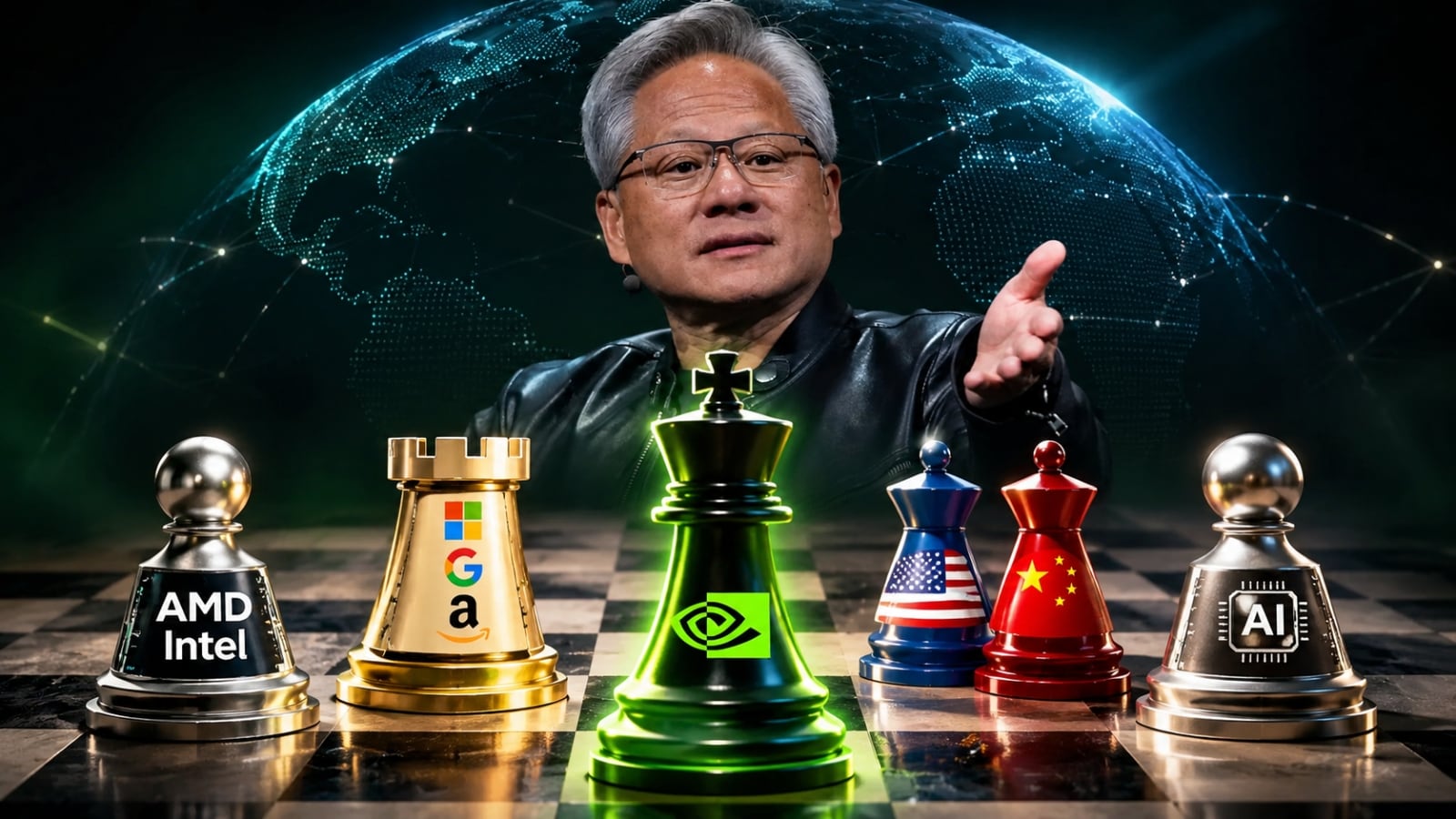
The departure of a CEO who was closely associated with Nvidia's strategy could encourage some customers to reconsider their options. That does not mean they will suddenly abandon Nvidia. Its software ecosystem and established relationships remain difficult to replace. But customers may become more comfortable spreading their orders across multiple suppliers.
The opportunity is pretty massive because the AI industry is no longer interested in buying chips simply to experiment with new technology. Companies are spending billions on infrastructure and want more control over performance, costs and supply. A stronger competitive market could give them more negotiating power.
AP has already reported that Huang's departure has created an opportunity for rival chipmakers, with AMD, Intel and Broadcom among the companies attracting investor attention amid the uncertainty.
The AI giants may gain more control
The next piece on the chessboard is Nvidia's customer base. Microsoft, Google, Amazon and other large cloud companies are not merely buying AI chips. They are building the infrastructure through which much of the world's AI services will operate.
These companies have a strong reason to diversify their hardware. Developing their own processors gives them greater control over costs, supply and the technology powering their services. If Nvidia's leadership transition introduces uncertainty around pricing, investment or long-term supply agreements, that incentive could become stronger.
There is another interesting angle here: the relationship between Nvidia and the companies buying its products. Huang was known for pursuing ambitious partnerships and investments across the AI ecosystem. Reuters has reported that some of these arrangements, including financing linked to AI infrastructure companies and customers, had attracted questions from investors about the risks of an increasingly interconnected AI economy.
Under new leadership, Nvidia could take a more cautious approach to such deals. That might reassure investors concerned about financial exposure, but it could also change the way the company supports emerging AI businesses.
For the larger cloud companies, this creates an interesting opening. They could become less dependent on Nvidia while gaining greater influence over the infrastructure, computing costs and commercial relationships that shape the AI market.
Washington, Beijing and the next CEO's biggest test
Nvidia's leadership transition also arrives at a particularly sensitive moment for the global semiconductor industry. Advanced AI chips have become strategic assets. The United States has imposed restrictions on the export of certain high-performance processors to China, while Beijing is trying to strengthen its domestic semiconductor industry. The debate is not simply about commercial competition. It is also about national security and who gets access to the computing power needed to develop advanced AI.
Huang had been one of the most visible voices arguing for a more measured approach to restrictions on chip exports to China. His departure could change how Nvidia engages with Washington and how aggressively it pushes its position on the issue.
The allegations surrounding his personal relationships and the reported national security concerns have added another layer of scrutiny. Nvidia's board announced an independent investigation on November 8 after reports raised questions about whether Huang had been targeted by a foreign intelligence effort. China has rejected the espionage allegations. Nvidia's November 12 announcement, however, did not specify a reason for his resignation.
The person who replaces Huang will inherit a difficult balancing act: protecting Nvidia's global business, maintaining relationships with US policymakers and navigating restrictions that could affect its access to one of the world's largest technology markets.
Can Nvidia win without the man who built it?
For now, Colette Kress has the responsibility of keeping the company steady. She joined Nvidia in 2013 and has led its finance organisation through a period of extraordinary growth. Her appointment provides continuity while the board searches for a permanent CEO.
However, the question is whether the next leader can match Huang's appetite for risk and his ability to anticipate where computing is heading. Reuters has reported that Kress had sometimes challenged Huang's ambitious investment plans, making her appointment particularly interesting as Nvidia enters a period of transition.
The company has already said that its operations, customer commitments and product roadmap are expected to continue without interruption. Its next major test will be executing that promise while convincing investors and customers that its long-term strategy remains intact.
Huang's exit will not suddenly make Nvidia's technology less capable or erase the ecosystem it spent decades building. But it could change how the company behaves, how its customers negotiate and how aggressively its rivals challenge its position.
The AI race is entering a phase where access to computing power, control over infrastructure and the ability to make enormous investments may matter as much as the models themselves. Nvidia has been at the centre of that shift, with Huang leading from the front.
The leather jacket era may be over, but the AI chessboard is still crowded. And for the first time in 33 years, Nvidia's competitors have to consider what the game might look like without Jensen Huang making the next move.


