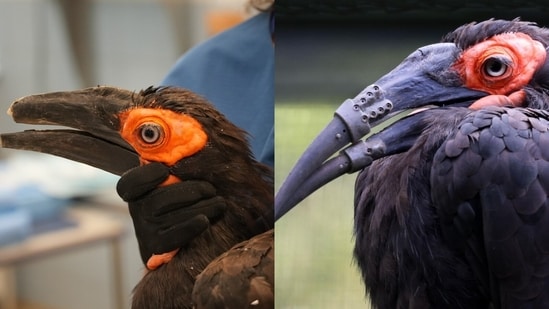
An injured southern ground hornbill at Artis Zoo in Amsterdam has received two custom-made, 3D-printed prostheses to replace the broken upper and lower parts of its beak. In what is believed to be a world-first procedure, the bird began using its new beak on the day of surgery.
(Also read: ‘This is Europe?’: Indian woman questions ‘civic sense’ after spotting litter in Amsterdam)
According to a report by NL Times, the innovative treatment involved specialists from several Dutch institutions.
“As far as is known, this is the first time in the world both parts of a bird’s beak have been restored in this way,” Artis said in a statement.
How the injury affected the hornbill
“A beak is essential to a bird,” the zoo said.
Southern ground hornbills rely heavily on their beaks to search for food, probe the ground and preen their feathers.
After breaking both sections of his beak, the male hornbill was left with two stumps. Although he managed reasonably well, the injury significantly restricted his everyday activities.
According to an official statement by Utrecht University, specialists used CT scans and preserved fragments of the original beak to reconstruct its shape.
How doctors created the new beak
{{/usCountry}}According to an official statement by Utrecht University, specialists used CT scans and preserved fragments of the original beak to reconstruct its shape.
How doctors created the new beak
{{/usCountry}}The procedure was carried out through a collaboration involving Artis Zoo, Utrecht University's Faculty of Veterinary Medicine, UMC Utrecht and Amnovis.
Joëll Magré of UMC Utrecht developed the two 3D-printed sections, while Amnovis manufactured titanium components used to secure them.
Artis veterinarian Martine van Zijll Langhout and avian specialist Yvonne van Zeeland helped develop the treatment plan.
Veterinary surgeons Bjorn Meij and Lucinda van Stee subsequently performed the operation.
Bird begins using new beak immediately
The biggest uncertainty was whether the hornbill would accept the prostheses.
However, the bird showed encouraging signs almost immediately.
“He started using the prostheses on the day of the surgery. The following morning, he independently picked up a small mouse from the ground,” the zoo said.
“After a few days, he also began preening his feathers.”
According to an official update from Artis Zoo, specialists will continue monitoring the bird to determine whether the prostheses remain effective in the long term.
(Also read: Indian woman amazed as Dutch firefighters use crane to rescue sick patient from building without a lift. Watch)
“If they do, this innovative treatment could open up new possibilities in veterinary medicine.”
The researchers also hope to publish their findings, potentially paving the way for similar treatments for other injured birds.