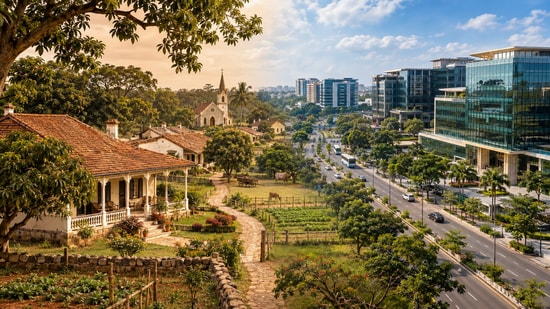
Bengaluru's Whitefield, now known for its sprawling IT parks, multinational companies and rapidly expanding urban landscape, has a history dating back more than 140 years. Long before becoming one of the city's major technology hubs, the neighbourhood was established as a settlement for Eurasian and Anglo-Indian communities in the late 19th century.
According to the Imperial Gazetteer of India (1908), Volume 24, page 387, Whitefield was established in 1882 on land granted by Mysore State. The historical record states, “It is named after Mr. D. S. White,” referring to the founder of an association in Madras.
How did Whitefield get its name?
According to the official history of Our Lady of Lourdes Church, Whitefield was named after David Emmanuel Starkenburgh White, who played a key role in establishing a settlement for European and Anglo-Indian families.
{{/usCountry}}According to the official history of Our Lady of Lourdes Church, Whitefield was named after David Emmanuel Starkenburgh White, who played a key role in establishing a settlement for European and Anglo-Indian families.
{{/usCountry}}An earlier Hindustan Times story published in January 2024 reported that White was the founder-president of the Eurasian and Anglo-Indian Association of South India.
In 1882, he persuaded the Maharaja of Mysore to grant 3,900 acres of land east of Bangalore Cantonment to establish a community where families could support themselves through agriculture.
What was life like in early Whitefield?
The settlement was planned around two concentric circles, with a village green, a Protestant church, a club, residential plots and agricultural fields, according to the HT report.
The 1908 Gazetteer recorded a population of just 968 in 1901, with approximately 50 houses, mostly occupied by pensioners. Residents cultivated fruits, vegetables, timber and grain crops and also kept poultry.
However, the original ambition of establishing an agricultural community did not fully materialise. Residents eventually turned towards horticulture, developing mango orchards, flower farms and casuarina plantations. Some also found employment at the nearby Kolar Gold Fields.
The official church history also documents the involvement of White's wife, Rose White, in establishing Our Lady of Lourdes Church, whose foundation stone was laid on July 3, 1894.
How did Whitefield become an IT hub?
Whitefield's transformation accelerated during Bengaluru's technology boom in the 1990s.
The earlier HT report traced this shift to 1996, when International Tech Park began operating in the area. The park was officially inaugurated on January 21, 2000 by Singapore's then prime minister Goh Chok Tong.
Despite rapid urbanisation, traces of the original settlement remain. A 2023 Indian Express report documented surviving heritage homes along Inner Circle Road, including Perfect Peace and Little Gem.
These buildings offer a glimpse into Whitefield's quieter past, long before its emergence as one of Bengaluru's busiest technology districts.