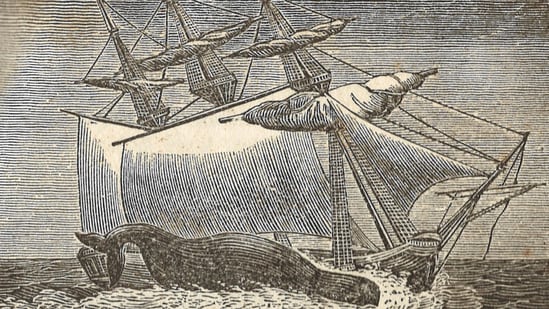
On November 20, 1820, an American whaling ship named Essex sank at sea after being rammed by a massive sperm whale. The incident would go on to serve as one of the inspirations for Herman Melville's 1851 novel, Moby-Dick.
Today marks 206 years since that fateful day, which took the survivors of the ship on a journey that would culminate in cannibalism. Here is a closer look at what happened to Essex and its crew.
The story of whaleship Essex
Essex was an American whaling ship from Nantucket, Massachusetts. In 1819, the ship set sail for a three-year voyage, reaching the South Pacific by early 1820.
According to the Nantucket Historical Association, on November 20 that same year, an enraged sperm whale rammed the ship in the middle of the Pacific Ocean. The whale, it is said, was as big as the vessel. At that time, the Essex was roughly 1,300 miles away from the nearest land.
All 20 sailors onboard the vessel survived. In three small whaleboats, and with a limited supply of food and water, they started sailing the open seas. According to Encyclopedia Britannica, afraid of finding cannibals in the Marquesas or Society islands, which were the closest lands, the sailors decided to head for Peru or Chile.
(Also read: Moby-Dick; Tracing the success of a Great American Novel)
{{/usCountry}}(Also read: Moby-Dick; Tracing the success of a Great American Novel)
{{/usCountry}}Bad weather and lack of food marred their journey, but on December 20, the three boats reached the uninhabited Henderson Island. They stayed at the island for less than a week, quickly running out of food and drinking water.
The crew realised that staying long-term on the island was not an option, and decided to sail again. Three members of the Essex crew, however, opted to stay behind on the island, while the other 17 prepared to leave.
On December 27, 1820, the remaining crew of 17 set sail, hoping to reach Easter Island. They again ran into severe difficulties, with lack of food and water, and one boat getting separated from the others.
“By January 1821, the starving survivors had resorted to cannibalism,” Encyclopedia Britannica said.
The Nantucket Historical Association notes that seven crew members were eaten by their fellow sailors. By the time that passing ships picked them up three months later, only five survivors remained. Three other survivors were still stuck on Henderson Island.
Inspiration for Moby-Dick
First mate Owen Chase and cabin boy Thomas Nickerson of the Essex later wrote accounts of the ordeal, which attracted international attention. The tragedy also inspired Herman Melville's 1851 novel Moby-Dick.
Melville later speculated that the crew might have survived had they followed Captain George Pollard's recommendation to sail towards the Society Islands.
“All the sufferings of these miserable men of the Essex might, in all human probability, have been avoided had they immediately after leaving the wreck, steered straight for Tahiti, from which they were not very distant at the time. But they dreaded cannibals,” he wrote in his annotations in his copy of Chase's 'Narrative', according to the New York Times.
(Also read: Sailors 'tried to jump off' US warship: What Homer knew and science now explains about being at sea for long)