On November 3, 1957, a stray dog named Laika made history by becoming the first animal to orbit Earth after being launched aboard the Soviet spacecraft Sputnik 2. The 3-year-old husky-spitz mix, picked from the streets of Moscow, was selected by the Soviet space programme for her small size and calm temperament.
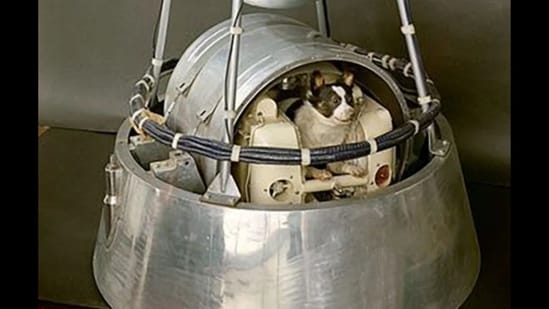
Laika’s mission marked a significant milestone in the early days of space exploration, coming less than a month after the Soviet Union launched Sputnik 1, the world’s first artificial satellite, on October 4, 1957. However, unlike later animal space missions, Laika’s journey was never designed to bring her back to Earth.
Before the launch, Laika underwent extensive training to prepare for the conditions inside the spacecraft. According to Britannica, she was confined in progressively smaller spaces, spun in a centrifuge to simulate the acceleration of a rocket launch and trained to eat food in a special jellied form.
She was placed inside Sputnik 2, which carried supplies of food and oxygen, and launched from the Baikonur Cosmodrome in Kazakhstan. The spacecraft was designed to keep her alive in orbit, but the technology to safely return a spacecraft from orbit had not yet been developed.
According to a report by the BC, Laika reached orbit alive and circled Earth in approximately 103 minutes. However, she died just 5 to 7 hours after liftoff due to overheating and stress after the spacecraft’s thermal control system failed. For years, Soviet officials claimed that she had survived for several days before dying, but the actual circumstances of her death were acknowledged in 2002, according to the BBC.
{{/usCountry}}According to a report by the BC, Laika reached orbit alive and circled Earth in approximately 103 minutes. However, she died just 5 to 7 hours after liftoff due to overheating and stress after the spacecraft’s thermal control system failed. For years, Soviet officials claimed that she had survived for several days before dying, but the actual circumstances of her death were acknowledged in 2002, according to the BBC.
{{/usCountry}}(Also Read: Chinese ‘top-secret’ spaceplane that's allegedly dumping unknown objects in orbit, pictured in clearest photo yet)
International outrage
The decision to send Laika to her death sparked international outrage at the time. In Britain, campaigners picketed the Soviet embassy, while dog owners were urged to observe a minute’s silence in her memory. Dog lovers also gathered outside the United Nations building in New York to protest the mission.
The backlash brought greater attention to the treatment of animals in space research, with subsequent missions engineered with recovery systems to return animals safely to Earth. According to the BBC, on August 19, 1960, two dogs, Belka and Strelka, were launched aboard Sputnik 5. They completed 17 orbits around Earth and returned safely the following day.
Laika’s mission also paved the way for human spaceflight. On April 12, 1961, Soviet cosmonaut Yuri Gagarin became the first human to orbit Earth. 8 years later, American astronauts Neil Armstrong and Buzz Aldrin walked on the Moon.
Laika remains an icon of space exploration
Despite the tragic end, Laika became an icon of early Soviet space exploration. Her image appeared on commemorative stamps and envelopes, while Soviet products, including cigarettes and matchboxes, also carried her name, as per the BBC. In 2008, a monument commemorating Laika was also unveiled in Moscow. Standing around two metres tall, it depicts a rocket transforming into a hand, with a dog standing in its palm.