Gurinder Chadha’s latest series, Beecham House, is set in late 18th century India. Its protagonist is a former East India Company soldier John Beecham who returns to Delhi to become a trader. A host of other motley brown and white characters surround Beecham who anchors the series. Beecham House, available on Netflix in India, from 22nd July has come out in interesting times. On one hand England is struggling to arrive at a Brexit deal a year after if voted to leave the European Union and on the other its relationship with former colonies is being re-romanticised in popular culture. Beecham House follows Indian Summers (2015) and The Good Karma Hotel (2017) in situating British stories and characters in India, a trope that peaked in the 80s, with what is now known as ‘Raj Nostalgia’.
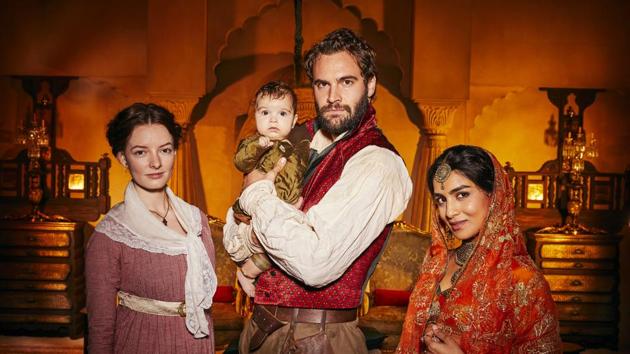
Nostalgia for the Raj hit a ceiling during the ’80s, with films like A Passage to India (1984), Heat and Dust (1983) and the mammoth TV series Jewel In the Crown (1984). “Firstly, this isn’t the Raj. This is the East India Company, a period in the late 18th century while the French were still in India. It is in that sense novel and shows a period that at least I haven’t seen before on television. Also we must note it has been directed by a British Indian and is quite critical of the East India Company,” historian William Dalrymple says about the series that has received underwhelming reviews even in the UK.
A large chunk of these negative reviews criticised the show’s white saviour complex. In the first scene itself, Beecham saves an Indian family from dacoits. “The saviour complex exists because all popular drama needs heroes, and broadcasters (even Gurinder Chadha) think enough of those heroes need to be white to get their series commissioned and watched; that’s the laziness I’m talking about,” historian Jon Wilson says before adding “They are obsessed with mixed race relationships, and children. It’s the ‘Kim complex’, a fantasy about having a familiar relationship with India which was – because of empire and its aftermath – impossible in practice.”
Chadha’s series openly criticises the East India Company, but makes sure nobility and heroism remains the preserve of its white characters. Most Indians make up the numbers. Strangely, Chadha’s last project, Partition 1947, was similarly kind on its white characters as well. Dalrymple believes that Indians also needs to acknowledge the disregard most men of the Raj showed towards affairs related to India. “There was definitely a period in the 80s when nostalgia for the Raj was high. But something that often goes unacknowledged is the lack of interest the British showed in their operations in India even during the Raj. Debates about India’s affairs were relatively few in the House of Commons,” he says .
Why then did something like nostalgia for the Raj surface during the 80s? “Empire reoccurs as Britain’s political unconscious, used as a stage on which Britons can play out their fears, hopes, fantasies and anxieties about themselves. Empire, and India, is a safe place to do that because they are so irrevocably in the past. Ultimately though, it’s all very narcissistic. The representation of India in the British media is about Britain and not India,” Wilson says. That a show like Beecham House, with its design-heavy sets and period paraphernalia is still getting a fair share of attention is indication of the fact that there is a sizeable audience for such projects in UK.
{{/usCountry}}Why then did something like nostalgia for the Raj surface during the 80s? “Empire reoccurs as Britain’s political unconscious, used as a stage on which Britons can play out their fears, hopes, fantasies and anxieties about themselves. Empire, and India, is a safe place to do that because they are so irrevocably in the past. Ultimately though, it’s all very narcissistic. The representation of India in the British media is about Britain and not India,” Wilson says. That a show like Beecham House, with its design-heavy sets and period paraphernalia is still getting a fair share of attention is indication of the fact that there is a sizeable audience for such projects in UK.
{{/usCountry}}While Beecham House is superficially critical of the East India Company, it simply fails to rise over standard clichés that seem permanently stitched to the fabric used to represent India’s shared history with the empire. Whites were bad, but the good ones were greater than the greatest. That said, both Wilson and Dalrymple agree Raj nostalgia isn’t making a comeback. “In the UK I don’t think there has simply been resurgence of nostalgia for the Raj. We’ve seen the emergence of a new polarised debate about the Raj, with arguments for and against both strengthening,” Wilson says.
The problems both believe run far deeper. “I don’t think romance for the Raj is re-emerging. In fact, I think people in Britain are so ill-qualified and shockingly ignorant of the history of the empire that they probably cannot contemplate their own past. It is natural to take pride in your ancestors, to believe they were benign, which explains the lens most Britons look at India with,” Dalrymple says. While shows like Beecham House are likely to only hurt a conversation that needs to be driven by sensitivity, not clichéd exoticism, things need to change on a granular level. “I’d like to see serious collaboration; how about jointly produced TV programmes, or co-written history textbooks or syllabi that are taught in both British and India (as well as Pakistani and Bangladeshi) schools. In doing so, both sides would need to be willing to question their presuppositions,” Wilson says.
.
Get more updates from Bollywood, Taylor Swift, Hollywood, Music and Web Series along with Latest Entertainment News at Hindustan Times.
Get more updates from Bollywood, Taylor Swift, Hollywood, Music and Web Series along with Latest Entertainment News at Hindustan Times.