Around 1.10 lakh people marched in Paris on Saturday as protests over rising living costs, school conditions and strained public services continued across France. Police used tear gas and water cannon to disperse the crowd, AP reported.
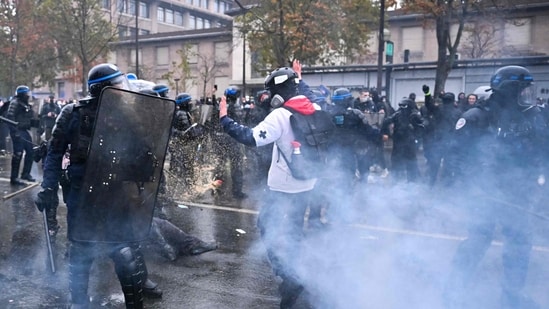
French authorities deployed around 70,000 police officers and gendarmes across the country as they stepped up security to prevent a repeat of last weekend’s unrest. Police patrols were increased, demonstrations were restricted in several cities, and armoured vehicles, helicopters and water cannon were kept ready, Reuters reported.
Major museums, cultural venues and shops in Paris closed or strengthened security ahead of the demonstrations. The heightened precautions followed protests on October 17, when over 5 lakh people took to the streets across France, according to AP.
The demonstrations were followed by reports of looting, fires, vandalism and attacks on public buildings. Around 3,000 shops and businesses were reportedly damaged or looted.
Louvre, Orsay and other museums close
Several of best-known cultural attractions in Paris shut their doors on Saturday as a precaution. The Louvre, the Musee d’Orsay, the Picasso Museum and the Grand Palais, which is hosting a major exhibition of works by artist Paul Cézanne, were among the venues that closed.
{{/usCountry}}Several of best-known cultural attractions in Paris shut their doors on Saturday as a precaution. The Louvre, the Musee d’Orsay, the Picasso Museum and the Grand Palais, which is hosting a major exhibition of works by artist Paul Cézanne, were among the venues that closed.
{{/usCountry}}The Tuileries Gardens, which connect the Louvre area to central Paris, were also sealed off. The Paris Opera closed both the Palais Garnier and the Opera Bastille, citing safety concerns for staff and visitors, Reuters reported.
Art Basel Paris, a major contemporary art fair being held at the Grand Palais, opened to the public on Friday but cancelled its weekend programme because of the risk of unrest.
More than 20 metro stations were also reported closed as authorities tightened security and managed movement around sensitive areas of the capital, as per Reuters.
ALSO READ | Targeted curfews, protest bans: France steps up security after worst riots in years; 2,400 arrested
Shops board up windows
Businesses across Paris spent the week preparing for possible violence. Shopkeepers covered windows with wooden boards, strengthened entrances and brought in additional security staff to protect their premises from looting and vandalism, AFP reported.
Some retailers removed merchandise from shop floors, while others decided to shut for the day. Luxury stores around Place Vendôme, a major shopping district, increased security.
Stores associated with brands such as Louis Vuitton, Dior and Bulgari strengthened their security arrangements.
Police deploy helicopters, armoured vehicles, specialist units
Interior minister Laurent Nuñez announced the deployment of around 70,000 police officers and gendarmes nationwide – about 10,000 more than were deployed during the October 17 demonstrations.
The operation includes specialist police units, helicopters, armoured vehicles and water cannons. Elite security teams and soldiers from France’s anti-terrorism military operation have also been deployed to help protect important locations, including sensitive public buildings and prominent sites in Paris.
Security forces were seen patrolling the Champs-Élysées, while police vans were positioned around the Arc de Triomphe, as per AP. Nuñez warned that the government would take a firm approach to looting and violence.
The expanded deployment follows criticism of the response to last weekend’s violence. President Emmanuel Macron acknowledged shortcomings in the authorities’ preparations.
Paris protest route changed, demonstrations restricted
Authorities have also changed protest arrangements to reduce the risk of violence in busy commercial areas. Paris police moved the planned route of a union-organised march away from the central Bastille-to-Nation route, proposing instead a route between Porte d’Italie and Porte de Vincennes on the southeastern edge of the capital.
Police said the original route posed a risk to public order because it passed through areas where businesses had been targeted during the previous weekend’s unrest.
ALSO READ | What France’s winter of discontent means for global governance
Demonstrations were also banned or restricted in several other cities, including parts of Lyon, Nice and Montpellier. Restrictions remained in force in a number of additional cities, while local authorities in Marseille allowed a union march to proceed after reversing an earlier restriction.
Some areas of Paris, including parts of Place de la République and Les Halles, were also subject to localised curfews.
The government said the measures were necessary to protect businesses, public buildings and residents.
Tear gas fired in Lyon
Despite the restrictions, demonstrations took place in several parts of France on Saturday. In Lyon, police fired tear gas to disperse a group of around 150 people who gathered in an area where demonstrations had been banned, as per France24.
Officers moved in after protesters attempted to block a road near university buildings and a police station. Helicopters, armoured vehicles and riot police were also deployed in the city.
In Orléans, thousands of people marched against the far-right National Rally party, led by Marine Le Pen, which was holding its congress in the city. Protesters carried anti-fascist placards and criticised both Le Pen and Macron.
The demonstration was organised by a group of unions, left-wing parties, student organisations and anti-racism groups.
Why France is protesting
The demonstrations began last month when high school students protested against staff shortages and poor conditions at schools in the Paris region. The movement later spread to other areas and expanded into a broader campaign over rising living costs, wages, public services and economic inequality.
Students have raised concerns about a lack of teachers, poorly maintained school facilities and difficulties accessing higher education. They are also demanding additional university places, increased student grants and a freeze on rents in public student housing.
Workers and trade unions have joined the protests, calling for higher wages and pensions to help households cope with rising expenses. Many demonstrators argue that public services are deteriorating while ordinary families struggle to meet everyday costs.
With inputs from agencies.