
 E-Paper



What France’s winter of discontent means for global governance
This article is authored by Gunwant Singh, scholar, international relations and security studies, Jawaharlal Nehru University, New Delhi.

 Prefer HTon Google


The boulevards of Paris, Lyon, and Marseille have once again transformed into cauldrons of civil unrest, enveloped in tear gas, ringing with chants, and punctuated by the sirens of riot police. While popular mobilisation is woven into the very fabric of the French Republic, the latest convulsions across the country represent something far more volatile than standard industrial action. What began as a series of classroom walkouts and local student strikes against underfunded facilities and proposed budgetary austerity has swiftly developed into an expansive, multi-sector revolt. As trade unions, public sector employees, farmers, and disaffected youth join the barricades, France finds itself wrestling with an existential friction between fiscal consolidation and the preservation of its sacred social contract. For an embattled government attempting to project stability on the world stage, the street has once again emerged as the supreme arbiter of political legitimacy.
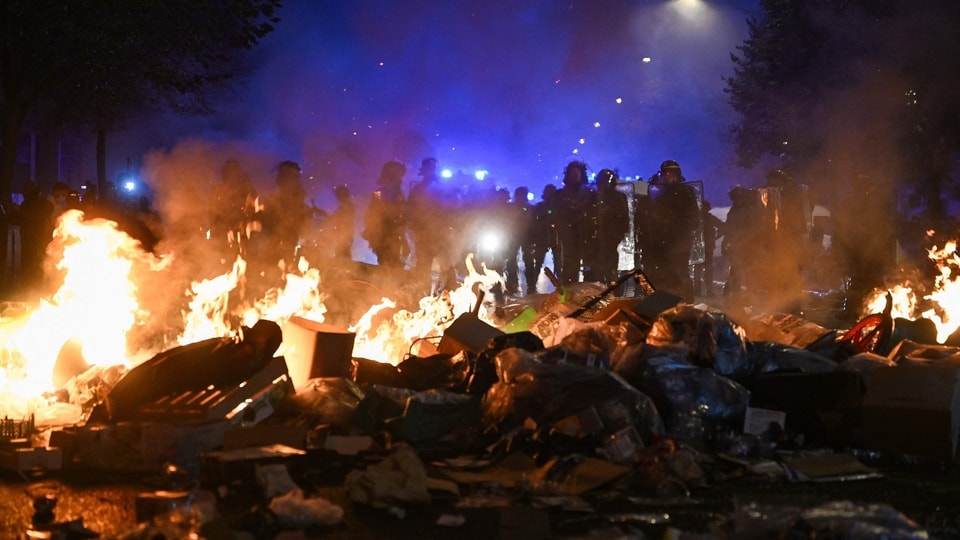
To understand the intensity of the upheaval, one must look beyond the immediate sparks to the structural decay that has built up over years. The immediate catalyst was the state’s contentious budget roadmap, which sought to rein in a ballooning national deficit by slashing thousands of public sector posts, particularly in primary and secondary education, while trimming social expenditures. This fiscal austerity, introduced against the backdrop of an already strained healthcare system and an acute cost-of-living crisis, lit an immediate spark among students and teachers. Simmering resentment over previous executive-driven measures, most notably the controversial pension reforms that raised the retirement age without an outright parliamentary vote, had never truly dissipated. Coupled with skyrocketing urban rents, persistent food inflation, and the lingering frustration of the agricultural sector burdened by green transition mandates and international trade competition, the French public perceived the government’s fiscal belt-tightening as an unequal sacrifice imposed by a detached technocratic elite.
The crisis is also inherently institutional, reflecting a fractured political architecture. Following recent snap elections that resulted in a hung and deeply polarised National Assembly, the French executive operates without a commanding legislative mandate. The reliance on constitutional manoeuvres to bypass parliamentary consensus has eroded public trust in institutional channels, driving opposition into the streets. When early student-led demonstrations were met with heavy-handed riot policing and widely shared footage of forceful arrests, moral outrage supercharged the movement. Trade unions recognised a moment of convergence, called general strikes, that paralysed commuter rail networks, municipal transit, and sanitation services. The resulting coalition uniting urban Gen Z students, suburban public sector workers, and rural agriculturalists illustrate how thoroughly the grievance has spread across sociological divides.
The global economic repercussions of this French paralysis are swift and consequential. France is the second-largest economy in the European Union and its primary military power. When Paris shudders, the tremors run straight through Frankfurt and Brussels. The country's sovereign debt, hovering near 120% of gross domestic product, has become an urgent concern for global bond markets. International investors, spooked by the prospect of prolonged governance paralysis and the impossibility of passing credible fiscal stabilisation bills, have pushed French borrowing costs upward, causing the yield spread between French and German government bonds to widen to levels reminiscent of past sovereign debt scares. A weakened, indebted France hobbles the fiscal cohesion of the entire Eurozone, complicating the European Central Bank’s monetary trajectory and dampening broader European economic growth at a time when the continent is already grappling with sluggish industrial output and competitive pressures from the US and China.
Beyond finance, France’s domestic turmoil carries profound geopolitical fallout. As a permanent member of the United Nations Security Council and the leading advocate for European "strategic autonomy", Paris has championed independent continental defence capabilities, ambitious climate transitions, and active diplomatic postures from the Middle East to the Indo-Pacific. A French presidency preoccupied with quelling urban unrest and surviving legislative votes of no-confidence inevitably lacks the political capital required to drive contentious foreign policy initiatives. In European decision-making circles, the Franco-German engine, already strained by ideological divergence, has ground toward a near standstill. Furthermore, persistent civil friction provides fertile ground for political extremes, raising the likelihood that future electoral cycles could empower populist, Euro-sceptic factions whose ascension would dramatically rearrange the continent's geopolitical architecture.
Critically, the upheaval in France possesses the potential to trigger a broader contagion of unrest across developed and developing nations alike. France has historically served as a political bellwether for the Western world; the tactical playbook developed on the streets of Paris frequently reverberates across borders. Across southern and western Europe, in countries like Spain, Portugal, and Italy, young populations confront identical pressures: prohibitive housing markets, precarious employment conditions, and public welfare programmes trimmed under fiscal consolidation directives. The visible effectiveness of French collective action, magnified exponentially across social media algorithms, offers a blueprint for youth-led, cross-sector mobilisation elsewhere. When ordinary citizens observe that sustained disruption can force concessions from a central government, the barrier to staging disruptive strikes declines significantly, threatening similar waves of domestic unrest throughout capital cities facing the universal pressures of post-pandemic inflation and high debt service burdens.
For India, the unfolding crisis in France is far from an esoteric European drama; it touches directly upon New Delhi’s strategic, economic, and diplomatic priorities. France has emerged over the last decade as India’s closest and most dependable strategic partner in Europe. The two nations share deep security cooperation, anchored by extensive defence procurements, including Rafale fighter aircraft, Scorpene-class submarines, and sensitive jet-engine technology transfers, alongside coordinated maritime patrols in the Indian Ocean. Prolonged political dysfunction and budget re-prioritisation in Paris could introduce bureaucratic inertia into these high-profile defence pipelines and co-development programmes. While strategic alignment remains resilient, executive distraction in Paris inevitably slows the timeline of high-level diplomatic deliverables and collaborative industrial projects.
The economic fallout likewise presents challenges for India’s international trade architecture. France is a major destination for Indian engineering goods, pharmaceuticals, textiles, and information technology services, as well as a prime proponent of the long-pending India-European Union Broad-based Trade and Investment Agreement (BTIA). A French political apparatus immobilised by domestic labour union pressure and protectionist demands from farmers will find it politically perilous to endorse sweeping multilateral trade concessions. Consequently, the momentum behind finalising a balanced India-EU free trade pact faces heightened resistance, delaying tariff rationalisation and smoother market access for Indian exporters seeking to diversify supply chains away from over-reliance on traditional East Asian manufacturing hubs.
The human and educational dimensions between the two nations are also directly impacted. In recent years, New Delhi and Paris implemented ambitious mobility frameworks aimed at hosting over 30,000 Indian students in French higher education institutions by the end of the decade, backed by simplified post-study work visas. Campus shutdowns, localised curfews, disruptions in public transportation, and protests focused directly on the state of university and secondary education create logistical anxieties for Indian families and researchers residing in French urban centres. Furthermore, heightened volatility in Paris inevitably dents European travel and hospitality, impacting Indian business delegations, international conferences, and the seasonal influx of Indian tourism across Western Europe.
Finally, the crisis in France holds instructive governance lessons for policymakers in New Delhi. The French upheaval lays bare the hazards of implementing technocratic fiscal and structural reforms without cultivating broad, consultative social consensus. Both nations possess vast, aspirational youth demographics entering competitive job markets marked by structural transitions and the pressures of technological disruption. When governments attempt to accelerate fiscal discipline, rationalise welfare subsidies, or reform public services without addressing fundamental anxieties regarding purchasing power and generational opportunity, the risk of explosive grassroots blowback surges. As Paris grapples with the embers of its latest public rebellion, the lesson resonating across world capitals, including New Delhi, is that fiscal math can never be entirely decoupled from the raw realities of the citizen's lived experience.
(The views expressed are personal)
This article is authored by Gunwant Singh, scholar, international relations and security studies, Jawaharlal Nehru University, New Delhi.


