...
...
Next Story

A lost civilization is baffling experts and rewriting China’s origin story

The otherworldly beasts and enigmatic masks of Sanxingdui still enthrall China, decades after the unearthing of ceremonial pits.

Published on: Aug 8, 2026, 14:10:15 IST
WSJ
Advertisement

GUANGHAN, China—In July 1986, workers at a brick factory in southwestern China were digging for clay when they hit upon something unexpected: dozens of dazzling pieces of jade.
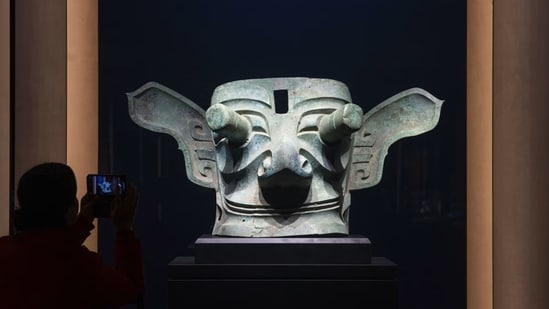
PREMIUMThe otherworldly beasts and enigmatic masks of Sanxingdui still enthrall China, decades after the unearthing of ceremonial pits.
The otherworldly beasts and enigmatic masks of Sanxingdui still enthrall China, decades after the unearthing of ceremonial pits.

The chance discovery led to one of the greatest archaeological finds in modern history—one that continues to thrill China with its ornate gold masks, towering humanoid figures, intricate 12-foot-tall bronze “sacred trees,” sculptures of fantastical beasts and hundreds of elephant tusks.

The artifacts from Sanxingdui, as the site is known, stirred questions

Visitors to the Sanxingdui museum view an intricate bronze 'sacred tree.'

The mysteries surrounding Sanxingdui have spawned even more outlandish questions: Do the enormous protruding eyes and enigmatic smiles featured on the figures suggest the ancient people were extraterrestrials? The puzzle only deepened with the discovery in recent years of six more ceremonial pits full of shattered artifacts.

Even the basics about the ancient civilization at Sanxingdui, located in the modern-day province of Sichuan in southwestern China, are fuzzy. It appears to have flourished roughly 3,000 years ago, boasting splendors even more exquisite than those of China’s heralded ancient dynasties.

The striking features of Sanxingdui’s humanoid figures—so “un-Chinese” in their appearance—have prompted a wholesale rethinking of what historians thought they knew about the origins of Chinese civilization. Perhaps it didn’t emerge solely from its traditional cradle in the Yellow River Basin. And could other advanced, independent civilizations have also flourished within China’s current borders before their subjugation?

China’s ruling Communist Party has stepped in to quash any heretical notions. Chinese leader Xi Jinping, who recently blessed a sprawling new expansion to the Sanxingdui Museum, has presented the findings as evidence that China has always enjoyed “unity in diversity” within its modern-day borders—and therefore that Beijing is a legitimate ruler of Tibet, Xinjiang and other regions not primarily populated by China’s dominant Han people, who account for more than 90% of the country’s population.

In the past five years, Sanxingdui has captured the imagination of a Chinese nation eager to revel in its long history and civilizational accomplishments. Sold-out exhibitions of the Sanxingdui treasures have crisscrossed the country. Their images have exploded in Chinese pop culture, appearing in videogames, animated films and collectible bobbleheads.

“Chinese civilization is both mysterious and incredible,” said Fang Qing, a 33-year-old real-estate professional from Changsha, who posed for pictures with an oversize Sanxingdui plushie during a visit to the site last month. “Some people speculate that it involves aliens, but I view it as a civilization in its own right, although we do not yet fully understand the nature of that civilization.”

New splendors unearthed

Ran Honglin, the lead archaeologist at the site, had long believed there was more to Sanxingdui—whose name means “Three Star Mound,” a reference to a nearby topographic feature—than the two sacrificial pits found in 1986.

In December 2019, Ran’s team uncovered an ancient Chinese ceremonial vessel in what would later be identified as Sacrificial Pit No. 3. “I actually jumped for joy,” Ran, 39, recalled.

Archaeological work under way at the Sanxingdui site in 2005.
A team works around one of the ancient sacrificial pits.

Unlike in 1986, when many of the artifacts, especially the elephant tusks, decomposed after being exposed to the open air, Ran improvised a new system for the dig.

The archaeologists built sterile, temporary structures with temperature and humidity controls, and lowered experts clad in head-to-toe medical gowns into the pits atop bedlike platforms so as to minimize contact with the artifacts. In the aboveground labs, they used artificial intelligence and digital technologies to reassemble the millions of shards into recognizable forms.

The unearthing of the six new ceremonial pits confirmed some theories that Ran held—for instance, that the pits were all likely dug at the same time, with pieces of the largest sculptures scattered among the various pits.

But the new discoveries also reaffirmed old mysteries, such as the lack of a writing system or human remains, and raised fresh questions.

Some of the buried objects had been burned so thoroughly as to defy explanation, while the abundance of gold—far more than can be found in China’s traditional Yellow River Basin—has perplexed experts. The apparent absence of weaponry or tombs, including for the civilization’s rulers, also remains a mystery.

A different face on Chinese civilization

Tristan Brown, a professor of Chinese history at the Massachusetts Institute of Technology, places the Sanxingdui discovery in 1986 alongside the discovery of the Terracotta Army in 1974 as two moments that reshaped how China regarded itself as the country entered the post-Mao Zedong years.

But whereas the Terracotta Army, outside modern-day Xi’an, reaffirmed China’s self-conception as a powerful civilization centered around the central plains where it has long traced its origins, the discovery of Sanxingdui—an equally advanced culture nearly 500 miles to the southwest, in hard-to-reach Sichuan—challenged that narrative entirely.

“It puts a different face on Chinese civilization,” Ran said. “If we didn’t have Sanxingdui, the picture we would have of China would be very different.”

Although there is speculation about the origins of the civilization—the notion that it might have been established by extraterrestrials remains widespread in China—experts’ understanding of how its people lived has grown, particularly after Ran’s discoveries.

Ran and other scholars now believe, based on the presence of hundreds of neatly arranged ivory tusks, as well as seashells—in a part of Asia that boasts no wild elephants and is far from any shoreline—that Sanxingdui conducted trade not only with the Chinese central plains, but also with Southeast Asia, hundreds of miles to the south.

The presence of gold scepters, a rarity in ancient Chinese traditions but more common in Central Asia, points to the possibility of influence from lands far to the west—perhaps even the Middle East or ancient Egypt.

The discovery at Sanxingdui helped force Chinese scholars to revise their understanding of ancient China—that it was never rooted in a single civilization on the banks of the Yellow River, but instead had multiple origin points that coalesced to become what we think of as China.

“It points to very different groups of people that populated Chinese antiquity,” said Brown of MIT. “There’s nothing to suggest anyone at Sanxingdui thought of themselves as Chinese. In fact, that was almost certainly not the case.”

For China’s Communist Party rulers, Sanxingdui helps to bolster their argument that the country’s current boundaries—with its officially recognized Uyghur, Tibetan, Kazakh, Mongol, Manchu, Korean and Russian minorities—is capacious enough to encompass more than just the Han Chinese.

While the absence of any writings by the Sanxingdui civilization makes it easier for wilder theories to flourish, it also gives Communist leaders more latitude to project onto Sanxingdui their own narrative.

“Part of the flexibility of Sanxingdui is exactly that lack of writing, which enables a certain level of looseness,” Brown said. “You see what you want to see.”

Unsolved mysteries

Perhaps the biggest mystery surrounds the actual people of Sanxingdui. “It’s a question that haunts our thoughts: Did the people of that time simply not die?” Ran said. “That’s impossible, of course. But if they died and were buried, there should be some trace.”

With only about 1/600th of the Sanxingdui site excavated so far, “we know that the work at Sanxingdui won’t be done in this generation. It will continue and require future generations to carry on the work.”

Zhao Yueling and Xiao Xiao contributed to this article.

Write to Jonathan Cheng at Jonathan.Cheng@wsj.com

GUANGHAN, China—In July 1986, workers at a brick factory in southwestern China were digging for clay when they hit upon something unexpected: dozens of dazzling pieces of jade.

PREMIUMThe otherworldly beasts and enigmatic masks of Sanxingdui still enthrall China, decades after the unearthing of ceremonial pits.
The otherworldly beasts and enigmatic masks of Sanxingdui still enthrall China, decades after the unearthing of ceremonial pits.

The chance discovery led to one of the greatest archaeological finds in modern history—one that continues to thrill China with its ornate gold masks, towering humanoid figures, intricate 12-foot-tall bronze “sacred trees,” sculptures of fantastical beasts and hundreds of elephant tusks.

The artifacts from Sanxingdui, as the site is known, stirred questions that still perplex experts four decades later. How could a civilization boasting gold and bronze masterpieces, jadeworking and silk production seemingly disappear overnight, leaving no written record or human remains? Why did that civilization appear to have systematically smashed and buried its treasures in ceremonial pits?

Visitors to the Sanxingdui museum view an intricate bronze 'sacred tree.'

The mysteries surrounding Sanxingdui have spawned even more outlandish questions: Do the enormous protruding eyes and enigmatic smiles featured on the figures suggest the ancient people were extraterrestrials? The puzzle only deepened with the discovery in recent years of six more ceremonial pits full of shattered artifacts.

Even the basics about the ancient civilization at Sanxingdui, located in the modern-day province of Sichuan in southwestern China, are fuzzy. It appears to have flourished roughly 3,000 years ago, boasting splendors even more exquisite than those of China’s heralded ancient dynasties.

The striking features of Sanxingdui’s humanoid figures—so “un-Chinese” in their appearance—have prompted a wholesale rethinking of what historians thought they knew about the origins of Chinese civilization. Perhaps it didn’t emerge solely from its traditional cradle in the Yellow River Basin. And could other advanced, independent civilizations have also flourished within China’s current borders before their subjugation?

China’s ruling Communist Party has stepped in to quash any heretical notions. Chinese leader Xi Jinping, who recently blessed a sprawling new expansion to the Sanxingdui Museum, has presented the findings as evidence that China has always enjoyed “unity in diversity” within its modern-day borders—and therefore that Beijing is a legitimate ruler of Tibet, Xinjiang and other regions not primarily populated by China’s dominant Han people, who account for more than 90% of the country’s population.

In the past five years, Sanxingdui has captured the imagination of a Chinese nation eager to revel in its long history and civilizational accomplishments. Sold-out exhibitions of the Sanxingdui treasures have crisscrossed the country. Their images have exploded in Chinese pop culture, appearing in videogames, animated films and collectible bobbleheads.

“Chinese civilization is both mysterious and incredible,” said Fang Qing, a 33-year-old real-estate professional from Changsha, who posed for pictures with an oversize Sanxingdui plushie during a visit to the site last month. “Some people speculate that it involves aliens, but I view it as a civilization in its own right, although we do not yet fully understand the nature of that civilization.”

New splendors unearthed

Ran Honglin, the lead archaeologist at the site, had long believed there was more to Sanxingdui—whose name means “Three Star Mound,” a reference to a nearby topographic feature—than the two sacrificial pits found in 1986.

In December 2019, Ran’s team uncovered an ancient Chinese ceremonial vessel in what would later be identified as Sacrificial Pit No. 3. “I actually jumped for joy,” Ran, 39, recalled.

Archaeological work under way at the Sanxingdui site in 2005.
A team works around one of the ancient sacrificial pits.

Unlike in 1986, when many of the artifacts, especially the elephant tusks, decomposed after being exposed to the open air, Ran improvised a new system for the dig.

The archaeologists built sterile, temporary structures with temperature and humidity controls, and lowered experts clad in head-to-toe medical gowns into the pits atop bedlike platforms so as to minimize contact with the artifacts. In the aboveground labs, they used artificial intelligence and digital technologies to reassemble the millions of shards into recognizable forms.

The unearthing of the six new ceremonial pits confirmed some theories that Ran held—for instance, that the pits were all likely dug at the same time, with pieces of the largest sculptures scattered among the various pits.

But the new discoveries also reaffirmed old mysteries, such as the lack of a writing system or human remains, and raised fresh questions.

Some of the buried objects had been burned so thoroughly as to defy explanation, while the abundance of gold—far more than can be found in China’s traditional Yellow River Basin—has perplexed experts. The apparent absence of weaponry or tombs, including for the civilization’s rulers, also remains a mystery.

A different face on Chinese civilization

Tristan Brown, a professor of Chinese history at the Massachusetts Institute of Technology, places the Sanxingdui discovery in 1986 alongside the discovery of the Terracotta Army in 1974 as two moments that reshaped how China regarded itself as the country entered the post-Mao Zedong years.

But whereas the Terracotta Army, outside modern-day Xi’an, reaffirmed China’s self-conception as a powerful civilization centered around the central plains where it has long traced its origins, the discovery of Sanxingdui—an equally advanced culture nearly 500 miles to the southwest, in hard-to-reach Sichuan—challenged that narrative entirely.

“It puts a different face on Chinese civilization,” Ran said. “If we didn’t have Sanxingdui, the picture we would have of China would be very different.”

Although there is speculation about the origins of the civilization—the notion that it might have been established by extraterrestrials remains widespread in China—experts’ understanding of how its people lived has grown, particularly after Ran’s discoveries.

Ran and other scholars now believe, based on the presence of hundreds of neatly arranged ivory tusks, as well as seashells—in a part of Asia that boasts no wild elephants and is far from any shoreline—that Sanxingdui conducted trade not only with the Chinese central plains, but also with Southeast Asia, hundreds of miles to the south.

The presence of gold scepters, a rarity in ancient Chinese traditions but more common in Central Asia, points to the possibility of influence from lands far to the west—perhaps even the Middle East or ancient Egypt.

The discovery at Sanxingdui helped force Chinese scholars to revise their understanding of ancient China—that it was never rooted in a single civilization on the banks of the Yellow River, but instead had multiple origin points that coalesced to become what we think of as China.

“It points to very different groups of people that populated Chinese antiquity,” said Brown of MIT. “There’s nothing to suggest anyone at Sanxingdui thought of themselves as Chinese. In fact, that was almost certainly not the case.”

For China’s Communist Party rulers, Sanxingdui helps to bolster their argument that the country’s current boundaries—with its officially recognized Uyghur, Tibetan, Kazakh, Mongol, Manchu, Korean and Russian minorities—is capacious enough to encompass more than just the Han Chinese.

While the absence of any writings by the Sanxingdui civilization makes it easier for wilder theories to flourish, it also gives Communist leaders more latitude to project onto Sanxingdui their own narrative.

“Part of the flexibility of Sanxingdui is exactly that lack of writing, which enables a certain level of looseness,” Brown said. “You see what you want to see.”

Unsolved mysteries

Perhaps the biggest mystery surrounds the actual people of Sanxingdui. “It’s a question that haunts our thoughts: Did the people of that time simply not die?” Ran said. “That’s impossible, of course. But if they died and were buried, there should be some trace.”

With only about 1/600th of the Sanxingdui site excavated so far, “we know that the work at Sanxingdui won’t be done in this generation. It will continue and require future generations to carry on the work.”

Zhao Yueling and Xiao Xiao contributed to this article.

Write to Jonathan Cheng at Jonathan.Cheng@wsj.com

All Access.
One Subscription.

Get 360° coverage—from daily headlines
to 100 year archives.

E-Paper
Full
Archives
Full Access to
HT App & Website
Games
 
Get the latest World News, breaking headlines and global updates from the US, UK, Pakistan, Bangladesh, Russia and other countries. Follow major international events on Hindustan Times.
SHARE THIS ARTICLE ON
Hindustantimes wants to start sending you push notifications. Click allow to subscribe