Less than two months after he took over as Bangladesh Army chief, it was left to Gen Waker-uz-Zaman to formally announce the dramatic resignation of former prime minister Sheikh Hasina and unveil a plan to restore normalcy in the country of 170 million people roiled by violent protests.
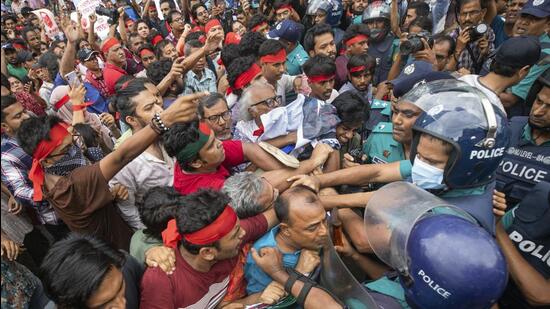
Zaman, who has had a stint as principal staff officer in the Prime Minister’s Office, said after consultations on Monday with leaders of Bangladesh’s political parties, excluding Hasina’s Awami League, that an interim government would be formed to restore peace and order following demonstrations across the country since last month.
“The honourable prime minister has resigned, and we will form an interim government to do our work. Please have patience, give us some time,” Zaman said, speaking in Bengali.
Read Here: Amid protests Sheikh Hasina flees Bangladesh, who will succeed her?
“God willing, we will be successful in solving all the problems by working together. Don’t go on the path of confrontation and return to the path of peace and order.”
Zaman, 58, an infantry officer who became the army chief on June 23, pledged that all deaths and acts of injustice during the recent protests will be investigated by authorities. More than 300 people, many of them students and youngsters, were killed in the government’s crackdown on protesters.
{{/usCountry}}Zaman, 58, an infantry officer who became the army chief on June 23, pledged that all deaths and acts of injustice during the recent protests will be investigated by authorities. More than 300 people, many of them students and youngsters, were killed in the government’s crackdown on protesters.
{{/usCountry}}“I give you my word that there will be justice for all killings and acts of injustice. Please have faith in the military. I am taking all the responsibility for your lives and property, and I give you my word that you should not give up hope,” he said.
Read Here: Sudden escalation, losing grip caught Sheikh Hasina off-guard
Zaman said he had held talks with leaders of major political parties, including Jamaat-e-Islami chief Shafiqur Rahman and top leaders of the main opposition Bangladesh Nationalist Party (BNP) and the Jatiya Party, and would meet President Mohammed Shahabuddin to discuss the formation of the interim government.
Responding to question on whether the erstwhile ruling party was invited to the meeting, he said: “There was no one from the Awami League.”
He also gave an assurance that all the demands of the protesters would be fulfilled and peace and order restored in the country. “Please cooperate with me and abstain from all the destruction, killing, fighting and conflict,” he said.
Bangladesh unrest: Protesters take away Dior bag, saree from ex-PM Sheikh Hasina's official residence; eat biryani
Zaman said the army will continue maintaining peace and order, and that it is the responsibility of students, political leadership, workers and media to help the military to control the situation. He said he had also directed the army and police not to fire at protesters. “If peace is restored, there is no need for curfew or other emergency measures,” he added.
Bangladesh has been ruled by the army for long spells in the 1970s and 1980s, and two of the key parties that participated in the consultations with Zaman – the BNP and Jatiya Party – were formed by military rulers Ziaur Rahman and Hussain Mohammad Ershad, respectively.
The military first staged a coup in August 1975 after assassinating Sheikh Mujibur Rahman, the father of the nation. This was followed by another coup in November 1975 that allowed former army chief Ziaur Rahman to seize power and become president. Less than a year after Ziaur Rahman’s assassination in May 1981, Ershad assumed power in a bloodless coup in March 1982.