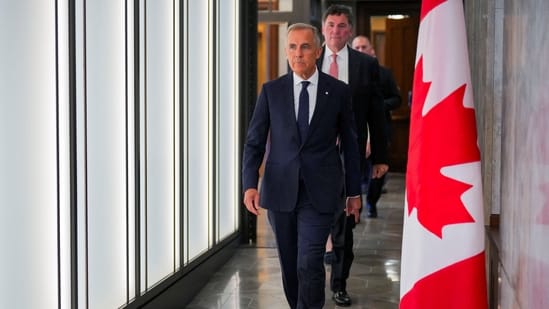
TORONTO—Over the past 17 months, as President Trump has freighted Canada’s economy with several rounds of punishing tariffs, Prime Minister Mark Carney has often repeated the guiding maxim for his negotiations with the U.S.: No deal is better than a bad one.
{{^htLoading}} {{/htLoading}} Now he’s putting that rule to the test.
After nearly a month of trade negotiations aimed at staving off more U.S. tariffs on Canada, Carney walked away from a deal at the last minute on Friday night, allowing
Deep Dive
What are the key reasons behind Prime Minister Mark Carney's decision to walk away from the trade deal with the U.S.?
Carney's decision was primarily based on the U.S. offering unfair 11th-hour changes to the deal, which did not meet Canada's standards for a fair agreement, leading him to insist that no deal was better than a bad one.
How might the new tariffs imposed by the U.S. affect Canadian businesses and consumers?
The new U.S. tariffs are expected to raise costs for certain Canadian goods, which could compel Canadian businesses to either absorb these costs or pass them onto consumers, resulting in higher prices for Canadians.
What retaliatory measures is Canada considering in response to U.S. tariffs, and what industries will be impacted?
Canada plans to implement dollar-for-dollar retaliatory tariffs on U.S. goods, with potential impacts on various sectors including agriculture, steel, and electronics, highlighting the significant economic interdependence between the two countries.
“We cannot accept what they’ve offered, and we will not give what they’ve asked,” Carney told reporters Saturday, vowing to retaliate with dollar-for-dollar tariffs on U.S. goods. “Our goal has always been to get the best deal for Canadians, never a deal at any price or any time frame.”
In quitting rather than acceding to what he called “unfair” 11th-hour U.S. changes to the deal, the prime minister charted a distinct path from other U.S. allies who have rushed to sign trade deals with Trump, some of which have drawn criticism for being too lopsided in favor of the U.S.
{{^htLoading}} {{/htLoading}} The approach has drawn broad support from Canadians and even Carney’s political opponents. But the gamble has risks. The U.S. is Canada’s largest trading partner, and uncertainty over the future of that relationship has been a drag on business confidence as the prime minister is trying to attract outside investment.
The question now is whether—and how long—Canadians are willing to shoulder the costs.
“Most Canadians were in the mood for an aggressive stance,” said David Coletto, chief executive of Ottawa-based pollster Abacus Data. If resolve weakens, he said, it will be “because the tariffs start to have a negative effect on Canada’s economy and retaliation starts to raise the price of things people in Canada need.”
Polls show most Canadians, enraged by Trump’s tariffs and his frequent musings about making the country the 51st state, support taking a tough stance in negotiations with the U.S. They don’t trust the president to stick to the terms of his own deals.
{{^htLoading}} {{/htLoading}} Carney enjoys high approval ratings. More than 75% said he was right to walk away, the Angus Reid Institute, a pollster, reported Sunday, even as nearly 90% worried about the economic costs. Just 18% backed making concessions to get a deal, an Abacus Data poll found last week.
Pierre Poilievre, the leader of Canada’s federal Conservative Party, and provincial leaders from across the political spectrum have also lined up behind Carney, though some questioned the wisdom of retaliating and have called for more transparency on what led to the breakdown in talks.
“President Trump is the type of person who would steal your lunch money the first day,” Ontario Premier Doug Ford, a conservative, told reporters on Saturday. “He’d steal the toque off your head the second day, and the third day he’d steal your running shoes. He is not to be trusted whatsoever.”
{{^htLoading}} {{/htLoading}} Canadian Ambassador to the U.S. Mark Wiseman disputed that domestic political pressure pushed Canada away from the negotiating table.
“The prime minister does not govern by public opinion polls or what social media says,” Wiseman said in an interview.
Trump used a never-before-used provision in the Tariff Act of 1930 to impose the new tariffs on Canada. Unlike prior rounds of U.S. levies, they don’t include a carve-out for items compliant with the U.S.-Mexico-Canada Agreement, the free-trade pact Trump negotiated in his first term.
The tariffs, which target about 5% of Canada’s U.S.-bound exports, are expected to have a modest impact on Canada’s economy, but will disproportionately weigh on certain sectors.
Robert Kavcic, an economist with BMO Capital Markets, said Canada’s producers of plastics, chemicals, forest products and machinery would bear the brunt of the new tariffs, and the tariffs would disproportionately squeeze provinces with bans on U.S. alcohol.
{{^htLoading}} {{/htLoading}} On aggregate, the imposition of the new levies appears “digestible,” Kavcic said, and will increase the effective U.S. tariff rate on Canadian goods to 7.5% from about 5%. However, he added, “trust in the trade relationship is further scarred,” which will further damage business confidence.
Small- and medium-size businesses might find it difficult to survive, economists said. Canada has recorded five straight quarterly declines in business investment, as companies scale back or cancel capital-expenditure plans amid elevated economic uncertainty.
In a survey this month from the Canadian Federation of Independent Business, 40% of exporters reported that they sold products that would be targeted by the tariffs. Of them, nearly 80% said they expected revenue losses if the tariffs were imposed.
{{^htLoading}} {{/htLoading}} “Many CFIB members have said this will end their U.S. sales, and some have reported this will kill their businesses,” Dan Kelly, the group’s chief executive, said in a social-media post after the trade talks collapsed.
Canada’s retaliatory tariffs on the U.S., which are slated to go into effect on Sept. 8, will also hurt Canadians by driving up the cost of imports from the U.S., economists said, compounding the pain for a Canadian economy that is much smaller than that of the U.S.
Carney, who last year rolled back most of the retaliatory tariffs levied by his predecessor, former Prime Minister Justin Trudeau, said he was imposing the levies “reluctantly,” acknowledging that they will raise costs for Canadians.
But, he added, doing so was in “the best interests of Canada.”
{{^htLoading}} {{/htLoading}} Carney, a former central bank governor in Canada and the U.K., earned praise for guiding those countries through the 2008 global financial crisis and Brexit. He came to power last year by pitching himself as an experienced crisis manager able to handle the threat Trump posed to Canada.
“No crisis, no Carney,” he often said on the campaign trail.
Since becoming prime minister, he has sought to diversify Canada’s export-dependent economy away from the U.S. and to build infrastructure projects such as pipelines and ports to get Canadian goods to new markets.
Before the last-minute breakdown in trade talks, it appeared Carney was poised to face a much different test: Selling a deal in which the government would have made several concessions in exchange for lower, but baked-in, tariffs on Canadian goods.
{{^htLoading}} {{/htLoading}} Under the deal, the U.S. would have lowered tariffs on Canadian steel and aluminum from 50% to 25% and eased top-line auto tariffs from 25% to 15%. In exchange, Carney was prepared to remove some retaliatory tariffs and to push premiers to end their bans on U.S. alcohol.
As details emerged, premiers, business leaders and industry groups wondered if it was a deal worth making. They warned that the deal would have locked in tariff rates that were still too high for many industries to be competitive in the long run and unlikely to be negotiated down in the future.
“There wasn’t one single thing” that derailed discussions, Wiseman said, “but as the details became more and more apparent, every one of those details seemed to work against our understanding of what a fair and economic agreement should be.”
Canadian businesses and provincial leaders argued their government was giving up too much leverage ahead of a review of the USMCA, which is viewed here as critical for the country’s prosperity. Carney would have needed the support of premiers to lift bans on U.S. alcohol.
“The concessions that would have had to have been made would not have been tenable here in Canada,” said Diamond Isinger, who advised Trudeau on U.S.-Canada relations.
Write to Amanda Coletta at amanda.coletta@wsj.com, Gavin Bade at gavin.bade@wsj.com and Paul Vieira at Paul.Vieira@wsj.com
{{^htLoading}} {{/htLoading}} TORONTO—Over the past 17 months, as President Trump has freighted Canada’s economy with several rounds of punishing tariffs, Prime Minister Mark Carney has often repeated the guiding maxim for his negotiations with the U.S.: No deal is better than a bad one.
Now he’s putting that rule to the test.
After nearly a month of trade negotiations aimed at staving off more U.S. tariffs on Canada, Carney walked away from a deal at the last minute on Friday night, allowing levies of 50% on $20 billion worth of Canadian goods to come into force.
Deep Dive
What are the key reasons behind Prime Minister Mark Carney's decision to walk away from the trade deal with the U.S.?
Carney's decision was primarily based on the U.S. offering unfair 11th-hour changes to the deal, which did not meet Canada's standards for a fair agreement, leading him to insist that no deal was better than a bad one.
How might the new tariffs imposed by the U.S. affect Canadian businesses and consumers?
The new U.S. tariffs are expected to raise costs for certain Canadian goods, which could compel Canadian businesses to either absorb these costs or pass them onto consumers, resulting in higher prices for Canadians.
What retaliatory measures is Canada considering in response to U.S. tariffs, and what industries will be impacted?
Canada plans to implement dollar-for-dollar retaliatory tariffs on U.S. goods, with potential impacts on various sectors including agriculture, steel, and electronics, highlighting the significant economic interdependence between the two countries.
“We cannot accept what they’ve offered, and we will not give what they’ve asked,” Carney told reporters Saturday, vowing to retaliate with dollar-for-dollar tariffs on U.S. goods. “Our goal has always been to get the best deal for Canadians, never a deal at any price or any time frame.”
{{^htLoading}} {{/htLoading}} In quitting rather than acceding to what he called “unfair” 11th-hour U.S. changes to the deal, the prime minister charted a distinct path from other U.S. allies who have rushed to sign trade deals with Trump, some of which have drawn criticism for being too lopsided in favor of the U.S.
{{^htLoading}} {{/htLoading}} The approach has drawn broad support from Canadians and even Carney’s political opponents. But the gamble has risks. The U.S. is Canada’s largest trading partner, and uncertainty over the future of that relationship has been a drag on business confidence as the prime minister is trying to attract outside investment.
The question now is whether—and how long—Canadians are willing to shoulder the costs.
“Most Canadians were in the mood for an aggressive stance,” said David Coletto, chief executive of Ottawa-based pollster Abacus Data. If resolve weakens, he said, it will be “because the tariffs start to have a negative effect on Canada’s economy and retaliation starts to raise the price of things people in Canada need.”
Polls show most Canadians, enraged by Trump’s tariffs and his frequent musings about making the country the 51st state, support taking a tough stance in negotiations with the U.S. They don’t trust the president to stick to the terms of his own deals.
{{^htLoading}} {{/htLoading}} Carney enjoys high approval ratings. More than 75% said he was right to walk away, the Angus Reid Institute, a pollster, reported Sunday, even as nearly 90% worried about the economic costs. Just 18% backed making concessions to get a deal, an Abacus Data poll found last week.
Pierre Poilievre, the leader of Canada’s federal Conservative Party, and provincial leaders from across the political spectrum have also lined up behind Carney, though some questioned the wisdom of retaliating and have called for more transparency on what led to the breakdown in talks.
“President Trump is the type of person who would steal your lunch money the first day,” Ontario Premier Doug Ford, a conservative, told reporters on Saturday. “He’d steal the toque off your head the second day, and the third day he’d steal your running shoes. He is not to be trusted whatsoever.”
{{^htLoading}} {{/htLoading}} Canadian Ambassador to the U.S. Mark Wiseman disputed that domestic political pressure pushed Canada away from the negotiating table.
“The prime minister does not govern by public opinion polls or what social media says,” Wiseman said in an interview.
Trump used a never-before-used provision in the Tariff Act of 1930 to impose the new tariffs on Canada. Unlike prior rounds of U.S. levies, they don’t include a carve-out for items compliant with the U.S.-Mexico-Canada Agreement, the free-trade pact Trump negotiated in his first term.
The tariffs, which target about 5% of Canada’s U.S.-bound exports, are expected to have a modest impact on Canada’s economy, but will disproportionately weigh on certain sectors.
Robert Kavcic, an economist with BMO Capital Markets, said Canada’s producers of plastics, chemicals, forest products and machinery would bear the brunt of the new tariffs, and the tariffs would disproportionately squeeze provinces with bans on U.S. alcohol.
{{^htLoading}} {{/htLoading}} On aggregate, the imposition of the new levies appears “digestible,” Kavcic said, and will increase the effective U.S. tariff rate on Canadian goods to 7.5% from about 5%. However, he added, “trust in the trade relationship is further scarred,” which will further damage business confidence.
Small- and medium-size businesses might find it difficult to survive, economists said. Canada has recorded five straight quarterly declines in business investment, as companies scale back or cancel capital-expenditure plans amid elevated economic uncertainty.
In a survey this month from the Canadian Federation of Independent Business, 40% of exporters reported that they sold products that would be targeted by the tariffs. Of them, nearly 80% said they expected revenue losses if the tariffs were imposed.
{{^htLoading}} {{/htLoading}} “Many CFIB members have said this will end their U.S. sales, and some have reported this will kill their businesses,” Dan Kelly, the group’s chief executive, said in a social-media post after the trade talks collapsed.
Canada’s retaliatory tariffs on the U.S., which are slated to go into effect on Sept. 8, will also hurt Canadians by driving up the cost of imports from the U.S., economists said, compounding the pain for a Canadian economy that is much smaller than that of the U.S.
Carney, who last year rolled back most of the retaliatory tariffs levied by his predecessor, former Prime Minister Justin Trudeau, said he was imposing the levies “reluctantly,” acknowledging that they will raise costs for Canadians.
But, he added, doing so was in “the best interests of Canada.”
{{^htLoading}} {{/htLoading}} Carney, a former central bank governor in Canada and the U.K., earned praise for guiding those countries through the 2008 global financial crisis and Brexit. He came to power last year by pitching himself as an experienced crisis manager able to handle the threat Trump posed to Canada.
“No crisis, no Carney,” he often said on the campaign trail.
Since becoming prime minister, he has sought to diversify Canada’s export-dependent economy away from the U.S. and to build infrastructure projects such as pipelines and ports to get Canadian goods to new markets.
Before the last-minute breakdown in trade talks, it appeared Carney was poised to face a much different test: Selling a deal in which the government would have made several concessions in exchange for lower, but baked-in, tariffs on Canadian goods.
Under the deal, the U.S. would have lowered tariffs on Canadian steel and aluminum from 50% to 25% and eased top-line auto tariffs from 25% to 15%. In exchange, Carney was prepared to remove some retaliatory tariffs and to push premiers to end their bans on U.S. alcohol.
As details emerged, premiers, business leaders and industry groups wondered if it was a deal worth making. They warned that the deal would have locked in tariff rates that were still too high for many industries to be competitive in the long run and unlikely to be negotiated down in the future.
“There wasn’t one single thing” that derailed discussions, Wiseman said, “but as the details became more and more apparent, every one of those details seemed to work against our understanding of what a fair and economic agreement should be.”
Canadian businesses and provincial leaders argued their government was giving up too much leverage ahead of a review of the USMCA, which is viewed here as critical for the country’s prosperity. Carney would have needed the support of premiers to lift bans on U.S. alcohol.
“The concessions that would have had to have been made would not have been tenable here in Canada,” said Diamond Isinger, who advised Trudeau on U.S.-Canada relations.
Write to Amanda Coletta at amanda.coletta@wsj.com, Gavin Bade at gavin.bade@wsj.com and Paul Vieira at Paul.Vieira@wsj.com