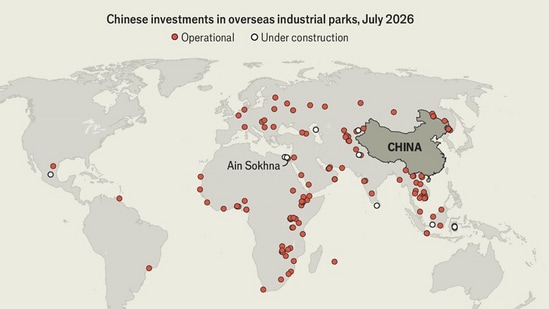
The ancient port of Ain Sokhna, on the Gulf of Suez, once received turquoise destined for the regalia of pharaohs. Now it welcomes a new source of wealth: Chinese manufacturers. In just a few years their investment has transformed the area. Scores of factories have appeared, producing everything from fibreglass to switchgears. In January a new port terminal—built with financing from two Chinese logistics giants, COSCO and CK Hutchinson—began operations.
Ain Sokhna forms part of the wider Suez Canal Economic
The ancient port of Ain Sokhna, on the Gulf of Suez, once received turquoise destined for the regalia of pharaohs. Now it welcomes a new source of wealth: Chinese manufacturers. In just a few years their investment has transformed the area. Scores of factories have appeared, producing everything from fibreglass to switchgears. In January a new port terminal—built with financing from two Chinese logistics giants, COSCO and CK Hutchinson—began operations.
Ain Sokhna forms part of the wider Suez Canal Economic Zone, a network of industrial parks and ports that stretches north to the Mediterranean. Roughly half the investment it has attracted in recent years has come from China. The factory-building extends far beyond North Africa (see map on next page). From Saudi Arabia and Hungary to Brazil and Indonesia, Chinese industrial parks are springing up, along with supporting infrastructure.
The pace of this investment has accelerated sharply. In the past three years alone Chinese companies have spent more than $200bn building overseas factories (see chart). The character of their supply chains is also changing, in three ways. First, they are spread more widely, with major production nodes in nearly every region of the globe. Second, they have grown deeper, with many Chinese suppliers following manufacturers into new sites, replicating the tight-knit ecosystems at home. Third, they are increasingly dominated by strategic industries, from electric vehicles and clean energy to data-centre gear. The consequence is a rewiring of global manufacturing.
A number of reasons explain why Chinese firms are making their wares in an expanding array of places. Weak consumer spending and fierce competition at home have encouraged them to venture into new markets. The tariffs introduced by the second Trump administration have also incentivised production in places that have been hit with less punitive levies than historic Chinese outposts such as Vietnam.
One Subscription.
Get 360° coverage—from daily headlines
to 100 year archives.
Archives
HT App & Website