
FlyDubai has been one of the world’s fastest expanding airlines, nearly doubling its staff since the pandemic to become the go-to low-cost carrier for a travel-hungry region.
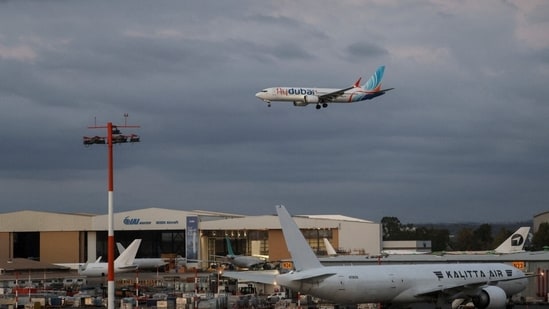
That growth is now running headlong into the biggest challenge in the carrier’s history: restoring trust after a novice pilot attempted to intentionally crash a plane on one of its most sensitive routes, to Israel’s Ben Gurion Airport.
FlyDubai’s model has been built on a simple proposition: a low-cost airline connecting a region
FlyDubai has been one of the world’s fastest expanding airlines, nearly doubling its staff since the pandemic to become the go-to low-cost carrier for a travel-hungry region.
That growth is now running headlong into the biggest challenge in the carrier’s history: restoring trust after a novice pilot attempted to intentionally crash a plane on one of its most sensitive routes, to Israel’s Ben Gurion Airport.
FlyDubai’s model has been built on a simple proposition: a low-cost airline connecting a region where air travel is often difficult and dangerous. That has made the carrier an increasingly important part of Dubai’s global aviation strategy, but it also places unusual demands on it. Now, the attempted hijacking by co-pilot Hamam al-Hammami is raising questions about whether FlyDubai’s push for growth has outpaced its ability to recruit and vet the people it entrusts to fly its planes.
FlyDubai is the discount cousin to the United Arab Emirates’ prestige long-haul airline, Emirates, whose brand adorns stadiums and the jerseys of European soccer teams. FlyDubai works in the background to offer cheap flights, often to the region’s more dangerous destinations. Both are state-backed and led by the ruler of Dubai’s uncle.
Migrant workers and vacationers are FlyDubai’s mainstay customers. They include Thais traveling from Bangkok to Israel to work as farmhands, traders coming from Somalia’s breakaway region of Somaliland and Russian vacationers coming from Moscow—even after Vladimir Putin launched his full-scale invasion of Ukraine in 2022.
Those flights represent a key plank of FlyDubai’s reach and appeal—the airline will go places Western carriers can’t or won’t. FlyDubai takes passengers to Taliban-ruled Kabul or postrevolution Damascus in Syria, where the suburbs around its airport remain largely concrete ruins.
Tel Aviv has been one of FlyDubai’s key destinations since the U.A.E. and Israel agreed to normalize relations in 2020. It was the first Gulf airline into the country, welcomed at the airport by Israeli Prime Minister Benjamin Netanyahu. Operations expanded to as many as 10 flights a day at one point, even after the Oct. 7, 2023, attack by Hamas on the country when other airlines pulled out over security concerns.
In 2025, FlyDubai flew over 800,000 passengers through Ben Gurion, a 71% increase from 2024. Overall, 1.5 million passengers traveled to the U.A.E. from the airport last year, behind only Greece and the U.S. as the biggest destinations.
FlyDubai was well-regarded in Israel, often the first foreign carrier to return after missile strikes shut the airspace. It offered a crucial and affordable air bridge for Israelis to Dubai, where they can connect to flights across Emirates’ more global route network.
“FlyDubai continued the whole time, they didn’t stop, which is remarkable,” said Yoel Guzansky, a senior fellow at the Institute for National Security Studies, a think tank based in Tel Aviv, who specializes in the Gulf states.
But authorities and industry insiders are now questioning whether the airline’s fast growth contributed to last week’s near catastrophe. The Omani first officer who took an ax to his captain in a failed attempt to crash the Boeing jetliner was part of a rapid postpandemic recruitment drive. The 29-year-old had failed stints at airlines in Oman and Morocco before FlyDubai hired him in February.
A FlyDubai spokesperson pointed to a company statement made in the wake of the near crash. The airline said it was cooperating with investigators and said the “safety and wellbeing of our passengers, crew and operations remain our highest priority.” The route between Dubai and Tel Aviv has been suspended since the incident.
Like other airlines in the industry, FlyDubai struggled with pilot recruitment after reducing its ranks during the pandemic.
FlyDubai has run recruitment roadshows in the last three years in cities including Milan, Dublin and Warsaw, and last year started a new training program for pilots aged 18 to 30, according to the company and industry promotional material. It opened a new 38,000- square-foot flight training center in Dubai, signed a deal with Boeing to provide in-house flight training and last year launched a new cadet program to train foreign pilots.
Since the pandemic, the airline’s total employee count has risen from 3,682 staffers at the end of 2021 to 6,763 at the end of 2025. The airline currently employs some 1,500 pilots, compared with 658 a decade earlier, company statements show. Pilot numbers during the pandemic weren’t immediately available.
This year, the discount carrier lowered the flight hours required to apply for a junior, second-officer pilot program. It also sweetened advertised salaries for new captains and first officers, according to its website. Captains are offered a monthly salary package in excess of $18,000 and benefits ranging from concessional flight tickets for family and friends, free flights for annual leave, and open-ended contracts.
It couldn’t be learned how the second officer was assigned to the sensitive route. FlyDubai categorizes airports in terms of difficulty, pilots say, with Tel Aviv’s airport ranking as one of the easier destinations in the airline’s network and not requiring major experience.
Aside from the political sensitivity, the airline’s crews typically regard Israel as an appealing route, according to current and former crew. The flight path travels through Saudi Arabian airspace, which is less busy than other parts of the region, and requires less interaction with air-traffic controllers.
Ben Gurion isn’t as busy since the Israel-Hamas war, meaning flights aren’t often delayed. Ground-handling teams are professional and efficient, with turnaround times typically taking about an hour.
When the discount carrier started in 2008, it marked a second phase in Dubai’s rise to become one of the dominant forces in global aviation. Emirates, with its double-decker Airbus aircraft and Boeing jetliners, flies to the major world destinations.
FlyDubai was created to reach everywhere else.
“Even though Dubai sits in a 4-hour flight radius of two billion people, the city is tough to reach by road,” said Jim Krane, an expert on Dubai at Rice University’s Baker Institute for Public Policy. “Airlines are the lifeblood of Dubai. The city has built its brand around connecting nearly everyone on earth through its airport.”
FlyDubai has had other problems, too.
In January 2015, a FlyDubai Boeing 737-800 carrying 154 passengers came under suspected sniper fire from Islamic State militants while landing at Baghdad International Airport. The gunfire hurt no one but inspections later discovered bullet holes in the plane’s fuselage.
The following year, another FlyDubai Boeing 737-800 crashed while trying to land in Rostov-on-Don, Russia, killing all 62 people aboard. Russian investigators later blamed pilot error and disorientation for the crash, which came after the pilots circled the airport for nearly two hours amid bad weather.
The airline’s reliance on a fleet of only Boeing 737s also put it under pressure when regulators worldwide grounded the 737 MAX in the wake of two crashes. But over time, the airline followed Emirates in reaching record-breaking results in 2024 as air travel rebounded following the pandemic. In 2025, the airline made a net profit of $531 million off revenues of $3.7 billion.
“We are focused on disciplined, strategic growth, expanding our network and strengthening Dubai’s position as a leading global aviation hub,” FlyDubai CEO Ghaith Al Ghaith said at the time.
Write to Jon Gambrell at jon.gambrell@wsj.com, Benjamin Katz at ben.katz@wsj.com and Feliz Solomon at feliz.solomon@wsj.com
One Subscription.
Get 360° coverage—from daily headlines
to 100 year archives.
Archives
HT App & Website