France has stepped up security measures, including targeted overnight curfews and restrictions on gatherings, after a weekend of violent rioting and looting which led to 2,400 arrests in the country.
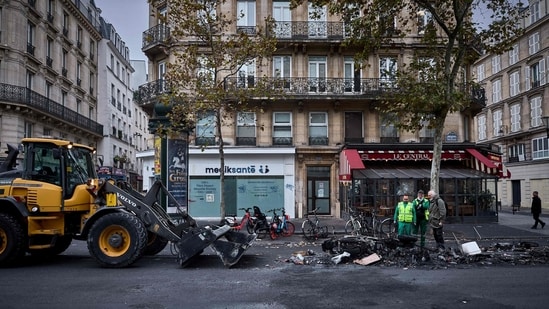
A targeted curfew refers to a restriction applying to a specific area or a particular neighbourhood, rather than an entire city. In Paris, the curfew has been imposed on two specific areas – the Place de la République and Les Halles.
The riots on Saturday led to thousands of businesses being affected, with public buildings, including city halls, targeted. The demonstrations, which began over rising living costs and declining public services, turned violent in several cities. The unrest even brought down the historic town hall in Limoges, which was “largely destroyed” in a fire.
French President Emmanuel Macron denounced the “unrestrained violence” by “insurrectionist elements from radical far-left groups, joined by numerous criminals”, the Associated Press reported.
Also Read | Protests set France on fire: Iconic Town Hall destroyed, shops looted, clashes with cops | Visuals
Security measures in place after weekend stir
{{/usCountry}}Also Read | Protests set France on fire: Iconic Town Hall destroyed, shops looted, clashes with cops | Visuals
Security measures in place after weekend stir
{{/usCountry}}Deep Dive
What triggered the protests in France, and how did they turn violent?
Which areas of Paris were placed under curfew after the riots?
How many people were arrested during the French riots?
The Paris police issued an overnight curfew on Monday which targeted two areas of the French capital, prohibiting anyone from entering or remaining at the Place de la République, which was one of the sites where rioting took place on Saturday (October 17).
A curfew, which authorities said was aimed at protecting “people and property from the violence and looting”, was also imposed on the shopping neighborhood of Les Halles, which had witnessed looting over the weekend, according to AP.
The curfew was imposed from 11pm on Monday till 6am on Tuesday, with demonstrations and gatherings banned from 8pm, the Paris police said. Local curfews were imposed for children and teenagers under the age of 18 in several cities in northern France starting Monday. The curfew, which includes the city of Lille, will be in place for the next two days from 8pm to 6am. Nice, on the French Riviera, also imposed an overnight curfew for minors from 9pm, AP reported.
French Prime Minister Sébastien Lecornu said more details on the “very limited” and “localised” curfews would be announced later Monday following consultations with mayors. Lecornu had earlier called on regional authorities to impose curfews where needed, Bloomberg reported. The French PM did not rule out imposing a state of emergency after the interior minister said police had “lost control”.
How cost-of-living protests turned violent, French government's response
The protests in France on Saturday drew more than half a million people across the country. However, the demonstrations soon deteriorated as fast-moving groups targeted hundreds of shops, according to Bloomberg.
Violence ensued in several cities, with masked groups attacking law enforcement, breaking into public buildings and setting some ablaze. Shops were looted and cars, bicycles and scooters were set on fire during the stir.
Nearly 2,400 people were arrested on Saturday, according to the French interior ministry data. Violence and looting continued on Sunday night, with another 108 arrests in Paris. Nationwide, over 2,513 people were arrested since the weekend, Justice Minister Gerald Darmanin said, adding that 67 had been jailed and “dozens” of criminal cases opened, according to AFP.
The French government faced accusations that it had failed to anticipate and respond to the violence, following which it vowed to re-establish order, AFP reported. Following the weekend marred by violence, French interior minister Laurent Nunez offered his resignation, but President Macron refused to accept it.
Macron acknowledged failures in government response, while slamming the “unbridled” violence. The French interior minister and intelligence services were to meet late Monday to discuss the violence.