WITH HER eyeliner, long locks and short skirts, Gloria Steinem wasn’t what most Americans pictured when they imagined a feminist activist. They had been led to believe “women’s libbers” were all dowdy, with hairy legs and frown lines. Ms Steinem, though, was glamorous. She was “trim” and “undeniably female”, marvelled one interviewer; she had “legs worthy of her mini-skirts, and a brain that keeps conversation lively”. She was funny, too. “The truth will set you free,” she said, “but first
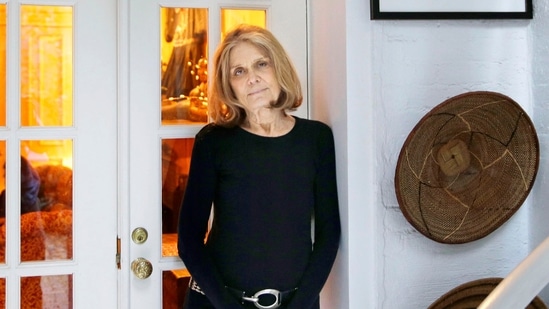
WITH HER eyeliner, long locks and short skirts, Gloria Steinem wasn’t what most Americans pictured when they imagined a feminist activist. They had been led to believe “women’s libbers” were all dowdy, with hairy legs and frown lines. Ms Steinem, though, was glamorous. She was “trim” and “undeniably female”, marvelled one interviewer; she had “legs worthy of her mini-skirts, and a brain that keeps conversation lively”. She was funny, too. “The truth will set you free,” she said, “but first it will piss you off.” Weren’t feminists meant to be angry and humourless?
Ms Steinem was baffled by the public’s obsession with her appearance. But her good looks proved useful. In her early days as a journalist in New York in the 1960s, they allowed her to go undercover as a Playboy bunny and describe the grim physical examinations, stringent code of conduct and restrictive costume (“the boning in the waist would have made Scarlett O’Hara blanch”). Her beauty brought media opportunities, which she used to bring attention to issues such as abortion and equal pay. And it made it a lot harder for those who sought to caricature feminist causes as the gripes of a load of disaffected spinsters. Women wanted to be like her—and they wanted to hear what she had to say.
She parlayed her public stature and journalism experience into Ms., America’s first national feminist magazine, in 1971. (They had considered calling it Bimbo, but reckoned the irony might be lost on a lot of readers.) Funding was not forthcoming; prospective investors described the venture as “crazy”. But Ms Steinem managed to scrape enough together to produce a test issue, which immediately put paid to the idea that there was no audience for it. Ms. sold out its initial run of 300,000 copies in eight days.
Deep Dive
How did Gloria Steinem's appearance influence her role in the feminist movement?
What was the significance of the founding of Ms. magazine in 1971?
Why did Gloria Steinem believe in the connection between personal experiences and political activism?
The first issue included a list of prominent women, including Ms Steinem, who had had abortions. The magazine covered all aspects of women’s experience, from housework and parenting to menstruation, rape and domestic violence. Ms. was soon receiving thousands of letters a week. “It is difficult to express the sense of exhilaration upon finding in print the ideas that have been smouldering in my semi-rebellious soul for some 40 years,” one read. “It is comforting to know I am not alone.”
When she was not working late in the cramped set of rooms that Ms. called an office, Ms Steinem was involved in electoral politics. Her enthusiasm for campaign work began in high school, when she volunteered for Adlai Stevenson, a Democratic presidential candidate. The experience taught her that “male staffers made decisions, and women carried them out, even women old enough to be their mothers.”
In 1971, in order to get more women into office, she co-founded the National Women’s Political Caucus alongside Betty Friedan, Shirley Chisholm and Bella Abzug. She tirelessly campaigned for the Equal Rights Amendment to the constitution, which promised that “equality of rights under the law shall not be denied or abridged...on account of sex”. It was passed by Congress, but hit a roadblock when it came to be ratified by state legislatures. The organised resistance from conservative women such as Phyllis Schlafly made it clear just how hard-won progress would be.
Ms Steinem’s doggedness was shaped by her upbringing. Her father was a travelling antiques salesman who kept the family on the road, meaning that she did not go to school for several years and learned to read from road signs. Freedom was a luxury afforded only to him. Ms Steinem’s mother had had her own journalistic career, but it was curtailed by marriage and children, and she had a mental breakdown in her 30s.
Each parent exerted an influence over Ms Steinem’s thinking in their own way. In her memoir she wondered whether she would “have dared to challenge rules later in life if [her] father had obeyed them”. And her mother’s struggles—financial, medical and social—showed her how the personal was political. “She led me toward an activist place where she herself could never go.”
By the time of her death, Ms Steinem had spent more than half a century at the forefront of the women’s movement. In her final years, she was dismayed by America’s political direction —in particular the undoing of Roe v Wade. She felt that, in any democracy, individuals should have the right to “make decisions over [their] own physical selves”. In 2015 she dedicated her memoir to John Sharpe, an English doctor who performed her abortion in 1957 and gave her the freedom to pursue her career. “This book is for you,” she wrote. “I’ve done the best I could with my life.”
One Subscription.
Get 360° coverage—from daily headlines
to 100 year archives.
Archives
HT App & Website