
A massive ice block nearly 100 times the area of Manhattan is poised to break off Antarctica’s Larsen C ice shelf, scientists reported on Friday.
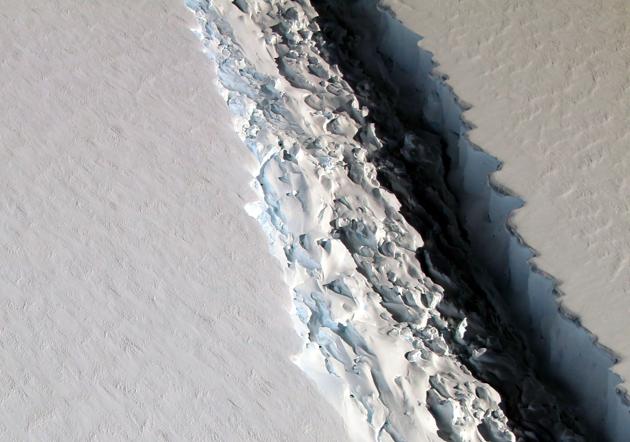
A slow-progressing rift suddenly grew by 18 kilometres at the end of December, leaving the finger-shaped chunk -- 350 metres thick -- connected along only a small fraction of its length.
Suggested For You
The rift has also widened, from less than 160 feet in 2011, to nearly 500 metres today.
“If it doesn’t go in the next few months, I’ll be amazed,” said Adrian Luckman, a professor at Swansea University in Wales, and leader of Britain’s Project Midas, which tracks changes in West Antarctic ice formations.
By itself, the soon-to-be iceberg will not add to sea levels, the likely consequence of ice sheet disintegration that most worries scientists.
The real danger is from inland glaciers, held in place by the floating, cliff-like ice shelves that straddle land and sea.
The fragile West Antarctic ice sheet -- where Larsen C is located -- holds enough frozen water to raise global oceans by at least four metres (13 feet).
Recent studies have suggested that climate change may already have condemned large chunks of it to disintegration, though whether on a time scale of centuries or millennia is not known.
{{/usCountry}}Recent studies have suggested that climate change may already have condemned large chunks of it to disintegration, though whether on a time scale of centuries or millennia is not known.
{{/usCountry}}The breaking off, or calving, of ice shelves is a natural process, but global warming is thought to have accelerated the process.
Warming ocean water erodes their underbelly, while rising air temperatures weaken them from above.
The nearby Larsen A ice shelf collapsed in 1995, and Larsen B dramatically broke up seven years later.
The ice block currently separating from Larsen C contains about 10 percent of its mass, and would be among the 10 largest break-offs ever recorded, Luckman said.
If all the ice held back by Larsen C entered the sea, it would lift global oceans by about 10 centimetres (four inches).
“We are convinced -- although others are not -- that the remaining ice shelf will be less stable than the present one,” Luckman said in a statement.
Oceans in recent decades have absorbed much of the excess heat generated by climate change, which has lifted average global air temperatures by one degree Celsius (1.8 degrees Fahrenheit).
The world’s nations have undertaken in the Paris Agreement, inked in the French capital in December 2015, to cap global warming at “well under” two degrees Celsius (3.5 degrees Fahrenheit) above pre-industrial era levels.
Explore More
ABOUT THE AUTHOR
Follow the latest breaking news, major developments and agenda-setting stories from India and around the world with the newsdesk at Hindustan Times. Operating round the clock, the desk brings together experienced editors, reporters and correspondents to deliver fast, accurate and contextual reporting across subjects that influence public policy, governance, business, society and international affairs. The HT News Desk covers politics, elections, government policies, the economy, business and markets, science and technology, the environment, law and order, infrastructure, education, climate issues and geopolitics, while closely tracking developments across states, institutions and global capitals. The team also leads coverage of major breaking news events, policy announcements, court proceedings, natural disasters, public emergencies and significant international developments. Reports published by the newsdesk are based on information gathered from reporters on the ground, official statements, government agencies, court records, regulatory filings, recognised institutions and other authoritative sources. Stories undergo editorial scrutiny and verification processes to ensure accuracy, fairness and relevance, and are updated as events evolve and additional information becomes available. Whether covering a key political decision in New Delhi, an economic policy shift affecting millions, a landmark court ruling or a major global event, the HT News Desk aims to provide readers with reliable, fact-based journalism that delivers not only the latest developments but also the context and analysis needed to understand their wider implications.