
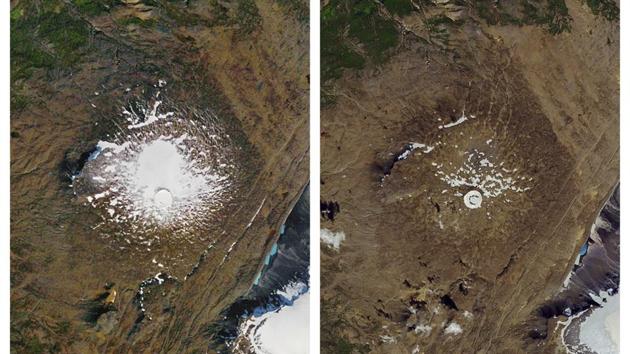
Iceland on Sunday honoured the passing of Okjokull, its first glacier lost to climate change, as scientists warn that some 400 others on the subarctic island risk the same fate.
A bronze plaque was unveiled in a ceremony on Sunday afternoon to mark Okjokull — which translates to “Ok glacier” — in the west of Iceland, in the presence of local researchers and their peers at Rice University in the US, who initiated the project.
Suggested For You
Iceland’s prime minister Katrin Jakobsdottir, environment minister Gudmundur Ingi Gudbrandsson, and the United Nations high commissioner for human rights Mary Robinson also attended the event.
“This will be the first monument to a glacier lost to climate change anywhere in the world,” Cymene Howe, associate professor of anthropology at Rice University, said in July. The plaque bears the inscription “A letter to the future,” and is intended to raise awareness about the decline of glaciers and the effects of climate change.
“In the next 200 years all our glaciers are expected to follow the same path. This monument is to acknowledge that we know what is happening and what needs to be done. Only you know if we did it,” the plaque reads.
{{/usCountry}}“In the next 200 years all our glaciers are expected to follow the same path. This monument is to acknowledge that we know what is happening and what needs to be done. Only you know if we did it,” the plaque reads.
{{/usCountry}}“Memorials everywhere stand for either human accomplishments, like the deeds of historic figures, or the losses and deaths we recognise as important,” researcher Howe said.
“By memorialising a fallen glacier, we want to emphasise what is being lost — or dying — the world over, and also draw attention to the fact that this is something that humans have ‘accomplished’, although it is not something we should be proud of.”
Iceland loses about 11 billion tonnes of ice per year, and scientists fear all of the island country’s 400-plus glaciers will be gone by 2200, according to Howe and her Rice University colleague Dominic Boyer.
Glaciologists stripped Okjokull of its glacier status in 2014, a first for Iceland.
In 1890, the glacier ice covered 16 square kilometres but by 2012, it measured just 0.7 square kilometres, according to a report from the University of Iceland from 2017.
According to a study published by the International Union for Conservation of Nature (IUCN)in April, nearly half of the world’s heritage sites could lose their glaciers by 2100 if greenhouse gas emissions continue at the current rate.
Explore More
ABOUT THE AUTHOR
Follow the latest breaking news, major developments and agenda-setting stories from India and around the world with the newsdesk at Hindustan Times. Operating round the clock, the desk brings together experienced editors, reporters and correspondents to deliver fast, accurate and contextual reporting across subjects that influence public policy, governance, business, society and international affairs. The HT News Desk covers politics, elections, government policies, the economy, business and markets, science and technology, the environment, law and order, infrastructure, education, climate issues and geopolitics, while closely tracking developments across states, institutions and global capitals. The team also leads coverage of major breaking news events, policy announcements, court proceedings, natural disasters, public emergencies and significant international developments. Reports published by the newsdesk are based on information gathered from reporters on the ground, official statements, government agencies, court records, regulatory filings, recognised institutions and other authoritative sources. Stories undergo editorial scrutiny and verification processes to ensure accuracy, fairness and relevance, and are updated as events evolve and additional information becomes available. Whether covering a key political decision in New Delhi, an economic policy shift affecting millions, a landmark court ruling or a major global event, the HT News Desk aims to provide readers with reliable, fact-based journalism that delivers not only the latest developments but also the context and analysis needed to understand their wider implications.