Most of us picture deserts as places of sand, heat, and little else. In 2026, one of the driest spots on Earth proved that picture wrong. In a 2019 International Journal of Applied Earth Observation and Geoinformation study, Roberto O. Chávez and colleagues described how a “blooming desert” occurs in years when the Atacama receives extraordinarily high rainfall. The rain came this year, and the rocky, brownish landscape of northern Chile turned bright with flowers across an estimated 17,000 square kilometers.
A desert that rarely gets rain
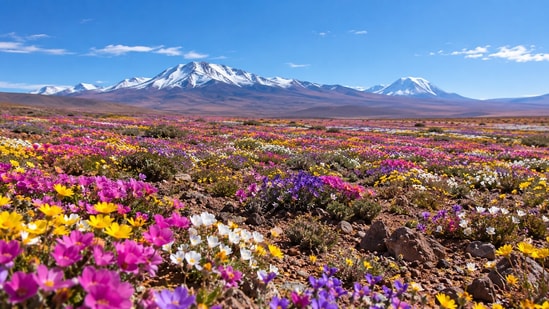
The Atacama lies between the Pacific Ocean and the Andes Mountains. It extends about 1,600 kilometers along the northern coast of Chile and is the driest nonpolar desert on Earth. Some parts get only a few millimeters of rain a year, and some get none, NASA’s Earth Observatory notes. The Andes form a very strong rain shadow, and a cold ocean current cools the air next to the coast, limiting the moisture it can carry. Normally, it looks like rocky, brownish dunes. Some flowers normally appear as winter turns to spring, but this year’s bloom was much larger.
How El Niño and rare rain woke the desert
The Associated Press reported that a super El Niño brought heavy rains to the region earlier this year, and CONAF Atacama biologist César Pizarro said some locations received 160 to 190 millimeters, the largest volumes since records began. Such rain matters because many of the blooming plants are short-lived species that grow quickly when water arrives. The 2019 paper used satellite vegetation data to track these events and described the burst of growth among short-lived and some woody desert plants. Scientists looking at satellite data from 1981 to 2015 identified 13 greening events, most starting in winter and continuing into the summer that followed, according to NASA.
A bloom with more than 200 plant species
{{/usCountry}}The Associated Press reported that a super El Niño brought heavy rains to the region earlier this year, and CONAF Atacama biologist César Pizarro said some locations received 160 to 190 millimeters, the largest volumes since records began. Such rain matters because many of the blooming plants are short-lived species that grow quickly when water arrives. The 2019 paper used satellite vegetation data to track these events and described the burst of growth among short-lived and some woody desert plants. Scientists looking at satellite data from 1981 to 2015 identified 13 greening events, most starting in winter and continuing into the summer that followed, according to NASA.
A bloom with more than 200 plant species
{{/usCountry}}The 2026 bloom is notable for its size and variety. The AP reported estimated coverage of some 17,000 square kilometers, with more than 200 species of plants and flowers in many colors, shapes, and forms. Chile’s forestry agency CONAF projections say this is expected to be the most intense and widespread Desierto Florido, or “flowering desert,” since 1997. It is worth noting that this is a projection and the coverage is an estimate, so the numbers are not definitive measurements. Desert blooms have happened before, as the 13 events in the satellite record show. What sets 2026 apart, according to CONAF’s projection, is the mix of wide coverage and strong intensity.
Tourists follow the flowers
Where there are flowers, there are visitors. According to data the National Tourism Secretariat provided to the AP, the Atacama region is expected to see nearly 300,000 overnight trips by the time the bloom ends in November. That makes Desierto Florido one of the main tourist attractions of the region this season. One visitor was 37-year-old chef Franco Moya, who journeyed nearly 1,000 kilometers from Santa Cruz, a town in central Chile’s Colchagua Valley, to mark his birthday in the desert. He said it was striking to see flowers growing in such a dry place. Right now, a typically empty desert is a blanket of wildflowers, and NASA’s tally of 13 events shows they do not happen every year.