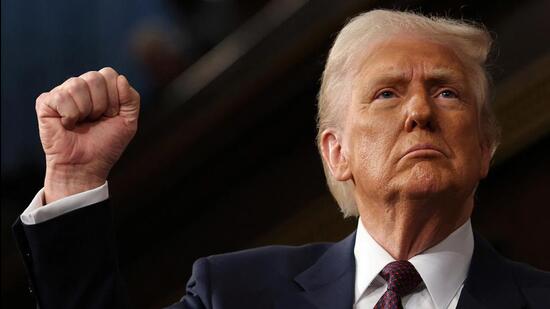
WASHINGTON: Donald Trump’s first address in his second term to the joint session of the US Congress on Tuesday confirmed he is making five big bets straddling politics, foreign policy and the economy. How these play out in the next year is the big question.
Trump’s first bet is that he can dramatically downsize the US State and its regulatory apparatus, scale back its services, and reduce its international footprint. His support for the Department of Government Efficiency, praise for Elon Musk and recital of what Trump considered instances of waste, abuse and fraud on Tuesday show that this remaking of the American State will continue. This stems from an ideological conviction against big government, an economic calculus that this can help reduce the deficit, strategic logic that the US hasn’t gained from its commitments abroad, and a worldview that the US needs a far more focused set of interests. That much is now known.
What remains uncertain is whether Trump can do this without affecting core governance functions, sparking political backlash or harming America’s interests abroad. After all, abolishing agencies creates vacuums. Removing federal workers means work that no longer gets done. Eliminating regulatory oversight increases the chances of market failure and public harm. Withdrawing development assistance diminishes global influence and networks.
Trump’s second bet is that he can work with Russia, force Ukraine to accept peace terms that Washington and Moscow are comfortable with, and get Europe to handle its own security. Trump’s insistence that Ukraine offer a share of its minerals to the US, his rebuke to Volodymyr Zelensky last week, suspension of military aid and intelligence sharing, slight willingness to reopen doors to Zelensky after his somewhat regretful approach, open advocacy of direct talks with Russia, defence of Vladimir Putin, and consistently sharp messages to Europe all form part of this wider strategic play. This reflects his conviction that European security isn’t America’s perennial responsibility, his faith that the Atlantic can insulate America, and his belief that Russia poses no real threat to core American interests. This much is known.
{{/usCountry}}Trump’s second bet is that he can work with Russia, force Ukraine to accept peace terms that Washington and Moscow are comfortable with, and get Europe to handle its own security. Trump’s insistence that Ukraine offer a share of its minerals to the US, his rebuke to Volodymyr Zelensky last week, suspension of military aid and intelligence sharing, slight willingness to reopen doors to Zelensky after his somewhat regretful approach, open advocacy of direct talks with Russia, defence of Vladimir Putin, and consistently sharp messages to Europe all form part of this wider strategic play. This reflects his conviction that European security isn’t America’s perennial responsibility, his faith that the Atlantic can insulate America, and his belief that Russia poses no real threat to core American interests. This much is known.
{{/usCountry}}The unknown is whether Trump can execute this balancing act without geopolitical costs. Maintaining dominance over the western alliance becomes difficult if Europe acts autonomously. Sustaining intelligence sharing across the Five Eyes network grows challenging if allies lose trust. Ensuring peace terms that leave a sovereign Ukraine intact becomes harder if Moscow feels emboldened. Preventing an empowered Russia from eyeing other Eastern European territories becomes more difficult if DC signals NATO commitment isn’t sacrosanct. And preventing this reset from signalling to China that territorial adventurism pays becomes harder.
Trump’s third bet is that he can reorder the international economic order to incentivise both American and foreign companies to invest in the US, force other countries to open markets to American goods, make the American market less accessible to foreign producers, and operate through bilateral deals rather than multilateral regimes. Trump’s attribution of recent US investment announcements to tariffs, his announcement of reciprocal tariffs from April 2, his message that non-tariff barriers will factor into determining reciprocal tariffs, and his defence of tariffs against Canada, Mexico and China all form part of this strategy. This reflects Trump’s conviction that others have exploited American openness, globalisation destroyed American jobs by making China the world’s production hub, and his faith in tariffs as the policy instrument to correct this while fulfilling his political promise to revive manufacturing and boost employment. This much is known.
The question remains whether this deliberate disorder will yield Trump’s hoped-for gains without corresponding costs. Increased tariffs shift burdens to importers and consumers, raising prices—contradicting Trump’s promise to keep prices low. Tariffs on close neighbours with intricate supply chain relationships can disrupt domestic industrial production. When tariffs trigger retaliation, American exporters including farmers—key parts of Trump’s coalition—suffer. Indiscriminate tariffs affect markets, that in turn concerns the New Yorker businessman in Trump. And if he appears too unpredictable as the self-styled “tariff king,” the world may pivot toward China rather than withdraw from it.
Trump’s fourth bet is to establish American dominance over the Americas. His instruction to Secretary of State Marco Rubio, from the stage, to take over the Panama Canal; repeated references to acquiring Greenland; criticism of Mexico as a den of cartels exporting illegal immigrants and fentanyl; earlier references to Canada as America’s 51st state; and reiteration of plans to build an iron dome to protect the homeland all align with this strategy. This appears to stem from Trump’s conviction that America’s core security interests require insulating the Americas from external (particularly Chinese) influence and ensuring that the US can call the shots from Greenland, through Canada, down to Mexico and Central America, all the way to Chile. This much is known.
The uncertainty is whether Trump’s strategy of coercion and vocabulary of threats will succeed in bringing countries into line, or whether American ultra-nationalism will trigger nationalist backlash among neighbours. Threatening to take over Canada angers even the most pro-American Canadian politicians. Calling Mexico cartel-controlled despite its reconciliatory actions alienates Mexican citizens. Forcing South American countries—many with China as their biggest trading partner—to make binary choices rather than offering incentives may backfire.
Trump’s four bets may succeed, given America’s immense power and Trump’s willingness to exercise it. So far, countries have sought bilateral deals with Trump to avoid his wrath. Those who had provoked him quickly sought reconciliation. Friends are nervous but value the relationship. Adversaries are wary but sense an opportunity to redirect American policy in their favour.
This reveals Trump’s hidden fifth bet. His address was conspicuously lacking a coherent policy statement on China. To be sure, the US has imposed an additional 20% tariff on China and there has been an absence of direct communication between Trump and Xi Jinping. But this marked the first time in years a US president didn’t characterise China as a peer-level adversary, mention the Indo-Pacific construct, address China’s military and economic threats in Asia, or even reference Taiwan—all against the backdrop of Trump’s signals that a deal with Xi is possible and desirable. How Trump ultimately plays his China hand, and how China responds, remains the major unanswered question after Tuesday. But the bets he has already made will transform America and the world in both anticipated and unanticipated ways.