India has committed a “strategic blunder” and “missed the bus” to long-term growth, Chinese state media has said about New Delhi’s decision not to join the China-led 15-country Regional Comprehensive Economic Partnership (RCEP), signed on Sunday at an online ceremony hosted by this year’s ASEAN chair, Vietnam.
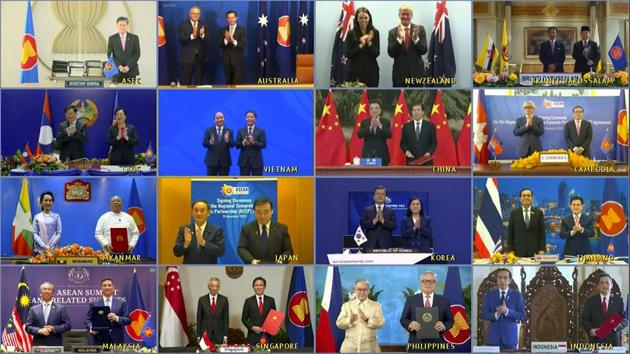
The 15 countries that signed the deal span the Asia-Pacific region including China, Japan, South Korea, Australia and New Zealand, along with the 10 members of the Association of Southeast Asian Nations (ASEAN).
Signed after eight years of negotiations, the RCEP has created the world’s largest trading bloc, aiming to boost the member nations’ economic growth that has been hit by the Covid-19-pandemic.
Together, they account for around 30% of the world’s gross domestic product (GDP) and population.
Also Watch l Explained: RCEP world’s largest trade deal, India’s rejection, China’s dominance
“The RCEP agreement covers a market of 2.2 billion people, or almost 30% of the world’s population, with a combined GDP of $26.2 trillion or about 30% of global GDP,” official news agency Xinhua reported.
It hailed the deal as “…not only a monumental achievement in East Asian regional cooperation, but more important, a victory of multilateralism and free trade”.
Two major economies - the US and India - are not part of the deal. India, which had initially taken part in the negotiations, pulled out of the trade bloc last year.
There are “significant outstanding issues, which remain unresolved”, New Delhi said last year before pulling out of the RCEP.
New Delhi’s list of concerns includes the possibility of opening up its markets to cheap, China-made goods, with which it already has a huge bilateral trade deficit.
Chinese South Asia experts were quick to criticise India for not joining the trade bloc, calling it a mistake, and blaming “interest groups” for the decision.
{{/usCountry}}Chinese South Asia experts were quick to criticise India for not joining the trade bloc, calling it a mistake, and blaming “interest groups” for the decision.
{{/usCountry}}“The Indian government argues that as China has an advantageous position in the deal, and India has a ballooning trade deficit with China, such a context would leave India in an unfair position, were it to join,” Liu Zongyi from the Centre for China-South Asia Cooperation at Shanghai Institutes for International Studies wrote in the Chinese state media.
“However, most international observers believe that it’s the work of some interest groups in India, trying hard to obstruct India’s participation for their own interests, while Indian Prime Minister Narendra Modi and the Bharatiya Janata Party made concessions in order to win their support,” Liu wrote.
Qian Feng, director of the research department at the National Strategy Institute at Tsinghua University, argued that New Delhi has missed the bus to the fast lane of economic recovery.
“With the world’s second largest number of novel coronavirus infections so far, India may miss a new round of regional industrial reconstruction and the fast lane of economic recovery,” Qian wrote in the nationalistic tabloid, Global Times.
“The Indian economy has been hit hard by Covid-19 and recorded a record contraction during the April-June quarter of 23.9%. According to an IMF estimate, it may shrink 10.3% in 2020. Though the RCEP may still leave a chance for India, it will be hard for the nation to reset its direction unless New Delhi clearly realises that its core interest has been hindered by its skewed strategy,” Qian added.
A joint statement issued in November 2019 in Thailand at the end of RCEP negotiations had acknowledged India’s concerns.
“India has significant outstanding issues, which remain unresolved. All RCEP participating countries will work together to resolve these outstanding issues in a mutually satisfactory way. India’s final decision will depend on satisfactory resolution of these issues,” the statement said.