With the final results for Israel's general election published by the Central Elections Committee, no clear winner has emerged, thus leaving the country in a political deadlock.
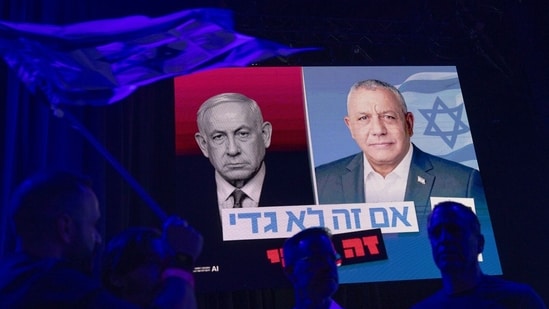
Prime Minister Benjamin Netanyahu's Likud emerged as the largest party with 27 seats in the polls, while former military chief Gadi Eisenkot's Yashar secured 21. The pro-Netanyahu bloc in total won 53 seats, and rival Eisenkot's opposition bloc secured 48 seats. In a surprise, the Arab parties – Joint List and Ra'am – won 19 seats in a historic showing.
However, no party or bloc could reach the 61-seat majority mark in the 120-seat Knesset, which will set off a slew of negotiations from all sides to form a coalition government. Here are four possible scenarios how Israel can get a new government.
Deep Dive
How many seats are needed to form a government in Israel, and did either bloc reach that number?
Can Gadi Eisenkot form a government with support from Arab parties?
What happens if Israel’s parties cannot agree on a coalition?
Follow live updates on Israel elections here
Netanyahu-led coalition with right-wingers from opposition
If Netanyahu can convince the right-wing parties in rival Eisenkot's bloc to break away and join him, he could lead a majority coalition government. The Likud leader's options lie in Naftali Bennett – who jointly leads the B’Yachad with Yair Lapid – and Avigdor Lieberman.
{{/usCountry}}If Netanyahu can convince the right-wing parties in rival Eisenkot's bloc to break away and join him, he could lead a majority coalition government. The Likud leader's options lie in Naftali Bennett – who jointly leads the B’Yachad with Yair Lapid – and Avigdor Lieberman.
{{/usCountry}}Both right-wing hardliners on security, they share political ground with Netanyahu and could be his best bet, according to BBC. Bennett's political career began with Netanyahu, and he joined the Netanyahu-led coalition following the 2015 election, wherein he was education minister. However, he was out of Netanyahu’s government in 2020. Lieberman was pivotal in turning Netanyahu into Likud’s dominant figure in 1996, the year the latter first became PM.
However, both have campaigned to oust the Israeli PM and to extend military conscription to the ultra-Orthodox, which would bring them into direct conflict with two ultra-Orthodox parties already part of the Netanyahu-led government. While some suggest Bennett and Lieberman's parties could replace the ultra-Orthodox parties, this may not be enough to reach the majority mark.
Eisenkot-led coalition with Arab parties' support
For the opposition bloc led by Gadi Eisenkot, support from Arab parties is essential to form a coalition government. If the Joint List and Ra'am join Eisenkot's bloc, he could have a majority government, with 67 seats in the Knesset. This would also signify a shift in Israeli politics, given that only one independent Arab party has ever formally been part of a coalition in the country, BBC reported.
However, Eisenkot's Yashar and all other parties in the opposition bloc, except the Democrats, have ruled out support from Arab parties to form government. Eisenkot, who has rejected alliances with parties that do not support Israel’s Jewish character, would see the Arab parties as a liability, and a coalition with them would go against his election promises. In another possible scenario, Eisenkot could leave Arab lawmakers out of the coalition and could secure their agreement to form a minority government. The former IDF chief will need at least six lawmakers from the Arab parties for the initial confidence vote, NYT reported. However, it is uncertain whether Arab leaders will support a government they have been excluded from.
National unity government
A national unity government jointly led by Netanyahu and Eisenkot could mean a clear majority for them in Knesset with a total of 66 seats, five more than the majority mark.
The alliance might bring together Netanyahu's Likud, Eisenkot's Yashar, Bennett-Lapid's B'Yachad, and Lieberman's Yisrael Beiteinu. However, Eisenkot would have to abandon his key positioning to join such a coalition, given that he has positioned himself as the only alternative to Netanyahu.
His entire campaign was focused on removing Netanyahu from power. Further, Netanyahu himself might not want to share power with his rivals, potentially at the expense of long-time allies, NUT reported.
Also Read | Israel vote theft row explained: Netanyahu's claims, probe and election results
Fresh elections
The final alternative, and probably the last one to be explored, would be fresh elections. This could hand an advantage to Netanyahu, who will then remain caretaker PM, and might see this as another chance to win a majority the next time.
Some suggest that the record Arab-voter turnout might not be repeated, and the right-wing could mobilise in a second poll, according to BBC. In addition, several right-wing parties who failed to cross the 3.25 per cent threshold needed for a seat in the Knesset might get fewer votes this time around, which could bring more votes for Netanyahu's Likud and its allies.
Notably, coalitions are not new in Israel, given that no bloc has ever reached the majority mark in elections in the country.
This has also led to shaky, short-lived governments and unlikely alliances over the years. Between 2019 and 2022 itself, Israel headed to polls five times as parties failed to form a government or hold a coalition, New York Times reported. Netanyahu's current government is the first to complete its full four-year term.