Israel-Hamas war latest news: The Israeli military was on Sunday readying for a looming Gaza ground invasion aimed at destroying Hamas, the Palestinian militant group that unleashed the deadliest attack in Israel's history.
In the eight days since Hamas gunmen killed more than 1,300 Israelis in their surprise onslaught, Israel has responded with a devastating bombing campaign that has claimed over 2,300 lives in Gaza.
An infuriated Israel has massed forces outside the long-blockaded enclave of 2.4 million people ahead of what the army has said will be a land, air and sea attack involving a "significant ground operation".
Prime Minister Benjamin Netanyahu, wearing a flak jacket, visited frontline troops on Saturday. "Are you ready for what is coming?" he said. "More is coming."
Hamas vs Israel war weapons: A comparison
Hamas: The source close to Hamas told news agency Reuters that the group's fighters had been training in Gaza since the last conflict in 2021, on occasion conducting drills in plain sight. The exercises involved building a mock Israeli settlement to practice a military landing and training to storm it, the source said.
- At the start of the operation, Hamas said it had fired 3,000 rockets in a first barrage. Israel's military said 2,500 rockets were fired, logging the bombardment at about 6.30 a.m (0330 GMT).
- Hamas has 15,000 to 20,000 fighters, according to the International Institute for Strategic Studies. Israel puts the number higher, at up to 30,000 fighters.
- In 2021, Israeli intelligence estimated that the total number of rockets available to factions in Gaza was about 30,000. While Iran and Syria have smuggled rockets to Gaza in the past, most rockets now appear to have been locally produced.
- Hamas has publicly claimed that it possessed precision-guided missiles. It has also attempted to acquire Iranian anti-ship missiles. Whether they succeeded after Israel foiled early attempts remains unknown, the IISS said.
- Hamas has used weaponised uninhabited aerial vehicles (UAVs) in the ongoing war. Types of UAVs used include direct-attack munitions guided by satellite navigation systems, loitering munitions equipped with video cameras and radio links, and quadcopters capable of dropping munitions.
- There is more evidence for the successful use of quadcopters. Videos show quadcopter-dropped munitions destroying an Israeli Merkava main battle tank and successfully turning off remotely controlled weapons stations installed on top of sentry towers along the border with Gaza.
Hamas: The source close to Hamas told news agency Reuters that the group's fighters had been training in Gaza since the last conflict in 2021, on occasion conducting drills in plain sight. The exercises involved building a mock Israeli settlement to practice a military landing and training to storm it, the source said.
- At the start of the operation, Hamas said it had fired 3,000 rockets in a first barrage. Israel's military said 2,500 rockets were fired, logging the bombardment at about 6.30 a.m (0330 GMT).
- Hamas has 15,000 to 20,000 fighters, according to the International Institute for Strategic Studies. Israel puts the number higher, at up to 30,000 fighters.
- In 2021, Israeli intelligence estimated that the total number of rockets available to factions in Gaza was about 30,000. While Iran and Syria have smuggled rockets to Gaza in the past, most rockets now appear to have been locally produced.
- Hamas has publicly claimed that it possessed precision-guided missiles. It has also attempted to acquire Iranian anti-ship missiles. Whether they succeeded after Israel foiled early attempts remains unknown, the IISS said.
- Hamas has used weaponised uninhabited aerial vehicles (UAVs) in the ongoing war. Types of UAVs used include direct-attack munitions guided by satellite navigation systems, loitering munitions equipped with video cameras and radio links, and quadcopters capable of dropping munitions.
- There is more evidence for the successful use of quadcopters. Videos show quadcopter-dropped munitions destroying an Israeli Merkava main battle tank and successfully turning off remotely controlled weapons stations installed on top of sentry towers along the border with Gaza.
Israel: Israel, which has likened last week's attacks to those on September 11, 2001, in the United States, has fired thousands of missiles at northern Gaza. One air strike killed Ali Qadi, described as "a company commander of the Hamas 'Nukhba' commando force" involved in the unprecedented attack, the army said.
- The Israeli military has a large number of tanks and armoured vehicles as it makes a "real difference" when crossing borders into other territories, Sky News quoted professor Michael Clarke, a British academic, who specialises in defence studies.
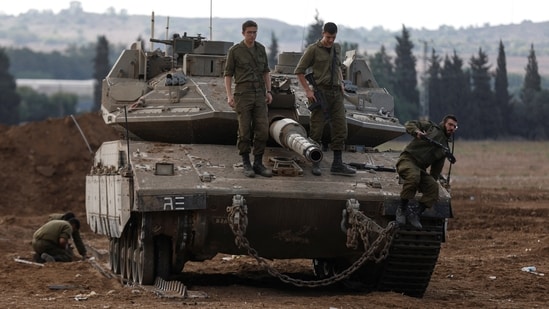
- Israel's Merkava tank is similar to the German Leopard 2 battle tank that has become well-known for its use in Ukraine, it reported. Designed and largely manufactured in Israel, the tank features heavy front armour to provide maximum protection for its four crew and is armed with a 120mm main gun as well as secondary armaments.
- Israel uses its own Kfir fighter jets - multirole warplanes based on the French-made Mirage aircraft. It also has a number of advanced F-35 Lightning II jets obtained from the US. Besides it has F-15 and F-16 jets.
- According to IISS, Israel has 169,500 active military personnel in the army, navy, and paramilitary. A further 465,000 constitute its reserve forces.
- Israel's defence budget, including US aid, is believed to be around $23.6 billion (£19 billion) in 2023.
- NUCLEAR: Israel is widely understood to have anywhere from 100-200 nuclear warheads, which the government in West Jerusalem has neither confirmed nor denied. Of these, approximately 30 are gravity bombs for delivery by aircraft. Around 50 weapons are for delivery by Jericho II medium-range ballistic missiles, which are believed to be based with their mobile launchers in caves at a military base east of Jerusalem.
- The operational status of a new Jericho III intermediate-range ballistic missile is unknown. In 2013 Israel conducted a launching test of a ‘rocket propulsion system’, which appeared to be for a Jericho III missile, the IISS said.