
 E-Paper



Mapping Maldives' relation with India and China
As ties between Malé and New Delhi fall to a new low, a look at why the island nation needs both its neighbours happy

 Prefer HTon Google


More than 35 years ago, India mounted possibly the first overseas operation by its three military services to thwart a coup in the Maldives assisted by a group of mercenaries. Within nine hours of an SOS from the government of the Maldives, Indian paratroopers flown to the archipelago by air force aircraft secured the capital of Malé while naval warships prevented the mercenaries from fleeing with several hostages, including some Maldivian ministers.
Operation Cactus, the Indian intervention in the Maldives in November 1988, highlighted both the importance of the Indian Ocean archipelago in the neighbourhood and India’s efforts to secure its role as the first responder and pre-eminent player in the region.
The success of the operation bolstered trust and long-term relations between India and the Maldives, especially since the immediate withdrawal of Indian troops following their mission dispelled any fears about long-term plans for dominance. India was the first country to help the Maldives after the 2004 Indian Ocean tsunami and during a water shortage in the capital of Malé in December 2014.
Besides acting as a net security provider for the Maldives, India gave a special place to the country under its “Neighbourhood First” policy aimed at ensuring stability and prosperity in the Indian Ocean. India has provided a range of military equipment, including two helicopters and a maritime aircraft, to the Maldives and offered to refurbish a key dock so that Maldivian vessels could be repaired at home instead of being sent abroad.
However, recent years have witnessed virulent anti-India campaigns in the Maldives, especially as some Maldivian politicians have latched on to such sentiments as an easy way to come to power by stoking fears of alleged Indian dominance of the country in spheres ranging from trade to security.
Perhaps the strongest supporter of the so-called “India Out” campaign has been former president Abdulla Yameen, who moved the Maldives closer to China while in power during 2013-18. Chinese firms invested $1.37 billion in the Maldives since the country joined China's Belt and Road Initiative (BRI) in 2014, including the expansion of an airport in Malé and the construction of a cross-sea “friendship bridge”.
China is the Maldives' largest bilateral creditor, while Saudi Arabia and India are in second and third place with dues of $124 million and $123 million, respectively. Former president Mohamed Nasheed, who has been a proponent of closer ties with India, has called China’s largesse “a debt trap”.
The Maldives also concluded a free trade agreement (FTA) with China in 2017, during Yameen’s tenure, though the government headed by his successor, Ibrahim Solih, kept the implementation of the pact in abeyance. Solih’s adoption of an “India First” policy that aligned with the “Neighbourhood First” policy was followed by India providing billions of dollars as a mix of grants and soft loans to implement a range of infrastructure projects, including $500 million for the flagship Greater Malé Connectivity Project.
The current president of the Maldives, Mohamed Muizzu, benefited from the “India Out” campaign spearheaded by Yameen and his supporters and even described New Delhi's influence in the region as a threat to the sovereignty of the Maldives during the campaign for last year’s presidential election. While Muizzu initially took steps that benefited Yameen – such as transferring the former president from the prison where he was serving a sentence for a graft case to house arrest – the two have since fallen out.
Muizzu has broken from the convention of Maldivian presidents making their maiden foreign visit to India and instead travelled to Türkiye, the United Arab Emirates and China. He has also been insisting that India should withdraw some 77 military personnel deployed to the Maldives to operate the aircraft provided by India, which have been used primarily for disaster relief and medical evacuations, and his government has opted not to renew an agreement with India on conducting hydrographic surveys.
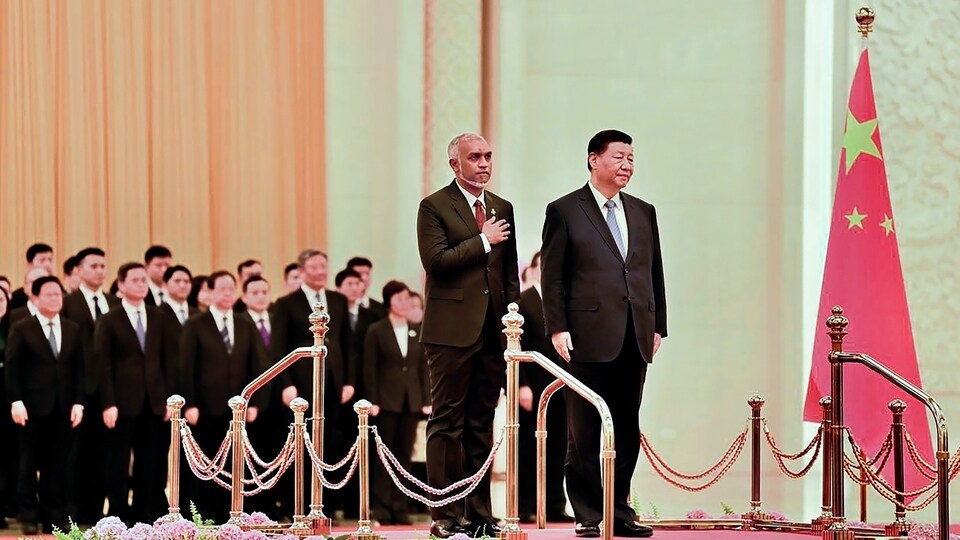
Muizzu has also openly courted China during his current visit to that country to send more investments and tourists to the Maldives, at a time when the ties between Malé and New Delhi have fallen to a new low because of a controversy over derogatory remarks made against India and its leadership by several Maldivian leaders. While Muizzu’s government has suspended three deputy ministers over these remarks, the action is unlikely to salvage the overall relationship.
At a time when concerns are growing in New Delhi over Beijing’s efforts to expand its economic and strategic footprint in the immediate neighbourhood, the actions of the government in Malé reflect the lack of importance attached to India’s worries. China has used both its economic largesse and strategic manoeuvres such as frequent forays into regional waters by surveillance vessels to challenge India in the region, adding to the tensions from the dragging military standoff on the Line of Actual Control.
India now has no option but to stay the course since any move that takes the Maldives further into China’s orbit will only add to New Delhi’s strategic and security concerns.



