Henri B Kagan and Kenso Soai have been awarded the 2026 Nobel Prize in Chemistry for solving one of chemistry's most intriguing puzzles: how can a chemical reaction produce mostly one of two mirror-image versions of a molecule?
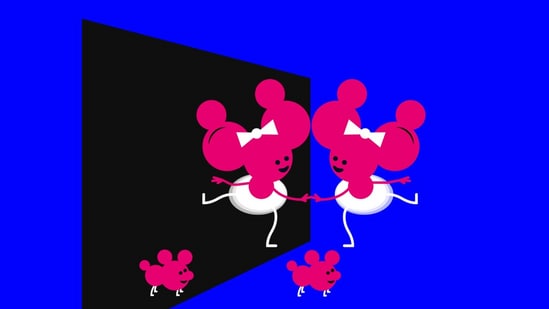
The Royal Swedish Academy of Sciences said the prize recognises their discoveries of non-linear effects and autocatalysis in asymmetric organic synthesis. In simple terms, Kagan found a way to make a chemical reaction favour one mirror-image molecule much more strongly than expected, while Soai showed how a molecule could help make more copies of itself, allowing one version to take over a reaction.
Their discoveries are important because molecules with the same atoms can sometimes exist in two forms that are mirror images of each other. These are known as enantiomers. While they may look almost identical, they can behave very differently inside the human body.
Think of molecules as left and right hands
{{/usCountry}}Their discoveries are important because molecules with the same atoms can sometimes exist in two forms that are mirror images of each other. These are known as enantiomers. While they may look almost identical, they can behave very differently inside the human body.
Think of molecules as left and right hands
{{/usCountry}}Deep Dive
What are the main discoveries of Henri Kagan and Kenso Soai that led to their Nobel Prize?
Why is the concept of homochirality important in biology and medicine?
How did Kagan's and Soai's findings impact pharmaceutical manufacturing?
The easiest way to understand the problem is to think about your hands.
Your left and right hands are mirror images of each other, but they cannot be perfectly superimposed. Some molecules have the same property. They are called chiral molecules, and their two mirror-image forms are called enantiomers.
This matters enormously in biology. The molecules that make up living organisms are largely "one-handed". For example, amino acids occur in two mirror-image forms, but proteins in our cells use only one of them. The sugars that form part of DNA similarly have a particular orientation. Scientists call this phenomenon homochirality.
The problem for chemists is that when they make a chiral molecule in the laboratory, a reaction will often produce both versions.
That can be a serious problem when making medicines. One mirror image may produce the desired therapeutic effect, while the other can have unwanted or harmful effects. The thalidomide tragedy of the 1960s was a stark demonstration of the importance of producing the correct molecular form.
The problem chemists could not solve
Chemists had known for a long time that it should theoretically be possible to make a reaction favour one mirror image.
By the early 20th century, researchers had even managed to create reactions that produced slightly more of one enantiomer than the other. Catalysts, substances that speed up chemical reactions without being consumed, could be used to influence the outcome.
But there was a deeper question: could this imbalance be amplified?
In 1953, theoretical physicist Charles Frank proposed a possible answer. He suggested that if three things happened together, a tiny initial imbalance could potentially grow dramatically.
There needed to be an asymmetric reaction, one mirror image had to be favoured over the other, and the reaction had to produce the catalyst itself. The last process is known as autocatalysis: the product effectively helps make more of itself.
Kagan and Soai provided the crucial experimental pieces needed to turn this idea into chemical reality.
Kagan discovered that a small advantage could become a big one
In the 1980s, Kagan was working on ways to make chemical reactions produce purer versions of one enantiomer, particularly for applications such as pharmaceutical manufacturing.
Chemists generally assumed that if a catalyst contained, for example, 75% of one mirror-image form and 25% of the other, the resulting product would show a similar 75:25 split.
Kagan questioned this assumption.
He realised that the metal component of a catalyst could interact with more than one chiral molecule at the same time. This meant that when both mirror-image forms were present, three combinations could be created: two molecules of the same type, or one of each.
The crucial discovery was that these three combinations did not work equally well.
The mixed combination was much less effective at driving the reaction. As a result, the catalysts containing two identical mirror-image molecules became much more influential.
The result was surprising: a relatively small imbalance in the catalyst could produce a much larger imbalance in the final product.
Kagan demonstrated this phenomenon in 1986 in three different asymmetric reactions. Chemists called it a non-linear effect because the amount of one enantiomer in the product did not simply mirror its proportion in the catalyst.
In the Nobel Foundation's example, a catalyst containing 75% of one enantiomer and 25% of the other could ultimately drive a reaction that produced about 90% of one enantiomer and only 10% of the other.
That gave chemists a powerful new way to increase the "handedness" of molecules they wanted to manufacture.
Soai took the idea one step further
Kenso Soai then asked an even more ambitious question.
What if the molecule being produced could itself act as the catalyst and help make more of the same molecule?
That would create a chemical version of a snowball effect.
Soai experimented with different molecules and eventually found one that could participate in such an autocatalytic process. In a 1995 experiment, he started with just a 2% excess of one mirror-image form. After the reaction, that excess had grown to 87%.
But Soai continued searching.
In 2003, he demonstrated a reaction in which a tiny initial imbalance could be amplified repeatedly. The molecule produced by the reaction helped produce more molecules with the same handedness.
In one experiment, after the process was repeated, more than 99.5% of the final product consisted of one enantiomer.
The remarkable part is that the reaction can start without a preference for either handedness. A tiny difference can arise by chance, and then autocatalysis amplifies that difference until one version dominates.
If the experiment is repeated, the opposite enantiomer can sometimes win instead. In other words, chance can determine which molecular "hand" gets the initial advantage, and autocatalysis then magnifies it.
Why does this matter?
The discoveries have both practical and fundamental importance.
For drug makers, producing the correct enantiomer can be critical because the two mirror-image versions of a molecule can interact differently with the human body. Kagan's discovery of non-linear effects has therefore become a useful tool for designing chemical reactions that produce purer enantiomers.
The same principles can be useful in making pharmaceuticals, flavours, fragrances, agricultural chemicals and some new materials.
But there is another, much bigger question behind the work.
Did this help explain how life became "one-handed"?
One of the great mysteries in the origins of life is why living organisms settled on one molecular orientation.
Chemistry normally produces both mirror-image forms. Yet life overwhelmingly uses one form of amino acids and particular forms of sugars.
Soai's experiment showed that it is possible for a tiny, almost accidental imbalance to become enormously amplified through autocatalysis.
His reaction is artificial and does not recreate the chemistry of early life. But it gives scientists a model for how a small initial imbalance could potentially grow into the overwhelming preference for one molecular form seen in living organisms.
Researchers are now trying to explore whether similar processes could have helped produce the homochiral amino acids and sugars associated with life.
That is ultimately why Kagan and Soai's work is so significant: Kagan showed how chemistry could amplify an existing molecular preference, while Soai demonstrated how that preference could become self-reinforcing.
Together, their discoveries provided crucial pieces of the answer to a question that has puzzled chemists for more than a century: how did chemistry become one-handed?