Satellite images have captured the transformation of Rafah from a densely populated city into a landscape marked by widespread destruction, with entire neighbourhoods reduced to rubble and large areas cleared of buildings. The images offer a stark view of the devastation in the southern Gaza city, much of which was already destroyed before the Israel-Hamas ceasefire.
From 'All eyes on Rafah' to Rafah in ruins
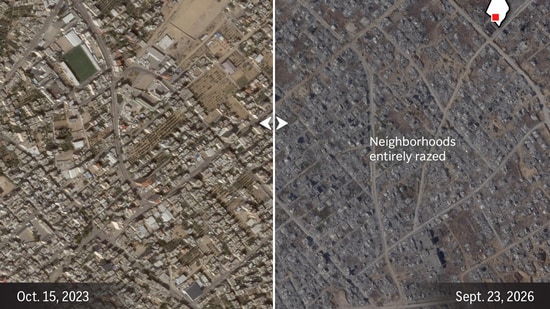
The scale of the destruction comes two years after ‘All Eyes on Rafah’ became a global social media campaign, drawing attention to the plight of Palestinians in the city that had become a refuge for hundreds of thousands of people during the war.
In 2024, users shared an AI-generated image depicting tent camps in Gaza with the tagline ‘All Eyes on Rafah’. According to the BBC, more than 47 million users posted the image on Instagram, including celebrities and influencers.
The latest satellite images show widespread destruction across Rafah and other towns and neighbourhoods, with buildings systematically demolished and, in some areas, rubble cleared away.
According to the Associated Press, demolitions using bulldozers and explosives have continued since the Israel-Hamas ceasefire agreement reached a year ago, as Israeli forces maintain control over roughly 60% of Gaza. The Israeli military says the demolitions are intended to prevent Hamas from using buildings and to destroy its tunnel networks.
Israel responsible for genocide in Gaza: UN commission
While the ceasefire has halted the largest offensives and heaviest bombardment, Israeli strikes have continued. According to Al Jazeera, 1,462 Palestinians have been killed since the ceasefire. Israel says the attacks target Hamas members, although civilians, including women and children, have also been among those killed.
In September 2025, a United Nations commission concluded that Israel had committed genocide in Gaza. Amnesty International, Human Rights Watch and the International Association of Genocide Scholars (IAGS) have also concluded that Israel’s actions in Gaza amount to genocide.
Israel and Prime Minister Benjamin Netanyahu’s government reject the genocide allegations, saying its military operations are directed at Hamas fighters and its infrastructure, which Israel says is embedded in civilian areas.
{{/usCountry}}Israel and Prime Minister Benjamin Netanyahu’s government reject the genocide allegations, saying its military operations are directed at Hamas fighters and its infrastructure, which Israel says is embedded in civilian areas.
{{/usCountry}}Gaza’s humanitarian crisis
The destruction of infrastructure is only one part of the immense toll borne by Gaza’s roughly two million Palestinians since Israel launched its military campaign following Hamas’s October 7, 2023, attack on southern Israel.
The BBC has reported on severe restrictions on the entry of humanitarian aid, food and water into the Gaza Strip, worsening the humanitarian crisis and leaving Palestinians without access to basic necessities.
More than one in 10 people from Gaza’s pre-war population has reportedly been killed or wounded, while displacement has become a reality for much of the population. With millions having lost their homes, large parts of Gaza have been transformed into densely populated areas of temporary shelters.
Tents made of canvas and nylon now cover beaches, former farmland and vacant plots, as Palestinians struggle to find shelter amid the devastation.
Rafah largely destroyed
Much of Rafah had already been destroyed before the ceasefire, but satellite images indicate that demolitions of the remaining structures have continued.
Several abandoned United Nations buildings and a municipal sports field appear to have been left standing. The sports field is reportedly now being used as a military base.
Gaza’s population is now concentrated in roughly 40% of the territory, while Israeli forces control the remainder.
(With inputs from AP)