
Papua New Guinea’s embattled prime minister stepped down on Wednesday, capping a months-long political crisis and calling a multi-billion-dollar French and US-backed gas deal into question.
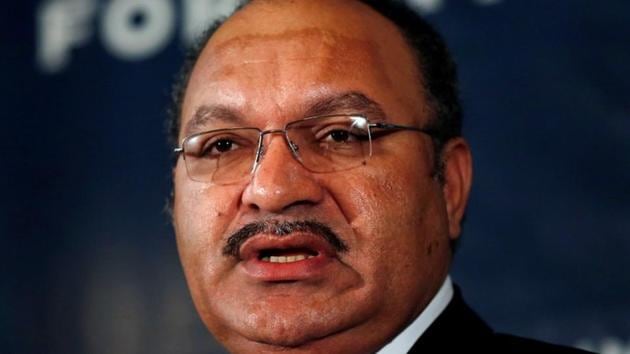
Facing a string of cabinet resignations and a vote of no confidence he looked sure to lose, veteran leader Peter O’Neill told parliament he had handed his letter of resignation to the country’s governor general.
Suggested For You
“I hereby tender my resignation as Prime Minister of the independent state of Papua New Guinea, effective immediately” read the letter that was obtained by AFP.
O’Neill said he had decided to step down “in the interests of ongoing political stability in our country” citing the need for “economic confidence and social unity.” For eight years O’Neill had led the rugged and ethnically diverse nation, which is home to over 800 languages.
But he had been heavily criticised for endemic corruption and chronic underdevelopment, in a country that has increasingly become a venue for US-China rivalry.
The government’s purchase last year of 40 Maseratis to ferry foreign dignitaries around Port Moresby’s few fully paved roads during an APEC summit became emblematic of his tenure.
But the breaking point appeared to have been a recent $13 billion deal with Total and ExxonMobil to extract, pipe and ship liquefied natural gas (LNG) overseas.
{{/usCountry}}But the breaking point appeared to have been a recent $13 billion deal with Total and ExxonMobil to extract, pipe and ship liquefied natural gas (LNG) overseas.
{{/usCountry}}The deal angered powerful regional and tribal leaders, who suggested they were not getting a fair share.
Finance minister James Marape -- from the Hela province in the highlands -- was the first to resign in protest, saying the money would not go to ordinary Papua New Guineans, local firms or the regions.
A similar deal in the last decade has failed to bring wealth to a country where only 13 percent of citizens have regular access to electricity.
O’Neill had earlier promised to resign, but subsequently took court action in a bid to cling to power, prompting physical confrontations in parliament.
But on Wednesday O’Neill finally resigned. In a valedictory speech, he touted his achievements in office, including hosting the 2018 APEC summit, a vast undertaking for a developing country with limited central government capacity.
“We have always been known for the wrong reasons,” O’Neill said.
A parliamentary vote on a new prime minister is expected to take place as soon as Thursday morning.
The fractured opposition had rallied around National Alliance Party leader Patrick Pruaitch as their alternative prime minister.
But it remains to be seen if that deal will hold, with opposition leaders set to meet later on Thursday to try and reach consensus.
Experts said O’Neill’s departure could see an end to big-ticket infrastructure projects that many believe have benefited only Port Moresby and the country’s connected elite.
“O’Neill’s departure has the potential for a wholesale shift in the policy direction taken by PNG’s government,” said Jonathan Ritchie of Melbourne’s Deakin University.
“But the suspicion of at least some informed Papua New Guinean observers is that it will result only in the rearranging of the deck chairs,” he wrote ahead of O’Neill’s departure.
Whoever takes power is likely to look again at how benefits are distributed from an LNG project that would almost double Papua New Guinea’s gas exports.
“The sticking point has been the benefit-sharing agreement with local landowners,” said Rystad Energy analyst Readul Islam.
“That’s happening regardless of the situation with the PNG prime minister,” said Islam, warning that any delay to the project could be damaging.
Papua New Guinea “is in competition with other LNG-producing countries and projects in trying to capture a possible undersupply of LNG developing in the mid-2020s,” he told AFP.
“I think all the project participants are aware that this is a race and the ones that can deliver the project quicker and lowest cost will benefit and delay will add to the cost and decrease the competitiveness of the PNG LNG exports.”
(This story has been published from a wire agency feed without modifications to the text. Only the headline has been changed.)
Explore More
ABOUT THE AUTHOR
Follow the latest breaking news, major developments and agenda-setting stories from India and around the world with the newsdesk at Hindustan Times. Operating round the clock, the desk brings together experienced editors, reporters and correspondents to deliver fast, accurate and contextual reporting across subjects that influence public policy, governance, business, society and international affairs. The HT News Desk covers politics, elections, government policies, the economy, business and markets, science and technology, the environment, law and order, infrastructure, education, climate issues and geopolitics, while closely tracking developments across states, institutions and global capitals. The team also leads coverage of major breaking news events, policy announcements, court proceedings, natural disasters, public emergencies and significant international developments. Reports published by the newsdesk are based on information gathered from reporters on the ground, official statements, government agencies, court records, regulatory filings, recognised institutions and other authoritative sources. Stories undergo editorial scrutiny and verification processes to ensure accuracy, fairness and relevance, and are updated as events evolve and additional information becomes available. Whether covering a key political decision in New Delhi, an economic policy shift affecting millions, a landmark court ruling or a major global event, the HT News Desk aims to provide readers with reliable, fact-based journalism that delivers not only the latest developments but also the context and analysis needed to understand their wider implications.