
WARSAW—Poland has one of the strongest economies in Europe, one of NATO’s highest rates of military spending and a nearly unmatched understanding of Russia’s threat to the continent. Yet the country punches below its weight on the world stage.
The reason? A divided political system that has paralyzed both sides for years and complicated Warsaw’s relationships with both President Trump and some of Europe’s biggest powers.
The divisions broke into the open late last month, when Prime Minister Donald Tusk’s
WARSAW—Poland has one of the strongest economies in Europe, one of NATO’s highest rates of military spending and a nearly unmatched understanding of Russia’s threat to the continent. Yet the country punches below its weight on the world stage.
The reason? A divided political system that has paralyzed both sides for years and complicated Warsaw’s relationships with both President Trump and some of Europe’s biggest powers.
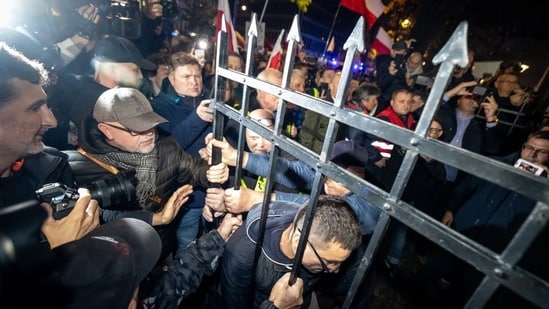
The divisions broke into the open late last month, when Prime Minister Donald Tusk’s centrist government ordered police to surround one of the country’s top judicial bodies in a new crisis point in a decadelong power struggle with its right-wing rivals. The police’s arrival triggered physical confrontations between top officials and protests that lasted late into the night.
Poland’s splintered politics are hardly unique in the West, where the U.S. and even traditional European powerhouses have succumbed to rifts between centrist and populist politicians amid sclerotic economic growth. But Poland’s divisions have persisted for decades, despite both sides sharing a common enemy in Russia and the country’s economy growing at an annual average rate of 3.6% in the past decade.
For its allies and neighbors, these splits weaken the voice of a model North Atlantic Treaty Organization member—with the largest military on the continent—as the alliance ponders both U.S.-European relations and its own fate as the war over Poland’s eastern border grinds on.
When Russia invaded Ukraine in 2022, Poland was vindicated after warning for years that a revanchist Moscow was the biggest threat to the European order. Warsaw went on to become one of the biggest early donors of military equipment that allowed Ukraine to keep fighting in the early days of the war. Millions of Ukrainians poured into the country, many of whom were given refuge there.
That hasn’t earned Poland a seat at the table with the decision makers.
Last month, senior U.S., Ukrainian and European officials convened in Oslo for high-level discussions on the war. Days later, a phone call took place between Russian President Vladimir Putin and the leaders of Norway and Finland, both of which share a border with Russia. Poland, which also shares a more than 100-mile border with Russia, was left on the sidelines.
That has left some Polish officials concerned that the country’s security interests are once again being left in the hands of Western European countries.
“The last thing we want is West Europeans dealing with Russia over the heads of the Eastern Europeans,” Foreign Minister Radoslaw Sikorski told reporters on Thursday.
The fierce rivalry between the centrist prime minister’s Civic Platform and right-wing President Karol Nawrocki, aligned with the opposition party Law and Justice, has led both sides to use foreign policy to play to their bases back home.
Tusk, who held a top European Union post a decade ago, and Sikorski have tangled with the Trump administration and its allies, including Elon Musk, who once told the Polish minister in a continuing online feud to “be quiet, small man.”
Meanwhile, Nawrocki has escalated a rift with Ukraine over the killing of Poles by Ukrainian nationalists in World War II while recently accusing Germany, the continent’s biggest economic power, of not needing Hitler to unleash anti-Polish sentiment.
“To have room for maneuvering on the national stage on Ukraine and Russia, you at least need to have open access to Kyiv and to the White House,” said Slawomir Debski, former government adviser and now a professor of international relations at the College of Europe in Natolin, Poland. “Now Tusk is unable to reach the White House. Nawrocki is unable to reach Kyiv.”
For Poland’s allies, this fissure is a missed opportunity.
“Serious people in Washington across the political spectrum laud the importance of Poland in the Alliance, the bilateral relationship, its commitment to its own defense and its contribution to trans-Atlantic security,” said Philip Bednarczyk, the German Marshall Fund’s Warsaw office director.
Trump has signaled the U.S. intends to potentially open a new base in Poland even as Washington weighs troop cuts in Germany and other countries.
Poland is at times an important player in Europe, too. It helped drive the EU toward raising more money for defense, including the creation of a 150 billion euro program, from which Poland has drawn 40 billion euros. Its economy and wealth have caught up rapidly with Western European countries since it joined the EU in 2004, and the U.K. is pushing to include Poland in the Group of 20 major economies.
But internal wrangling is damping what might otherwise be a powerful voice when the EU’s biggest powers, France and Germany, frequently disagree.
Many Poles have grown frustrated with their country’s corrosive politics. In a country steeped in its sometimes tragic history, some draw parallels to the internal divisions of the late 18th century that allowed larger European powers to partition the country.
“Now I understand how it happened,” said Maciej Kuziemski, CEO of Philanthropy for Impact. “Poland for centuries now has a history of infighting that is detrimental to its success.”
Current and former officials acknowledge that the internal fighting has damaged Poland’s influence.
“We do not seem to be able to undertake a more ambitious, and nuanced foreign policy right now,” said Tomasz Szatkowski, who was fired as Poland’s ambassador to NATO shortly after Tusk won power.
Political tensions came to a head on Oct. 30 with the mobilization of police around the Constitutional Tribunal, which rules on how laws should be applied, including how EU rules should be implemented in Poland. Nawrocki, who was flying to Africa, turned his plane around. Landing in Warsaw, he crossed through police lines into the courthouse to physically confront judges and promise to defend the tribunal leaders his party had appointed when in power.
Both sides have accused each other of attempting to stage a coup ahead of parliamentary elections next year. The confrontation comes as the country still needs to pass a budget and while Russia is stepping up its campaign of sabotage and hybrid attacks. Nawrocki is also holding up swaths of diplomatic, judicial and military appointments.
Even a shooting in Krakow on Saturday, which killed six people, quickly descended into partisan rancor, with the interior minister saying the shooter was a far-right extremist, drawing criticism from nationalist parties.
Some officials now said clashes may erupt around Poland’s Independence Day marches on Wednesday. Tusk’s justice minister, Waldemar Zurek, who has led the push to ensure the new judges elected by Poland’s parliament are able to take their seats at the Constitutional Tribunal, said he hopes Nawrocki and Tusk can reach an agreement to cool heads on both sides.
“It is absolutely damaging to Poland’s reputation if there is unrest in the country,” said Zurek.
Write to Laurence Norman at laurence.norman@wsj.com and Thomas Grove at thomas.grove@wsj.com
One Subscription.
Get 360° coverage—from daily headlines
to 100 year archives.
Archives
HT App & Website