...
...
Next Story

Political options run out for PM Oli in Nepal cliff-hanger

PM Oli appeared to have softened his past hard stance in his meeting with NCP co-chair P.K. Dahal on Friday morning but that could be part of the political tactics to buy time for himself to remain both the head of government and the party.

Updated on: Jul 18, 2020, 15:54:57 IST
Hindustan Times, New Delhi | By
Prefer HTon Google
Advertisement

Options seem to be running out for Nepal prime minister KP Sharma Oli with the high powered nine-member secretariat of the ruling Nepal Communist Party (NCP) scheduled to meet on Saturday in Kathmandu to decide the political future of the country.
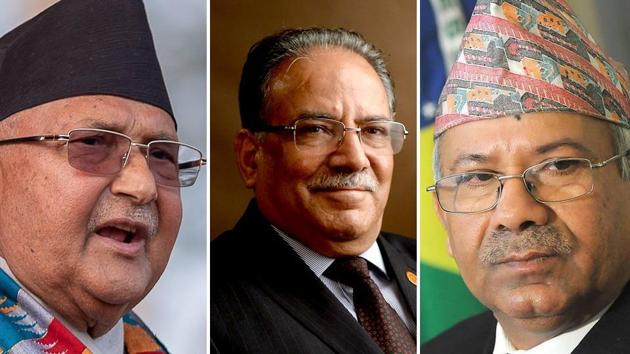
Nepal PM Oli wants Pushpa Dahal-Madhav Nepal combine to be seen as breakers of Communist Unity in Nepal and paint them as Indian agents. (REUTERS)

The meeting will be held today in Baluwatar.

According to political sources based in Nepal, Oli appeared to have softened his past hard stance in his meeting with NCP co-chair PK Dahal on Friday morning but that could be part of the political tactics to buy time for himself to remain both the head of government as well as the party.

In case the secretariat is not deferred on Saturday on grounds of Oli’s indisposition, the apex body may decide to hold the standing committee meeting on Sunday to take a decision on whether he remains either the prime minister or NCP co-chair or even lose both the posts for single-handedly playing into the hands of China and destroying bilateral relations with India.

Apart from laying territorial claims on India-Nepal border, Oli has used all tactics in the book to paint anyone opposed to him politically as an agent of India. This despite the fact that the Chinese ambassador to Nepal seems to be the master puppeteer of the Himalayan kingdom.

The political situation in Nepal seems to be fluid as none of the three principal contenders—Oli, Dahal or Madhav Nepal—want to be seen as the breakers of the NCP’s unity. This works to the advantage of Oli as this ensures that neither Dahal nor Nepal will precipitate the matters and hence the change in the power structure of Nepal will be slow.

However, as numbers count in political parties more than words or slogans, Oli is a minority in the secretariat, standing committee and the central committee as of now.

It is widely expected that the secretariat will make a decision on Oli’s continuation as the prime minister or co-chair of the NCP or both but the final decision will come through elaborate party processes.

The China model of Nepal is that the NCP remains united and individuals can be dealt with pelf and power at a later stage. The Indian model for Nepal is the people-to-people relationship with a working relationship with whosoever is in power.

Oli has done his best to break the working relationship.

 
ABOUT THE AUTHOR
Shishir Gupta

Shishir Gupta is Executive Editor at Hindustan Times and one of India's top journalists covering national security, strategic affairs, foreign policy and geopolitics. Over the past three decades, he has extensively reported on India's military, diplomatic and security landscape, covering every major conflict and national security challenge, from the 1999 Kargil War and the 2020 East Ladakh standoff to Operation Sindoor in 2025. He has also covered major terror attacks, including the IC-814 hijacking, the 26/11 Mumbai attacks and the 2025 Pahalgam terror strike, along with numerous Pakistan-backed terrorist incidents in the Kashmir Valley and across India. He has reported on national and state elections for more than three decades. A recognised authority on strategic affairs, Gupta has covered India's nuclear programme since the Pokhran-II (Shakti series) tests in May 1998 and has written extensively on global nuclear issues, Indian diplomacy and the country's expanding global outreach. He has also reported widely on international conflicts and terrorism, with a special focus on the Indian subcontinent. Gupta has interviewed Prime Minister Narendra Modi more than four times, including Modi's first interview with the print media after becoming Prime Minister in May 2014. His other interviews include three with the Dalai Lama, as well as conversations with Benjamin Netanyahu, Amit Shah, Yogi Adityanath, S. Jaishankar, Nirmala Sitharaman and Piyush Goyal. He is the author of Indian Mujahideen: The Enemy Within (Hachette, 2011) and Himalayan Face-off: Chinese Assertion and Indian Riposte (Hachette, 2014). He was awarded the Chevening-Wolfson Joint Scholarship at Wolfson College, University of Cambridge, UK, in 1998 and participated in the International Visitor Leadership Program (IVLP) of the US State Department in 2006. He received the Ben Gurion Prize from Israel in 2011 and the K. Subrahmanyam Prize for Strategic Studies in 2015 from the Manohar Parrikar Institute for Defence Studies and Analyses (MP-IDSA). Since 2024, he has hosted Point Blank, Hindustan Times' weekly YouTube show on global geopolitics.

Get the latest World News, breaking headlines and global updates from the US, UK, Pakistan, Bangladesh, Russia and other countries. Follow major international events on Hindustan Times.
SHARE THIS ARTICLE ON
Hindustantimes wants to start sending you push notifications. Click allow to subscribe