SpaceX launched the 15th test flight of Starship on Friday as part of Elon Musk's bold mission to build a fully reusable rocket system that can accelerate travel to space. However, the company faced a setback after its Super Heavy booster malfunctioned during its return journey, exploding into a fiery ball in the Gulf of Mexico.
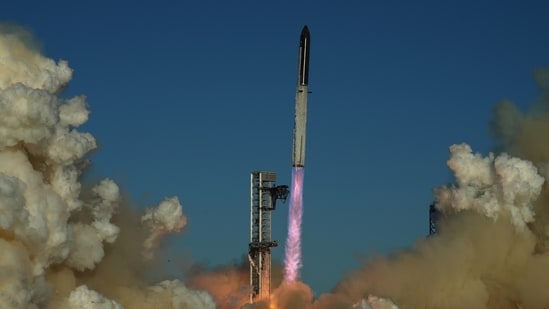
The Starship spacecraft however still reached the orbit on Friday, where it deployed 26 advanced Starlink satellites. The 236-foot spacecraft, designed as one of the world's most powerful launch vehicles, is expected to cover 15 laps around the world for a period of 22 hours before heading back to the launch site in Texas, as per the company.
The rocket contains two parts, the Super Heavy booster and the main spacecraft, called the "ship". The original goal of the Starship flight was to retrieve every single piece of the rocket for the purpose of future recycling, something which has never been achieved before. However, the first part of the double-catch failed as the company aborted the planned recovery and diverted the booster towards the Gulf of Mexico.
Also Read | Nonprofit groups sue OpenAI, Google, Anthropic, Meta and SpaceX's AI division seeking halt on AI development
What happened during the flight?
{{/usCountry}}Also Read | Nonprofit groups sue OpenAI, Google, Anthropic, Meta and SpaceX's AI division seeking halt on AI development
What happened during the flight?
{{/usCountry}}Until now, SpaceX had made three booster grabs at the company’s Starbase in Texas near the US-Mexico border, but never actually the spacecraft portion of Starship. The spacecraft of the 14 previous Starships ended up in the ocean, either by design at flight’s end or by accident in a stream of flaming wreckage.
On Friday, the 15th Starship spacecraft lifted off from Texas, aided by the Super Heavy rocket booster that fired for two minutes and 20 seconds to push it out of the Earth's atmosphere. After reaching the required altitude, the Starship spacecraft and the Super Heavy booster separated through a process of "hot staging".
The booster made its way back to the launch tower at Starbase, where two giant mechanical arms called 'Chopsticks' were supposed to catch it. However, it malfunctioned and ended up in the Gulf of Mexico after an automatic abort. The booster exploded in a massive fireball, marking an end to SpaceX's ambitious plan to catch both components of the Starship rocket.
SpaceX has not publicly commented on what went wrong with the return, but Starship V3 has faced a series of engine issues during prior test flights, according to CNN.
Starship flight continues
Despite the setback, the bullet-shaped Starship spacecraft reached orbit about 27 minutes after lift-off. As per the latest update, the spacecraft got permission from mission controllers to fire its engines and put itself on an orbital trajectory, which means it is still in good shape with no major issues.
Upon reaching orbit, Starship 15 began releasing its cargo of 26 satellites in a payload-delivery operation expected to take less than an hour to complete, SpaceX said in a livestream of the operation. Mission controllers are hoping to have better luck in steering Starship's upper stage back to home base at the end of its flight.
Also Read | SpaceX AI growth puts Nvidia and CoreWeave stocks in focus as demand for computing power rises
Musk's space and AI business views Starship as key to expanding its network of Starlink internet satellites. The last flight in September ended after roughly three hours, with an upper stage splashing down intact into the Pacific Ocean before bursting into flames.
NASA's contribution
Notably, NASA is paying SpaceX billions of dollars to land Artemis astronauts on the Moon with Starships. SpaceX has put at least $15 billion of its own funds into the rocket's development. Jeff Bezos' Blue Origin is also developing a moon lander for NASA's Artemis programme.
However, NASA and SpaceX's plans to land humans on the moon by 2028 have faced major challenges, including complex fuel transfers between Starship tanker rockets in orbit, which is expected to push the timeline back.
Congratulating SpaceX on the Starship launch, NASA Administrator Jared Isaacman said, "We are looking forward to some of that on-orbit Starlink capability on Artemis III. Tomorrow is a big day for the community, with a Vulcan launch and Starship's return on deck."
(with inputs from Reuters, AP)