
China strongly criticised on Monday United States ambassador to India Richard Verma’s visit to Arunachal Pradesh last week, asking Washington to stop its attempt to “sabotage” the ongoing Sino-India talks on the festering boundary problem.
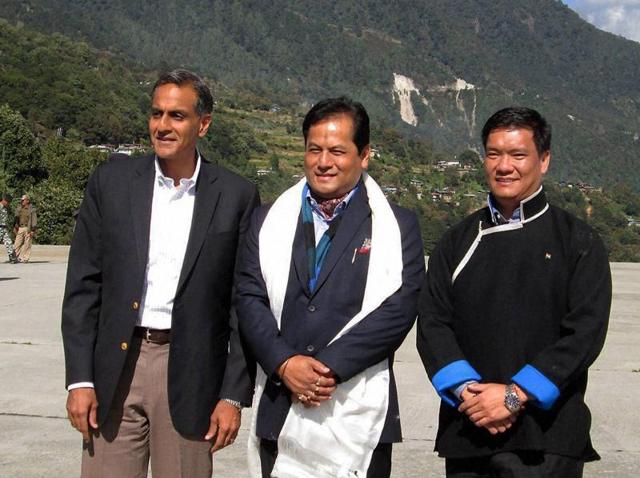
Verma visited Tawang for an annual festival and later tweeted a photograph with chief minister Pema Khandu. China claims Arunachal Pradesh as south Tibet and says it is “disputed” territory and part of the nearly 4,000 km border problem.
Suggested For You
The ministry of foreign affairs (MFA) was quick to criticise Verma’s visit – as it has done in the past following visits to Arunachal Pradesh by Prime Minister Narendra Modi, besides other Indian politicians and foreign diplomats.
“We are firmly opposed to visit to disputed area between India and China,” Lu Kang, MFA spokesperson, said at the regular presser on Monday when asked to comment on the visit.
“China’s position on eastern section is clear and consistent. The two countries are now trying to resolve territorial disputes through negotiations and consultations,” he said.
Lu used strong words to describe Verma’ visit to the northeastern state. He called it irresponsible and an attempt to sabotage the decades-long talks between India and China to resolve the problem.
{{/usCountry}}Lu used strong words to describe Verma’ visit to the northeastern state. He called it irresponsible and an attempt to sabotage the decades-long talks between India and China to resolve the problem.
{{/usCountry}}Third parties, he said, should not interfere in the matter.
“Any third party sense of responsibility should respect efforts made by China and India for peace reconciliation and tranquility rather than the opposite,” Lu said.
“The behaviour of the US runs contrary to efforts by China and India. It will only make the dispute more complicated, disturb peace and tranquility of border areas and sabotage peaceful development of region,” the MFA spokesperson said.
“We urge the US to stop interference in the boundary issue between China and India and make more commitment to regional peace and stability,” he said.
“The boundary question between China and India is very complex and sensitive. Interference by a third party will only stir up or heighten tension. At the end of the day only the peoples of the two countries will fall victim,” the Chinese official said.
“We believe India and China have the wisdom to properly handle dispute,” Lu said.
China’s reaction to Verma’s visit would have been expected by the Indian government.
Beijing could have well interpreted the visit as Washington’s support for India in the dispute – especially in context of China’s growing close ties with the Philippines.
Earlier this year, China had reacted sharply after Craig L Hall, US consul general in Kolkata, had said that Washington considers Arunachal Pradesh an integral part of India.
“China and India are wise and capable enough to deal with their own issue and safeguard the fundamental and long-term interests of the two peoples. The intervention of any third party will only complicate the issue and is highly irresponsible,” the MFA had said in its reaction then.
In February, 2015, China had issued a strong statement after Modi visited Arunachal Pradesh.
It said there was “huge controversy” in the eastern border region between the two countries.
“China on Friday lodged strong representation with India to express diametrical opposition to Prime Minister Narendra Modi’s visit to a disputed zone along the China-India borders,” ministry spokesperson, Hua Chunying had said in the statement in February, 2015.
“…the act of the Indian side is not conducive to properly resolving and controlling disputes between the two sides, nor in conformity with the general situation of growth of bilateral relations,” Hua had said.
Explore More
ABOUT THE AUTHOR
Follow the latest breaking news, major developments and agenda-setting stories from India and around the world with the newsdesk at Hindustan Times. Operating round the clock, the desk brings together experienced editors, reporters and correspondents to deliver fast, accurate and contextual reporting across subjects that influence public policy, governance, business, society and international affairs. The HT News Desk covers politics, elections, government policies, the economy, business and markets, science and technology, the environment, law and order, infrastructure, education, climate issues and geopolitics, while closely tracking developments across states, institutions and global capitals. The team also leads coverage of major breaking news events, policy announcements, court proceedings, natural disasters, public emergencies and significant international developments. Reports published by the newsdesk are based on information gathered from reporters on the ground, official statements, government agencies, court records, regulatory filings, recognised institutions and other authoritative sources. Stories undergo editorial scrutiny and verification processes to ensure accuracy, fairness and relevance, and are updated as events evolve and additional information becomes available. Whether covering a key political decision in New Delhi, an economic policy shift affecting millions, a landmark court ruling or a major global event, the HT News Desk aims to provide readers with reliable, fact-based journalism that delivers not only the latest developments but also the context and analysis needed to understand their wider implications.