AT ALMOST EVERY UN climate conference there comes a moment when the negotiators portray themselves as too far apart to agree on a final text. And at almost every conference they proceed to reach that agreement. On the former count COP31, the meeting which began on November 9th in Antalya, Turkey, played true to form. On the latter, it broke with tradition. On the afternoon of Sunday November 22nd, 48 hours after discussions were meant to have come to an
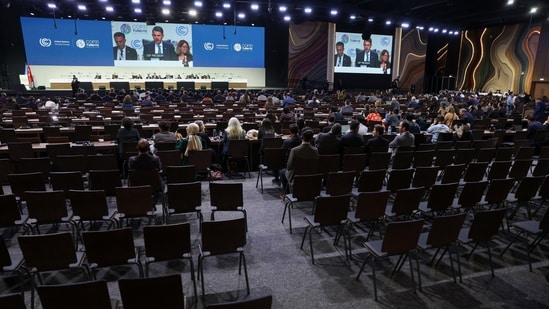
AT ALMOST EVERY UN climate conference there comes a moment when the negotiators portray themselves as too far apart to agree on a final text. And at almost every conference they proceed to reach that agreement. On the former count COP31, the meeting which began on November 9th in Antalya, Turkey, played true to form. On the latter, it broke with tradition. On the afternoon of Sunday November 22nd, 48 hours after discussions were meant to have come to an end, positions in the final plenary proved still too far apart for reconciliation. The conference collapsed ignominiously, with large parts of its business left unachieved.
The finger-pointing began after the European Union rejected the proposed “cover text”, the overarching document laying out the decisions made at the summit, in the final plenary, just minutes before it would ordinarily be gavelled through. Dozens of other countries then followed suit. Shortly afterwards, Murat Kurum, Turkey’s environment minister and the conference’s president, walked out, informing the press that there would be no attempt to produce any further text.
Suggested For You
When proceedings eventually resumed, it was with an unusually frank acknowledgement that the failure was structural rather than something peculiar to this meeting, with its particular chairs, negotiators and circumstances . “We must evolve”, Simon Stiell, executive secretary of the UN Framework Convention on Climate Change (UNFCCC), told the crowd. But what that evolution might feasibly look like is hard to say.
Deep Dive
Why did COP31 fail to adopt its cover decision?
What climate issues were left unresolved after COP31?
When will countries return to discuss the unresolved COP31 issues?
COPs are “conferences of the parties” to the UNFCCC, an agreement on climate change which was signed in Rio in 1992. In 2015, at COP21—a mere two decades on—those parties finally managed to put together a process by which the convention’s overarching goal of stabilising greenhouse-gas effects on the climate could be put into practice.
In the ten years since then, the main business of the roughly annual COPs has been to realise and build on the procedures of that Paris agreement and to provide a high-profile forum at which countries that want to see more done on climate can try to pull forward the positions of those that are less keen.
There was delight among the pullers-forward three years ago when the final statement from COP28, held in Dubai, endorsed the need for “transitioning away from fossil fuels in energy systems, in a just, orderly and equitable manner”. This weak tea was, remarkably, the first explicit reference to moving away from fossil fuels in any such statement.
Last year, in Belém, a small city in Amazonia, the forces of fossil reaction, with India in the forefront, managed to bowdlerise away any repetition of Dubai’s forthrightness. This year Saudi Arabia, Russia and others pressed for a similar silence, and got their way—the final text of what was to have been the “Antalya pact” avoided any mention of transition from fossil fuels. At the same time it included bullish language on scaling up technology for “carbon capture and storage”. As this is designed to capture and sequester specifically the carbon dioxide given off through combustion it is an approach seen by many climate-vulnerable countries as a fig-leaf for continued fossil-fuel use.
Darragh O’Brien, Ireland’s climate minister and the EU’s representative at the COP, declared the fossil-fuel-free text “unconscionable” and said the EU would not accept “negotiating backwards in time”. Britain, Belize, Fiji, the Marshall Islands, Norway, Panama, Vanuatu and others agreed. And so things fell apart.
The dying conference did manage to adopt some of the decisions that had been mandated for it by previous meetings and the Paris agreement—like developing a programme to stop poorer countries’ development being curtailed by the expense and difficulty of shifting to renewable energy. But others, including measures meant to help countries cut their carbon emissions more quickly, were, at best, kicked down the road.
The row over the f— f— words seems, on the face of it, absurd. And so it is. But it is also a symptom of a much deeper malaise. The political declarations made at the closing of COPs have been taking on a performative importance precisely because the actual achievements on offer are so scant. Paul Watkinson, a former EU negotiator, sees the trend towards broad headline commitments being regarded as the most important outcome of each conference as an understandable reaction to the rapidly worsening impacts of climate change.
At COP31 that workaround finally broke down, messily and in public. This year’s temperature is likely to stand at something like 1.6ºC above the pre-industrial norm. The warming effects of the current El Niño event have boosted that figure, but even taking that into account the world is swiftly moving past the 1.5ºC of warming which it promised to try and prevent at Paris—and doing so sooner than most had expected. As a global response to this enormity the sclerotic process of specifying rules for implementing the Paris agreement feels profoundly unsatisfactory. But building a consensus around pledges to do anything more seems to have become impossible.
One Subscription.
Get 360° coverage—from daily headlines
to 100 year archives.
Archives
HT App & Website