
Anthony Bozza told a room full of Wall Street titans that they were playing with fire.
A value investor who runs Lakewood Capital Management, Bozza was on hand in Miami Nov. 5 for Morgan Stanley’s annual conference for its top trading clients. This year’s event—other attendees included Dan Loeb, David Einhorn and Mala Gaonkar—was happening in the wake of a “Blue Wave” election that had rattled the AI industry.
In a morning session, Bozza drew attention to how investors had piled into the same, highly concentrated AI trades. He asked organizers to put up a Morgan Stanley slide showing that this summer, net exposure by the bank’s hedge fund clients in AI hardware stocks accounted for roughly 40% of their portfolios, although the portion has been lower more recently.
Deep Dive
Why has the AI trade become more volatile for investors?
How could Nvidia pulling back its financial support affect AI startups?
Why is Anthropic’s IPO being watched as a test of the AI market?
“It is absolutely unbelievable that the sum total of hedge funds all decided to chase the exact same thing,” Bozza said, according to a person in attendance at the closed-door event, adding that sophisticated hedge funds should have differentiated portfolios and performance. “Right or wrong, this should not happen.”
Bozza was met with silence. By the market’s close that day, his warning seemed prescient. Investors in tech stocks had run for the exits. That day, some $2.5 trillion in market value was erased in the Nasdaq’s worst session in almost two years—one of several wild swings that has rocked Wall Street’s “AI trade” in the past several weeks.
{{/usCountry}}Bozza was met with silence. By the market’s close that day, his warning seemed prescient. Investors in tech stocks had run for the exits. That day, some $2.5 trillion in market value was erased in the Nasdaq’s worst session in almost two years—one of several wild swings that has rocked Wall Street’s “AI trade” in the past several weeks.
{{/usCountry}}For three years, investors have minted money from the AI boom without having to make hard choices. Nearly every stock tied to what is projected to be the largest infrastructure spending spree in U.S. history zoomed higher, from chip makers to power companies to obscure equipment makers to cloud-computing companies of all sizes.
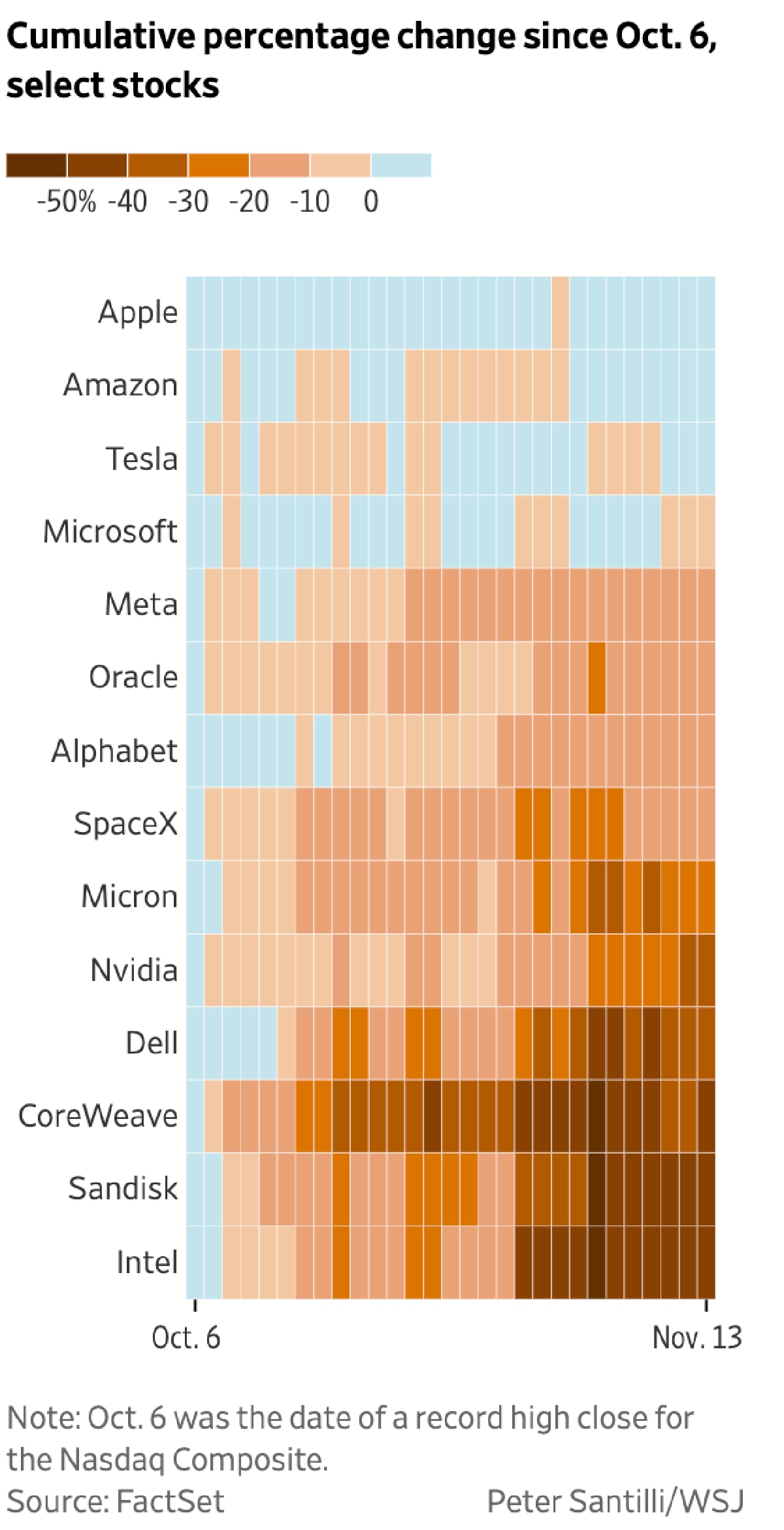
That “no-brainer” era is over. A punishing bout of volatility stretching back to the Nasdaq’s recent peak on Oct. 6, through the election’s aftermath and Jensen Huang’s stunning exit as CEO of Nvidia, has fundamentally rewired the AI trade.
The lesson for investors from the weeks of turbulence and anxiety is that they can no longer count on juicy returns from broad-based AI bets. Instead, they must size up winners and losers and look around corners to spot the risks that can trigger an avalanche of selling.
The AI trade is vulnerable from a dizzying number of angles. Rising interest rates threaten overextended borrowers. The payoff from vast amounts of capital spending, plus trillions of dollars of off-balance-sheet commitments, is still hazy or could be far off. China’s low-cost alternative AI products could undercut U.S. champions. The country’s blue turn—especially in Texas—could mean delays, or worse, in big data-center projects. And, as Bozza warned, the crowding of hedge funds into the same bets is itself proving to be a risk, especially on days when they all sell at once.
“I don’t remember puzzling over uncertainties of this magnitude in my days analyzing the conglomerates in the 1970s, or in connection with the internet and e-commerce in 1999-2000,” investor Howard Marks of Oaktree Capital Management wrote in a memo to clients last week. “Those businesses, as novel and complex as they were, seem simple and straightforward compared to AI.”
The unpredictable and sometimes violent nature of the movements in markets—stocks notched gains last week after the postelection rout——has vexed traders. Almost any bit of news can be a trigger. Anthropic’s IPO, set for this week, could be a major turning point.
Investors knew that any major disturbance at chip maker Nvidia, which is at the very center of the universe in AI, could have ramifications across the sector. Such a jolt arrived last week when Huang resigned, following revelations of his romantic entanglements, including with a suspected Chinese spy. Nvidia has lost $573 billion in market value over the past week, the largest weekly market-cap decline for any company on record, according to Dow Jones Market Data.
While shares of tech giants bankrolling the AI boom have pulled back, some of the suppliers building its backbone—chip makers and specialized cloud providers—have been punished the most by investors.
The thinking is that in a slowdown, big tech companies still have plenty of capacity to make money off their existing models, but suppliers’ immediate revenues would be hit. Some of the bigger tech companies are also less sensitive to borrowing costs and have more diversified business models.
Shares of chip maker Micron have fallen 12% this month, while Nvidia has dropped 20%. CoreWeave, a key customer of Nvidia, has shed 3.2% and has lost around a quarter of its value this year, while AI cloud company Nebius is down 25%. Dell Technologies, which delivers the powerful supercomputers that tech giants can’t get enough of, has dropped 19%.
But as worried as Wall Street’s fund managers are about what comes next, few are willing to sit entirely on the sidelines, betting AI stocks will climb over the long run, traders and investors said.
‘One Big Trade’
At Goldman Sachs, researchers referred to Wall Street’s AI fever as “One Big Trade.” It wasn’t just that every major investor was betting on sectors with proximity to AI, but that many were buying the exact same stocks. Of the 12 stocks Goldman added to a list of popular hedge-fund holdings in May, seven were AI infrastructure companies.
Almost 85% of the excess returns generated by stock picking hedge funds in the first half of the year was driven by AI-related positions, according to Goldman’s prime-brokerage division. There were major selloffs—including one that nearly put Leopold Aschenbrenner’s Situational Awareness out of business over the summer—but the market kept rolling to new records.
Paul Britton, the founder of asset manager Capstone Investment Advisors, said he had been growing uneasy about the lockstep rally in tech and AI shares for months. Around six weeks ago, he had lunch with the chief executive of a U.S. investment bank, who said he was concerned about the runaway borrowing by big tech companies for AI-related spending, even in the face of rising borrowing costs.
The AI trade, Britton said he thought, might have some significant cracks—and violent market swings could be coming.
Britton, who oversees nearly $15 billion at Capstone, had doubled down on the so-called dispersion trade. It’s a wager that pays off when individual stocks in an index are significantly more volatile than the index overall. These strategies often profit when individual stocks are going haywire.
“You could be in a position where companies that were worth hundreds of billions of dollars could be zeros,” Britton said.
On Oct. 8, some of the first signs of looming trouble emerged. Traders latched onto a report in the Financial Times that OpenAI’s annualized revenue projection was $20 billion below what some investors had expected, weighing on the tech-heavy Nasdaq.
Jitters also started showing up in the debt market. Fears of higher borrowing costs, combined with the idea that capital in AI was becoming scarce, started to take a big toll on AI stocks.
After AI-related companies issued $13 billion in high-yield bonds in September, that market essentially shut. Some investors were even starting to price in a higher chance of default, sending credit-default swap spreads, or the cost of insurance against default, tied to hyperscalers—the enormous tech companies that operate networks of data centers—to levels in October that were the highest on record, according to bond data provider Solve.
With AI companies borrowing heaps of cash in every way possible for their mega projects, money managers started dumping bonds in companies they deemed risky, including CoreWeave, and a vicious cycle of selling was set in motion.
By Oct. 15, a CoreWeave bond due in 2031 traded at a yield more than 10 percentage points higher than that of comparable Treasurys, breaching the symbolic level where traders start considering a bond “distressed.”
“Your risk manager taps you on the shoulder and says we’ve lost enough, we can’t lose anymore,” said John Sheehan, a portfolio manager at asset manager Osterweis Capital Management.
The following week, at a closed-door event in Tribeca for an audience of Wall Street A-listers, legendary investor Stan Druckenmiller debated with hedge-fund manager Paul Tudor Jones about whether AI was a bubble. Druckenmiller said his firm, Duquesne Family Office, had been investing in the AI theme since 2022, and he believed it was one of the biggest technological shifts ever, not a bubble, people in attendance said.
But he also sounded notes of caution about the cyclicality of the AI trade and noted his fund had trimmed its AI exposure, according to the people in attendance. Nvidia, Druckenmiller said, was “overearning” in ways that would end, suggesting its sky-high profit margins would come under pressure and its competitors would gain market share.
He also said lenders and investors might not pony up the cash required to build all the data-center capacity that companies like SpaceX are forecasting, given the market skepticism toward other recent AI capital raises.
Meanwhile, AI could worsen wealth inequality by further enriching tech executives. “We’re small fries in the billionaires club now,” he said, noting the staggering fortunes of the AI elite.
Jones, for his part, pointed out that Nvidia’s market value as a share of GDP exceeded that of Standard Oil and AT&T at their peaks. When those companies’ valuations reached a similar threshold, it marked market tops.
Tough October
Few were more bullish on AI than Ben Hoskin. The 30-something Oxford University graduate and his partner, David Field, had launched an AI-focused hedge fund at their firm, Value Aligned Research Advisors, amassing around $10 billion in a year and a half while posting gains of about 260% since inception. They say they try to identify companies that will be transformed by AI.
A rumor had been circulating in the market—amplified on social media by “pharma bro” Martin Shkreli—that VARA was blowing up.
Against that backdrop, Hoskin in late October pitched an elite group of investors at the Montage Palmetto Bluff resort in South Carolina, including representatives for several dozen of the wealthiest families in the world. To some in attendance, he seemed unfazed. He told the crowd that VARA was up 68% for the year through the prior month, according to people present.
Before long, the picture had changed markedly. Fears about Meta’s spending spree and the state of Alphabet’s core business sent tech stocks reeling. VARA informed clients that its hedge fund had lost nearly 33% in October, dragging its year-to-date gains down to around 13%.
Tech-focused hedge funds as a group were down 12.6% for the month of October, according to Goldman.
In contrast, Bozza’s Lakewood favors companies with predictable cash flows; its biggest positions include a European home-alarm company and an industrial coatings company. It also shorts companies and typically steers clear of hot investing themes such as AI.
Being on the sidelines meant he had missed out on the huge returns some rivals enjoyed in recent years. But his strategy meant he fared better amid the recent turmoil. Lakewood told clients it was up 4% in October and a double-digit percentage for the year.
Political landscape
Hedge funds widely were betting against the market heading into the election on Nov. 3, in anticipation of Democratic victories, traders said. Many candidates campaigned on fighting the spread of data centers, and the Democratic landslide put the fast pace of their growth in question.
Hedge-fund manager Brad Gerstner spent election night at the San Francisco Opera House alongside Nvidia’s Huang and other AI luminaries to watch Mozart’s “The Marriage of Figaro.” Gerstner had been wary about the state of the AI trade. After riding memory and semiconductor stocks to big gains, he believed the market had overshot.
His firm, Altimeter Capital Management, exited its position in CoreWeave and reduced its holdings of other AI stocks in the preceding months. He cited postelection risks such as potential new regulation, electricity and supply chain issues, and higher borrowing costs for data centers and other projects as challenges for the AI infrastructure trade.
Stock futures fell sharply upon the election results but quickly snapped back. They have risen last week after the Nov. 5 tech selloff.
James Van Geelen, 34, launched his popular Substack Citrini Research in 2023 and has made some bold calls on AI. On Nov. 4, in the election’s aftermath, he completely rejiggered his widely followed model portfolio and said the hope-fueled rally propelling everything from AI hardware stocks to semiconductors and data centers over the past three years was over. In an interview last week, he said there’s “no way the AI trade is over,” but rather “it’s just going to become a different trade.”
Spotting opportunities
Despite the percolating problems through October, traders said they were surprised by the magnitude of the tech-stock rout two days after the election.
One hedge-fund manager, wiped out from the frenetic market activity that day, said he blew off a dinner and took an Ambien to help him sleep and recover for the next day’s trading session. He said he has added some hedges but retains a focus on AI.
Many other investors aren’t calling it quits on the AI trade either. Individual investors poured money into Nvidia shares on Tuesday, even as pressure grew on the company amid Huang’s troubles. The stock sank, but it was the second-highest buying day among individual investors on record, according to Vanda Research.
Mitchell Green, the founder of investment firm Lead Edge Capital, had been calling the AI boom a bubble for months. Yet when the market plunged after the election, Green—who counts Steve Cohen among investors in his funds—sensed opportunity.
Toward the end of a wild week, he shot off an email to his team to look at buying stocks such as Micron and other AI firms.
“When everybody wants to sell something, we should look at it,” Green said.
Write to Juliet Chung at Juliet.Chung@wsj.com, Peter Rudegeair at peter.rudegeair@wsj.com and Gunjan Banerji at gunjan.banerji@wsj.com