
The Trump administration has said the United States will withhold $255 million in military aid to Pakistan as it expects Islamabad to take decisive action “against terrorists and militants on its soil”.
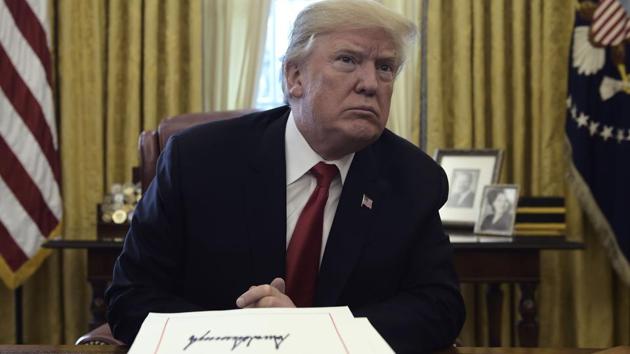
The announcement on Friday reflected the US’s disillusionment with Pakistan for disregarding explicit warnings by President Donald Trump and his members of his team such as secretaries James Mattis and Rex Tillerson.
Suggested For You
“The United States does not plan to spend the $255 million in FY 2016 in Foreign Military Financing for Pakistan at this time,” said a spokesperson of the US President’s National Security Council in a statement to Hindustan Times.
“The President has made clear that the United States expects Pakistan to take decisive action against terrorists and militants on its soil, and that Pakistan’s actions in support of the South Asia strategy will ultimately determine the trajectory of our relationship, including future security assistance.
“The Administration continues to review Pakistan’s level of cooperation.”
The withheld aid amount is left over from the $1.1-billion US aid earmarked for Pakistan in 2016, and which included non-military assistance. It was cleared for release in August, just days before it would lapse as unspent money.
{{/usCountry}}The withheld aid amount is left over from the $1.1-billion US aid earmarked for Pakistan in 2016, and which included non-military assistance. It was cleared for release in August, just days before it would lapse as unspent money.
{{/usCountry}}“This could be the severest blow dealt to Islamabad by this administration if it indeed decided to withhold,” said a leading US expert on Pakistan who did not want to be identified. “There is more coming,” the expert added.
First reported by The New York Times, the move to withhold the money, which may not be a large amount but would have signalled US backing, comes shortly after Pakistan refused to hand over to the Americans an operative of the Haqqani Network apprehended during the rescue of an American-Canadian family in October.
The Haqqani Network is an affiliate of the Afghan Taliban and works out of Pakistan, inflicting massive casualties on the US-led international coalition in Afghanistan. Frustrated by Islamabad’s reluctance, the US has tied large portions of military aid payments to Pakistan to its actions aimed at debilitating the network.
The Trump administration has been clear from the start it wouldn’t continue its aid to Pakistan without real changes. “We have been paying Pakistan billions and billions of dollars at the same time they are housing the very terrorists that we are fighting,” Trump had said unveiling his new South Asia strategy in August. “But that will have to change, and that will change immediately.”
But there was no marked change in Pakistan’s behaviour, top US military commander General John Nicholson said in November, three months after Trump’s unequivocal warning.
Instead, Pakistan released Lashkar-e-Taiba founder Hafiz Saeed from house arrest, which led an outraged White House to use unusually harsh language to demand Saeed’s re-arrest, warning that it could have “repercussions” for bilateral ties.
Saeed remains free, and Pakistani officials have sought to shift the blame for it on the independence of the country’s judiciary.
Pakistan also sought to blame India for providing insufficient evidence in connection with the 2008 Mumbai terror attacks carried out by Saeed’s Lashkar-e-Taiba. There is a US bounty of $10 million for his arrest.
Denial of aid, many critics of Pakistan argue, is unlikely to have an impact on Islamabad, and call for harsher measures. They say that stripping Pakistan of the status of a non-NATO ally, for one, could cost it military aid in terms of money and equipment. Even more punishing, they contend, would be to declare Pakistan a state sponsor of terrorism, such as Syria and North Korea.
That’s the impending “more” indicated by the South Asia expert.
Explore More
ABOUT THE AUTHOR
Follow the latest breaking news, major developments and agenda-setting stories from India and around the world with the newsdesk at Hindustan Times. Operating round the clock, the desk brings together experienced editors, reporters and correspondents to deliver fast, accurate and contextual reporting across subjects that influence public policy, governance, business, society and international affairs. The HT News Desk covers politics, elections, government policies, the economy, business and markets, science and technology, the environment, law and order, infrastructure, education, climate issues and geopolitics, while closely tracking developments across states, institutions and global capitals. The team also leads coverage of major breaking news events, policy announcements, court proceedings, natural disasters, public emergencies and significant international developments. Reports published by the newsdesk are based on information gathered from reporters on the ground, official statements, government agencies, court records, regulatory filings, recognised institutions and other authoritative sources. Stories undergo editorial scrutiny and verification processes to ensure accuracy, fairness and relevance, and are updated as events evolve and additional information becomes available. Whether covering a key political decision in New Delhi, an economic policy shift affecting millions, a landmark court ruling or a major global event, the HT News Desk aims to provide readers with reliable, fact-based journalism that delivers not only the latest developments but also the context and analysis needed to understand their wider implications.