
 E-Paper



Trump-Putin Summit Ends Without Breakthrough
“There’s no deal until there is a deal,” President Trump told reporters following his meeting with the Russian leader in Alaska.


ANCHORAGE, Alaska—President Trump and Russian leader Vladimir Putin ended their highly anticipated meeting here without announcing a breakthrough, leaving the path toward ending the war in Ukraine unclear.
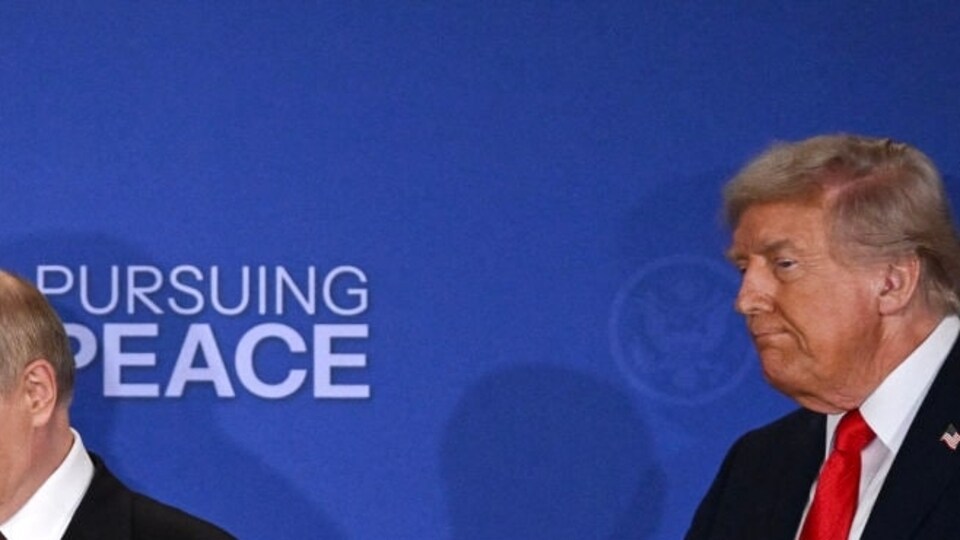
At the end of the over three-hour meeting, the two men offered few details about their talks. “There’s no deal until there is a deal,” Trump told reporters at a news conference following the close of the summit. The typically talkative U.S. president took no questions from the dozens of reporters assembled before him. The president said the delegations made progress on key issues, but added, “We haven’t quite got there.”
Trump said he would call members of the North Atlantic Treaty Organization and Ukrainian President Volodymyr Zelensky. “We will probably see you again very soon,” Trump told Putin. The Russian president interjected and offered that their next meeting could take place in Moscow. Trump responded, “I can see it possibly happening.”
Trump had come into the summit seeking Putin’s agreement on a cease-fire in Ukraine. But Putin in his remarks gave no indication he was prepared to agree to that demand, repeating that Moscow wanted the root causes of the 3½ year conflict addressed—a term that refers to Moscow’s demands for demilitarizing Kyiv and blocking its hopes for membership in NATO.
In contrast to the handshakes and smiles that characterized the start of their meeting on the tarmac on Joint Base Elmendorf-Richardson, Putin and Trump looked stone-faced during much of the news conference. Putin spoke for roughly eight minutes. Trump then spoke for three minutes, before leaving the room.
Even before the meeting officially began, Putin, who has been sanctioned by the U.S. and largely snubbed on the world stage, racked up a series of symbolic wins.
Trump waited onboard Air Force One for 30 minutes before the Russian president’s plane touched down. The U.S. president greeted his Russian counterpart warmly, applauding as he walked down a red carpet and shook his hand. After posing for photos, both men got into the U.S. president’s armored limousine, known as the Beast, giving Putin the one-on-one time with Trump that some of the American president’s advisers sought to avoid.
Photographers caught the Russian leader smiling as he sat next to Trump in the limo. While it isn’t unusual for an American president to invite a foreign leader for an intimate ride in the president’s motorcade, the privilege comes after Putin has repeatedly thumbed his nose at Trump’s repeated calls to stop the violence in Ukraine.
Trump’s earlier reception of Putin was markedly different from the way the U.S. president treated Zelensky during a February visit to the Oval Office. Trump and Vice President JD Vance berated the Ukrainian president for not, in their view, showing sufficient gratitude for U.S. support in the war with Russia. Relations between Trump and Zelensky have subsequently improved.
But Trump, a former reality-television star who focuses intently on stage-managing his public events, also sent a message to Putin about America’s military might. Trump and Putin walked down a red carpet flanked on either side by F-22 stealth fighters and, as the two leaders stepped onto a riser with the words “ALASKA 2025,” a nuclear-capable B-2 bomber and four F-35 jet fighters roared overhead. As the meeting was in progress, Russian military forces launched new attacks targeting Ukraine’s eastern regions, according to the Ukrainian air force.
Securing a face-to-face meeting with Trump is a win for Putin, analysts said. The fact that the meeting took place in Alaska, which Russia sold to the U.S. in 1867, is an bonus for the Russian leader.
It’s “a Russian revisionist dream come true,” said Celeste Wallander, a senior Pentagon official in the Biden administration.
The Russian Foreign Ministry’s spokeswoman Maria Zakharova wrote on Telegram that the meeting signaled to the media a shift in relations between Moscow and Washington. “For three years, they have been reporting that Russia is in isolation, and today they saw the red carpet, laid to greet the Russian president in the United States,” she wrote.
Trump has expressed frustration with Putin in recent months after once claiming his strong relationship with the Russian president could lead to a resolution of the war in just a day.
In the days leading up to the summit, Trump played down the prospects for a breakthrough, calling his first face-to-face meeting with Putin in six years a “feel-out meeting.” He didn’t rule out the possibility the talks could fail and he said he was prepared to walk away entirely if Putin refused to work toward peace.
Trump said he hoped Friday’s meeting would lay the groundwork for a second meeting in the near future in which Putin would negotiate directly with Zelensky toward a cease-fire. But in the hours before the summit, Trump upped the stakes, telling Fox News that he wouldn’t be happy if Putin didn’t agree to a cease-fire at the meeting.
The summit was initially set to begin with a one-on-one meeting between Trump and Putin, but it was expanded to include top advisers from each delegation at the U.S. president’s request. Trump, Secretary of State Marco Rubio and special envoy Steve Witkoff represented the American delegation, while Putin was joined by Yuri Ushakov, his longtime foreign-policy adviser, and Foreign Minister Sergei Lavrov.
While Trump and Putin have spoken several times in the last six months, the meeting in Anchorage was the first time they met in person since the Group of 20 summit in Osaka, Japan, in 2019.
Russian officials indicated that Putin wanted to push a spectrum of bilateral issues onto the negotiating table, likely in an attempt to water down talks about Ukraine, decouple the conflict from U.S.-Russia ties and avoid the threat of sanctions from the Trump White House.
The absence of any binding steps for the Russian side to follow out of the meeting could give Putin a chance to continue prosecuting his war in Ukraine, where Russian troops are gaining crucial footholds in eastern Ukraine, while avoiding any new sanctions on Russian oil.
Putin’s broader goal of trying to put Russia on an equal footing with the U.S., however, was already achieved just by clinching the meeting, particularly on U.S. territory.
“This meeting elevates Russia in some ways to an equal status to the United States, which is what he has craved,” said Heather Conley, a senior fellow at the American Enterprise Institute and a former top State Department official on European affairs.
Kremlin loyal media had suggested the meeting would carry echoes of the 1945 Yalta Conference in which the U.S. and the Soviet Union managed to carve up Europe into spheres of influence, a scenario Putin would be eager to repeat with Trump.
Putin is unlikely to be deterred from his ultimate goal of conquering Ukraine militarily or politically to re-establish the Russian sphere of influence in Europe which Moscow lost with the collapse of the Soviet Union.
“Putin is primarily carrying out this war to end the post Cold War order, that is to return Russia to its place as a great power in the classic sense, with its sphere of influence and the right to establish its own conditions there,” said Ruslan Pukhov, founder of Moscow-based defense think tank Center for the Analysis of Strategies and Technologies.
Conflict negotiation is usually a drawn-out process that involves detailed timetables, confidence-building measures and verification over months and years. But little of that is expected to be hammered out in a matter of several hours, leaving the rapid cease-fire agreement that Trump wants an open question.
“The big question is whether any of this is enough for Trump,” said Samuel Charap, a veteran Russia watcher and senior political scientist at Rand Corporation. “He wants an immediate cease-fire, and that’s highly unlikely.”
Write to Lara Seligman at lara.seligman@wsj.com, Meridith McGraw at Meridith.McGraw@WSJ.com and Thomas Grove at thomas.grove@wsj.com


