Ohio Governor-elect Amy Acton has ruled out any conversation with her defeated Republican rival, Vivek Ramaswamy, following a bitter election campaign marked by controversy over a personal attack advertisement involving her estranged mother.
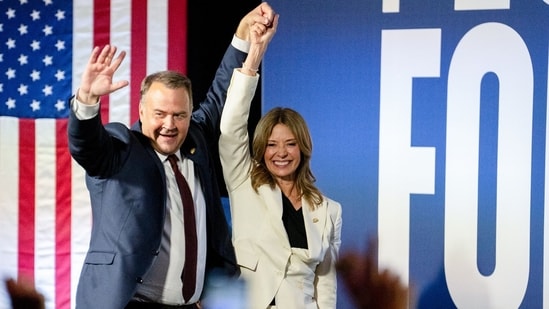
Speaking in her first televised interview since winning Tuesday's gubernatorial election, Acton told CBS Mornings on Friday that she had no plans to speak with Ramaswamy, despite his claim that he had called her after the election to offer congratulations.
"I have no intention of speaking to him," Acton said, emphasizing that political leaders must be held accountable for their words and actions.
Her remarks signal that tensions between the two political leaders remain unresolved even after the election has concluded.
Vivek Ramaswamy's controversial advertisement sparks backlash
The dispute centres on an attack advertisement aired by Ramaswamy's campaign during the closing days of the race. The commercial featured Donna Arthur, Acton's estranged biological mother, who accused her daughter of being a liar.
The advertisement attracted widespread criticism because of the deeply personal nature of the allegations and the circumstances surrounding Acton's childhood.
{{/usCountry}}The advertisement attracted widespread criticism because of the deeply personal nature of the allegations and the circumstances surrounding Acton's childhood.
{{/usCountry}}Acton, as per US media reports, had not seen her mother since she was 12. She and her brother were removed from their mother's care after their stepfather, Cledith Arthur, was arrested and charged with sexually abusing Acton when she was between 10 and 12 years old.
According to Acton's brother, their mother remained married to the stepfather until his death in 2004.
Acton described the decision to feature her mother in the campaign advertisement as particularly reprehensible, arguing that it was an attempt to exploit a painful chapter of her personal history for political advantage.
She also suggested that the advertisement reflected the Republican campaign's difficulties in the final stretch of the election.
Republicans and Democrats criticise campaign tactic
The advertisement triggered condemnation across party lines, drawing criticism from Democrats as well as prominent Republicans in Ohio.
Republican Governor Mike DeWine and Senator Jon Husted were among those who denounced the campaign's decision to use the footage.
President Donald Trump, however, defended the advertisement, describing it as "very powerful". He also said he had advised Ramaswamy against withdrawing it.
Acton maintained that the campaign had repeatedly relied on inflammatory messaging and misleading claims.
She said the advertisement was especially troubling given her mother's circumstances, adding that it was apparent to her that her birth mother was not well.
"I would like to say I didn't expect this, but there was no low my opponent wouldn't sink to," Acton said.
She described the campaign's advertisements as being characterised by hostility, misinformation and personal attacks.
Acton calls for unity and decency in politics
Looking beyond the controversy, the governor-elect said her campaign had revealed a strong appetite among Ohio voters for a different style of political leadership.
According to Acton, voters were increasingly frustrated with political hostility and wanted elected officials who concentrated on delivering practical solutions rather than fuelling divisions.
Describing herself as a determined candidate with roots in Youngstown, she said she was not afraid of political confrontation. However, she stressed that standing firm did not require abandoning compassion or respect.
"Kindness isn't weakness," she said, identifying unity, decency and public service as central messages of her campaign.
Data centres and economic development among Amy Acton's key priorities
Beyond the campaign controversy, Acton also outlined her position on another major issue facing Ohio: the rapid expansion of data centres.
She has supported a conditional moratorium on new data-centre facilities, arguing that economic development must be balanced against environmental protection and the interests of local communities.
Acton said Ohio should remain attractive to businesses and investors while ensuring that industrial expansion does not come at the expense of clean air, safe water and workers' rights.
She also emphasised the importance of creating well-paying union jobs as part of the state's economic development strategy.
"We are open for business, but we're not for sale, and we're not to be exploited," she said.
The position reflects her broader argument that investment should benefit Ohio residents rather than simply serve corporate interests.