In 2019, a group of free climbers accidentally discovered a large number of mysterious footprint traces on the cliffs of Monte Cònero near Ancona, on Italy’s Adriatic coast. The marks were preserved in a limestone slab that formed on a pelagic seafloor during the Cretaceous period.
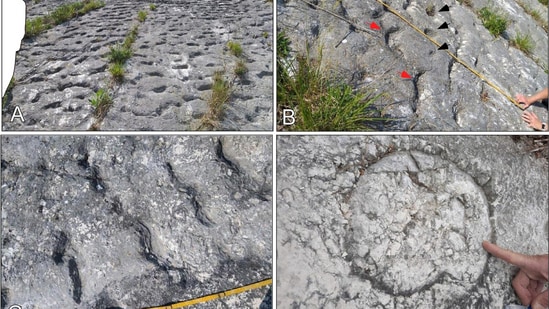
The site is part of the La Vela area, where researchers later documented more than 1,000 traces that they believe were made by marine reptiles, most likely sea turtles. After years of investigation, scientists concluded that the impressions may record a group of sea turtles responding to an earthquake about 80 million years ago.
A stampede preserved in ancient seafloor
The discovery is reported in Cretaceous Research by geologist Alessandro Montanari and a team of researchers from Italy and Norway. The site was documented in detail by the researchers, who identified more than 1,000 fossil impressions across a limestone slab covering about 200 square meters.
The impressions were concentrated in groups, with some showing regularly spaced, double-curved paddle marks. The researchers interpret the pattern as indicating that the animals were moving together during a sudden disturbance, probably an earthquake. The shape and arrangement of the paddle-like impressions led the researchers to interpret them as reptile footprints. Among possible marine reptiles, the team considers sea turtles the most likely trackmakers, although the traces cannot identify a precise species. What makes this discovery unusual is not just the number of tracks. It's that they survived at all. The rock at Monte Cònero formed on a deep marine seafloor, and such an environment is not generally favorable for preserving footprints.
{{/usCountry}}The impressions were concentrated in groups, with some showing regularly spaced, double-curved paddle marks. The researchers interpret the pattern as indicating that the animals were moving together during a sudden disturbance, probably an earthquake. The shape and arrangement of the paddle-like impressions led the researchers to interpret them as reptile footprints. Among possible marine reptiles, the team considers sea turtles the most likely trackmakers, although the traces cannot identify a precise species. What makes this discovery unusual is not just the number of tracks. It's that they survived at all. The rock at Monte Cònero formed on a deep marine seafloor, and such an environment is not generally favorable for preserving footprints.
{{/usCountry}}Since modern-day turtles lay their eggs openly on beaches, turtle tracks on the sand are relatively common. However, a seabed is a very different environment. Currents and burrowing organisms can disturb soft seafloor sediments, making the preservation of footprints difficult. For these delicate impressions to survive, they had to be protected from such disturbance.
Burial caused by an earthquake
The researchers propose that an earthquake triggered a sediment-laden flow known as a fluxoturbidite, which subsequently covered the tracks and helped preserve them in the rock. The age of the rock layer was established through a combination of biostratigraphy and magnetostratigraphy, placing the footprint-bearing layer in the lower Campanian, about 80 million years ago.
There's also the question of why turtles, rather than the other large reptiles swimming those seas at the time. The behavior of the animals also helps narrow down the possible trackmakers. The large number of impressions and their apparent concentration in a mass movement are consistent with the study's interpretation that the traces were made by sea turtles responding together to a sudden disturbance. Modern sea turtles can also gather in large numbers at breeding and nesting sites, although the fossil tracks cannot establish exactly what brought these Cretaceous animals together at Monte Cònero. This makes a mass movement of sea turtles during the earthquake a plausible explanation for the unusual concentration of tracks.
What another Italian fossil reveals about Cretaceous turtles
Fossils of sea turtles from Italy's Cretaceous rocks are relatively uncommon, although several marine turtle remains have been found in the region. In this respect, a study published in the journal PLOS One can provide valuable insight. This team of researchers studied the fossil remains of a large marine turtle found in Turonian strata of the Scaglia Rossa near Sant’Anna d’Alfaedo in Verona province, northeastern Italy. The semi-articulated specimen preserves pebbles in its thoracic area, which the researchers interpret as gastroliths, or stones that the turtle had ingested during its lifetime. Drawing comparisons with living green turtles, the PLOS One researchers suggested that the stones may have been ingested to supplement calcium after or in preparation for egg deposition, raising the possibility that the fossil turtle was a gravid female.
Taken together, the two studies offer glimpses of how Cretaceous marine turtles may have lived and behaved. One preserves possible evidence of a turtle ingesting stones in connection with reproduction, while the other records an unusual concentration of tracks that researchers interpret as a mass movement triggered by an earthquake. For the climbers who first spotted those strange tracks on the rock face, it was an unusual glimpse into one fateful day, 80 million years ago.