Some plants look like a great idea until they take over the yard. Hawaii learned that lesson on a huge scale with gorse, a thorny shrub from western Europe. A 2000 Hawaii Department of Agriculture news release said gorse was introduced to Hawaii from England or Scotland in the early 1900s for sheep forage. By then, more than 35,000 acres on Maui and the Big Island were covered by the weed. That’s how a useful plant became a chronic problem for the islands.
A shrub brought in to feed sheep
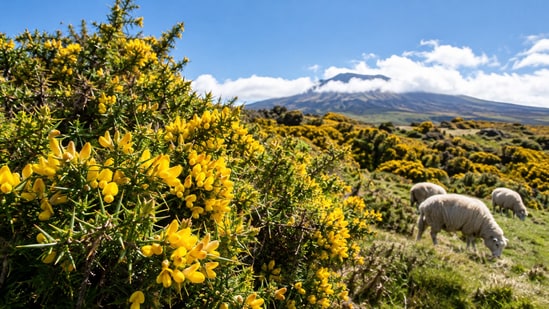
People once valued gorse for practical reasons. A 1988 paper by George Markin and colleagues, published in the Hawaiian Botanical Society Newsletter, states that it was considered an effective hedgerow plant until barbed wire started being used for fences. The authors note that it was also used as pasture for sheep and goats. In other words, people intentionally brought it in because it was useful.
According to the press release in Hawaii, the plant was introduced in Hawaii in the early 1900s as feed for sheep. However, the real problem arose much later, when there was a shift in the way people farmed the land.
Deep Dive
Why did gorse spread across Hawaii after it was introduced as sheep forage?
How much land did gorse cover in Hawaii, and where was it found?
How did Hawaii plan to control gorse?
What happened when the sheep industry faded
The agency noted that once the sheep industry had declined, the growth of gorse could not be controlled. The Markin paper gives some explanations as to why this happened. The land had been changed over from sheep to cattle ranching. However, the cattle did very little grazing on gorse. In addition, its seeds are viable for as long as 30 years. Despite several attempts at major chemical control, gorse was still well established near Haleakala and Makawao on the island of Maui and around Mauna Kea on the island of Hawaii, the authors say. State authorities said it is one of the most difficult noxious plants to get rid of in Hawaii.
How big the problem grew
{{/usCountry}}The agency noted that once the sheep industry had declined, the growth of gorse could not be controlled. The Markin paper gives some explanations as to why this happened. The land had been changed over from sheep to cattle ranching. However, the cattle did very little grazing on gorse. In addition, its seeds are viable for as long as 30 years. Despite several attempts at major chemical control, gorse was still well established near Haleakala and Makawao on the island of Maui and around Mauna Kea on the island of Hawaii, the authors say. State authorities said it is one of the most difficult noxious plants to get rid of in Hawaii.
How big the problem grew
{{/usCountry}}The numbers show how far the weed spread. The survey carried out from 1984 to 1987, as documented in the Markin article, showed that gorse was present in 20,415 acres on the island of Hawaii and 14,789 acres on Maui. This adds up to about 35,200 acres, which is similar to the state’s estimate, which is above 35,000 acres. Gorse was mainly found at elevations between 2,070 and 7,380 feet.
In response to this, the Hawaii Department of Agriculture planned, in February 2000, to release a rust fungus at Humuula, which is located on the southern side of Mauna Kea. It has been found that the fungus does not pose a risk to desirable plants in Hawaii. It weakens and kills the gorse stems and spines, and the spores of the fungus can easily be carried by wind. Another release was scheduled for Maui. These figures come from a 1984–87 survey and a 2000 state release, so current numbers may differ.
But the lesson is simple: a plant chosen for one job can outlast the industry that wanted it, and that is worth remembering whenever someone brings something new into a place for what seems like a good reason.