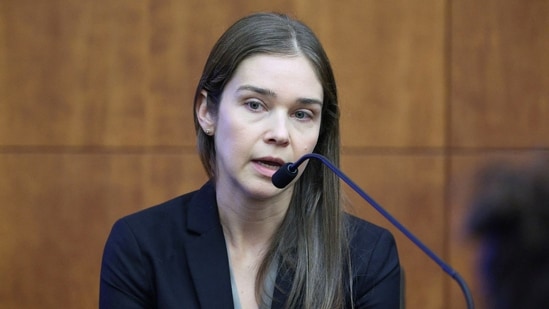
Dr Jennifer Tufts’ testimony gave the court a closer look at Lindsay Clancy’s mental health in the weeks before her children’s deaths, detailing worsening depression, suicidal thoughts and repeated medication changes.
Lindsay Clancy is on trial for the deaths of her three children, Callan, Dawson and Cora, who were found strangled at the family’s home in Duxbury, Massachusetts, in January 2023. Clancy has pleaded not guilty, and while the defense does not dispute that she killed the children, it argues that severe mental illness, including postpartum psychosis and bipolar disorder, left her unable to be held criminally responsible.
Clancy's condition worsened after Zoloft dose was increased
Court resumed at 11:45am local time with Dr Jennifer Tufts of Aster Mental Health back on the stand. She told the court that Lindsay Clancy felt “awful” after her Zoloft dose was increased, as per the testimony reported by NBC Boston. Clancy became more depressed, was “crying all day,” and had trouble eating and sleeping, along with “mental fog.”
Reading from her records, Tufts described Clancy's condition at the time: “Anxiety was really bad even before med, now hard to differentiate. Overnight racing thoughts, paranoid of getting suicidal thoughts, something bad happening. Doesn't want to be alone.”
{{/usCountry}}Reading from her records, Tufts described Clancy's condition at the time: “Anxiety was really bad even before med, now hard to differentiate. Overnight racing thoughts, paranoid of getting suicidal thoughts, something bad happening. Doesn't want to be alone.”
{{/usCountry}}Tufts said she was "very concerned" at this stage and decided to stop Clancy's Zoloft and monitor her closely. She saw Clancy again the next day, on October 21. Tufts also looked into Zulresso, an intravenous drug used for severe postpartum depression, but Clancy did not end up pursuing that treatment.
Brief improvement followed by a hospital stay
During a telehealth visit on November 2, Tufts said Clancy's psychiatric condition was “improving,” so she decided to lower Clancy's Ativan dose and look at other options for sleep-related anxiety.
Three weeks later, on November 22, Tufts asked Clancy if she was still having suicidal thoughts. According to Tufts' notes, “Patient denies SI,” meaning Clancy reported no suicidal ideation at that time.
By the next appointment on December 1, Clancy said she was struggling to sleep because of the number of medications she was on, one of which was Remeron. She told Tufts she had "worse depression and intrusive thoughts," along with "the feeling that I was going to die." This was also the day Clancy said she was "close" to having suicidal thoughts.
Defense attorney Kevin Reddington pressed Tufts on how she responded: “You've got a woman telling you she's hopeless, she doesn't care if she dies, she can't sleep, what did you do to validate on your therapy?" Tufts replied, “I told her that this was something we could address, there was hope, there were treatments.”
When Reddington asked if she had bipolar disorder, Tufts said, “No. She never had mania.” They also discussed a plan for hospitalization, and Clancy later spent one day at Women & Infants Hospital in Rhode Island.
Also Read: Who is Shanan Buckingham? Why prosecutor's hair bow is drawing attention at Lindsay Clancy trial
December setbacks and a missed warning sign
At the December 16 appointment, Tufts said Clancy “was sleeping but she was still feeling very poorly.” Clancy remained deeply depressed, felt hopeless and had some suicidal ideation. She had gone to Massachusetts General Hospital with suicidal thoughts but was not admitted.
Tufts explained, "When she went to hospital, she went because she had no motivation, some SI," but added that Clancy denied having any plan to harm herself. "While she was certainly struggling, she did not require hospitalization at that point," Tufts said.
Reddington also asked Tufts if she knew that Clancy had told her then-husband, Patrick, that she was having thoughts of hurting the children. Tufts said she did not know about this at the time and that it would have been “very concerning” if she had known.
January visits before the killings
Tufts' next session with Clancy was on January 6, 2023, an appointment Clancy scheduled herself the day after leaving McLean Hospital, a psychiatric facility where she had spent several days and was diagnosed with "major depression." Clancy described feeling "very numb" and had trouble sleeping, so her Trazodone dose was increased.
On January 12, she added more medication, including Trazodone, and on January 16, she prescribed Amitriptyline, another antidepressant. On that date, Clancy again said she felt numb and was only "able to force herself out of bed," and that bonding with her infant son felt forced. “I was concerned that she was depressed,” Tufts said. The two also discussed Ketamine treatment as an option.