After more than 10 months at sea supporting the Iran war, thousands of sailors aboard the USS Abraham Lincoln returned to San Diego Bay on Thursday, reuniting with families, meeting babies born during their absence and bringing an unusually long deployment to an emotional close.
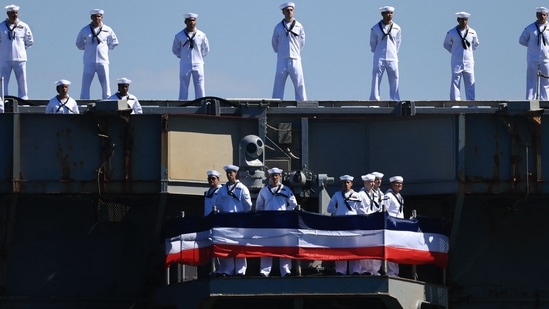
The homecoming followed a deployment marked by combat operations, limited opportunities to replenish supplies and concerns raised by families about the crew’s well-being. Some relatives said they struggled with anxiety after hearing reports of shortages and deteriorating mental health among sailors, with communication often limited to occasional emails and rare WhatsApp calls.
The aircraft carrier’s deployment lasted 322 days, according to the Associated Press, while the ship also recorded 265 days of uninterrupted time at sea.
“It feels amazing,” 20-year-old sailor Abel Ramirez said as he left the carrier, describing the relief of completing his first deployment. “There was a certain point when I never thought I would come off.”
Sailors meet children born while they were away
For many families, the return marked the end of months of separation. The Navy said 64 fathers were among the first sailors to leave the carrier and meet their babies for the first time. Including the air wing, the number of new fathers was 122, the ship’s commanding officer, Capt. Daniel Keeler, said.
{{/usCountry}}For many families, the return marked the end of months of separation. The Navy said 64 fathers were among the first sailors to leave the carrier and meet their babies for the first time. Including the air wing, the number of new fathers was 122, the ship’s commanding officer, Capt. Daniel Keeler, said.
{{/usCountry}}Kathy Monterrosa, who waited with her six-month-old daughter Sarahi for her husband to return, described the child as their “deployment baby”. She said the reports about conditions aboard the ship had been particularly difficult to hear while she was pregnant.
Other families looked forward to celebrating missed birthdays and milestones. Cassity Garduque, 14, said her mother, a sailor aboard the carrier, had missed most of her seventh-grade year and her birthday.
Food was also on the minds of returning crew members. Some sailors had shared lists of meals they wanted to eat after months away, while families recounted concerns about shortages of food and showers during the deployment.
Navy responds to concerns over conditions aboard
The Navy initially played down reports of problems aboard the carrier but later acknowledged some difficulties. In August, acting Navy Secretary Hung Cao said combat operations had restricted opportunities to resupply the ship, temporarily reducing meal options, although food supplies remained adequate.
Keeler said the issues faced by the crew were normal for a deployment of such length. He added that sailors had access to four meals a day, describing the carrier as a “floating city” where routine problems could arise.
The Navy also told lawmakers that eight sailors attempted suicide during the deployment, according to the AP report, highlighting the mental-health pressures associated with prolonged time at sea.
Carrier honored for combat operations
Defence Secretary Pete Hegseth visited the Lincoln on Wednesday to present its crew with the Presidential Unit Citation, one of the US military’s highest unit honours.
He also took to X to describe the development as “historic.”
According to the citation read by Hegseth, the carrier and its strike group conducted nearly 3,700 combat missions, launched 450 Tomahawk cruise missiles, shot down 77 one-way attack drones, sank 64 Iranian warships and destroyed 21 anti-ship cruise missiles.
Hegseth rejected portrayals of the deployment as a sign of dysfunction or low morale, praising sailors for adapting to difficult conditions and completing their mission.
The Lincoln left San Diego in November and reached the Middle East in January. The USS George Washington, normally based in Asia, relieved it in the region in August.
The homecoming follows another unusually long carrier deployment: the USS Gerald R. Ford returned in May after 326 days at sea, the longest aircraft-carrier deployment in the past 50 years.
(With inputs from AP)