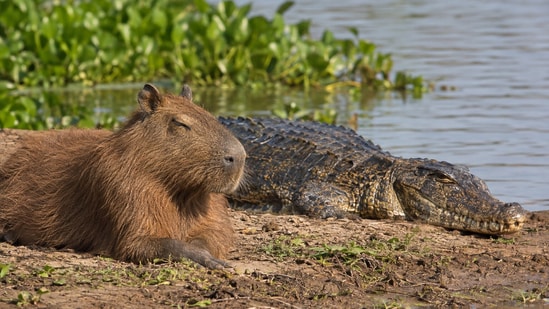
Photographs of capybaras relaxing next to crocodiles and caimans continue making the rounds on the Internet, and these pictures aren’t fabricated in any way. Scientists who have been studying the rodents for years have offered clues about why such encounters can happen, from predator economics and the capybara’s defenses to studies on how these animals respond to predation risks.
What the research reveals
Biologist Ana Belen Avila and her team offered a detailed look at capybara responses to predators in 2022, publishing their work in the journal Animal Behaviour. The researchers compared capybara groups in Brazil's predator-heavy Pantanal wetlands with Argentina's Iberá wetlands, where large predators had been absent for decades as the ecosystem went without the same level of predator pressure. Contrary to what the team expected, Pantanal capybaras were not more watchful overall than the Iberá population. They actually spent more time feeding, formed smaller groups, and stayed close to water for a fast getaway. Iberá capybaras, raised without real predator pressure, raised their guard for random background noise almost as often as for an actual predator call, a sign that the ability to separate genuine danger from harmless sound can fade when predator pressure is absent over generations. Stress hormone readings were also higher in that population, a pattern Avila's team linked to the unpredictability of living somewhere risk could resurface without warning.
The same group returned to the subject in 2025 with a paper in Behavioral Ecology and Sociobiology, this time tracking where and when capybaras chose to forage instead of just how alert they stayed. The study used observations from Iberá collected before jaguars were reintroduced there in 2021, allowing the researchers to compare those conditions with capybaras living under predator pressure in the Pantanal. Pantanal capybaras stayed in relatively close groups, grazed near water, and stuck to daylight hours across different temperature and moon-phase conditions, according to the study. Their Iberá counterparts ranged farther from water and adjusted their activity around weather conditions rather than an immediate threat. Avila and her co-authors concluded that living near big cats pushes capybaras to manage risk across both location and timing, and that restoring predators to a landscape can reshape more than prey behavior, potentially extending to vegetation and soil over time.
{{/usCountry}}The same group returned to the subject in 2025 with a paper in Behavioral Ecology and Sociobiology, this time tracking where and when capybaras chose to forage instead of just how alert they stayed. The study used observations from Iberá collected before jaguars were reintroduced there in 2021, allowing the researchers to compare those conditions with capybaras living under predator pressure in the Pantanal. Pantanal capybaras stayed in relatively close groups, grazed near water, and stuck to daylight hours across different temperature and moon-phase conditions, according to the study. Their Iberá counterparts ranged farther from water and adjusted their activity around weather conditions rather than an immediate threat. Avila and her co-authors concluded that living near big cats pushes capybaras to manage risk across both location and timing, and that restoring predators to a landscape can reshape more than prey behavior, potentially extending to vegetation and soil over time.
{{/usCountry}}Why crocodilians keep their distance
Research on capybara ecology provides useful context for understanding why some encounters between capybaras and caimans may remain peaceful. Adult capybaras can weigh more than 100 pounds and carry thick hides plus sharp incisors capable of causing injury, so attacking one can carry a cost for a caiman, especially when fish and other easier prey are available nearby.
Researchers who study capybara ecology frame this as ordinary risk-versus-reward math, the kind most predators are less likely to attack when the potential cost is high relative to the nutritional benefit. Capybaras also have defenses that cost them little: living in groups in which individuals can share vigilance, and swimming with their eyes, ears, and nostrils positioned high on the head so they can remain mostly submerged while still tracking movement nearby. Put the size, group living, and quick escape into deep water together, and a healthy adult capybara may be a less attractive target for a caiman than smaller or less risky prey.
This does not make the association risk-free. Juveniles lack the size and physical defenses of adults, making them more vulnerable to caimans, anacondas, and even birds of prey. Lower water levels during the dry season could also increase the chances of contact between the animals. Nevertheless, when it comes to healthy adults, the broader ecological picture is consistent with a predator weighing the potential cost of an attack against its reward. The tranquil picture of a sleeping capybara next to a crocodilian does not indicate friendship in any way. It is more like a truce.