
Scientists are not fully confident that Covid-19 vaccines will work on a new variant of the coronavirus found in South Africa, ITV’s political editor said on Monday, citing an unidentified scientific adviser to the British government.
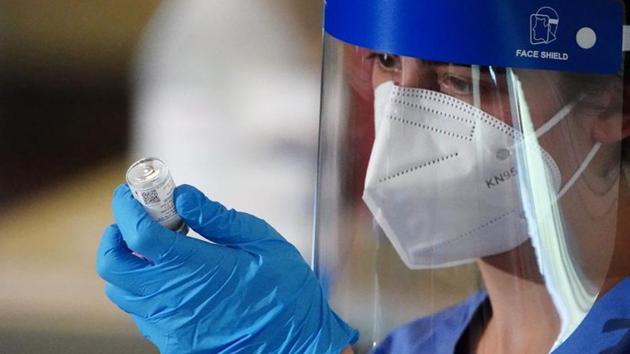
Both Britain and South Africa have discovered new, more infectious variants in the coronavirus in recent weeks that have driven a surge in cases. British Health Secretary Matt Hancock said on Monday he was now very worried about the strand found in South Africa.
Suggested For You
Scientists including BioNTech CEO Ugur Sahin and John Bell, Regius Professor of Medicine at the University of Oxford, have said they are testing the vaccines on the new variants and say they could make any required tweaks in around six weeks.
“According to one of the government’s scientific advisers, the reason for Matt Hancock’s ‘incredible worry’ about the South African Covid-19 variant is that they are not as confident the vaccines will be as effective against it as they are for the UK’s variant,” ITV political editor Robert Peston said.
Public Health England said there was currently no evidence to suggest that vaccines will not be effective against the new strain. The health ministry did not immediately respond to requests for comment on the report.
{{/usCountry}}Public Health England said there was currently no evidence to suggest that vaccines will not be effective against the new strain. The health ministry did not immediately respond to requests for comment on the report.
{{/usCountry}}The world’s richest countries have started vaccinating their populations to safeguard against a virus that has killed 1.8 million people and crushed the global economy.
There are currently 60 vaccine candidates in trials, including those that are already being rolled out from AstraZeneca and Oxford, Pfizer and BioNTech, Moderna, Russia’s Sputnik V and China’s Sinopharm.
That has helped to lift global financial markets, but the discovery of the new variants has raised fresh alarm.
Scientists say the new South African variant has multiple mutations in the important “spike” protein that the virus uses to infect human cells.
It has also been associated with a higher viral load, meaning a higher concentration of virus particles in patients’ bodies, possibly contributing to higher levels of transmission.
Oxford’s Bell, who advises the government’s vaccine task force, said on Sunday he thought vaccines would work on the British variant but said there was a “big question mark” as to whether they would work on the South African variant.
He told Times Radio that the shots could be adapted and “it might take a month or six weeks to get a new vaccine”.
BioNTech’s Sahin told Spiegel in an interview published on Friday that their vaccine, which uses messenger RNA to instruct the human immune system to fight the coronavirus, should be able to cope with the variant first detected in Britain.
“We are testing whether our vaccine can also neutralise this variant and will soon know more,” he said.
Asked about coping with a strong mutation, he said it would be possible to tweak the vaccine as required within six weeks - though it might require additional regulatory approvals.
Explore More
ABOUT THE AUTHOR
Follow the latest breaking news, major developments and agenda-setting stories from India and around the world with the newsdesk at Hindustan Times. Operating round the clock, the desk brings together experienced editors, reporters and correspondents to deliver fast, accurate and contextual reporting across subjects that influence public policy, governance, business, society and international affairs. The HT News Desk covers politics, elections, government policies, the economy, business and markets, science and technology, the environment, law and order, infrastructure, education, climate issues and geopolitics, while closely tracking developments across states, institutions and global capitals. The team also leads coverage of major breaking news events, policy announcements, court proceedings, natural disasters, public emergencies and significant international developments. Reports published by the newsdesk are based on information gathered from reporters on the ground, official statements, government agencies, court records, regulatory filings, recognised institutions and other authoritative sources. Stories undergo editorial scrutiny and verification processes to ensure accuracy, fairness and relevance, and are updated as events evolve and additional information becomes available. Whether covering a key political decision in New Delhi, an economic policy shift affecting millions, a landmark court ruling or a major global event, the HT News Desk aims to provide readers with reliable, fact-based journalism that delivers not only the latest developments but also the context and analysis needed to understand their wider implications.