NO SITTING American president has greeted a foreign leader arriving in Washington at the airport for 64 years. But when Xi Jinping arrived in the city on September 23rd, he was greeted not only by Donald Trump but also a level of pomp and circumstance far in excess of anything offered by China during Mr Trump’s reciprocal visit to Beijing in May. The lopsided pageantry reflects Mr Trump’s eagerness to preserve stable ties with Mr Xi, whom he described as
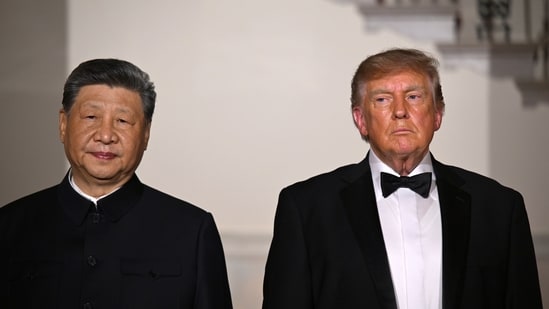
NO SITTING American president has greeted a foreign leader arriving in Washington at the airport for 64 years. But when Xi Jinping arrived in the city on September 23rd, he was greeted not only by Donald Trump but also a level of pomp and circumstance far in excess of anything offered by China during Mr Trump’s reciprocal visit to Beijing in May. The lopsided pageantry reflects Mr Trump’s eagerness to preserve stable ties with Mr Xi, whom he described as “strong, vibrant and fit”. It also stood in contrast to the paucity of the agenda, with little sign of progress on a litany of issues.
Mr Trump hosted a state dinner for Mr Xi on the evening of September 24th, with a private tea at the White House and a tour of the National Archives the following day. But the main achievement of this week’s summit appears to be an extension of the economic truce that America and China reached last year, ending a tit-for-tat spat in which China wielded rare-earth export controls to strike back against Mr Trump’s tariffs. China wanted to extend the truce, which was due to end in November, until the end of Mr Trump’s tenure. In the end, the two sides agreed to a paltry two-month extension, expiring on January 10th. The only other new agreement announced by the end of the first day of talks was for China to provide two giant pandas to a zoo in Atlanta.
American officials grumble about China’s compliance with the trade truce, which also included commitments to stop the flow of chemicals used to make fentanyl, a drug that causes tens of thousands of deaths in America, and to buy more American soyabeans. Chinese exports of rare earths to America have hovered around 500,000kg per month for the past year, far lower than the pre-truce level. On November 10th China is also due to expand restrictions on rare earths to cover new elements, including erbium, which is used in fibre-optic cables. Scott Bessent, America’s treasury secretary, said that he would use the extension to press China for “more fulsome” implementation. He later added that America was also considering a “bigger” deal that China had proposed.
Deep Dive
What were the main achievements of the Trump-Xi meeting in September 2026?
Why did Xi Jinping warn against a 'win-or-lose' rivalry with the United States?
How does the trade truce extension affect U.S.-China relations?
In America, where debates over artificial intelligence have intensified in recent weeks, some advocates of AI safety had hoped that Mr Trump and Mr Xi might come to an agreement that would increase scrutiny of models or even slow down the pace of progress. Others wanted Mr Trump to push back on China’s so-called “distillation” of American AI, which involves taking the output of one model to improve another. Instead, Mr Trump said on September 24th that artificial intelligence—or “Super Intelligence” as he now calls it—would be a “big topic” but that both he and Mr Xi were content to “leave it exactly where it is”. Mr Xi said later that the two sides should maintain human control of AI and continue their dialogue on the subject.
Perhaps most striking has been Mr Trump’s scant interest in matters of security and defence, issues that have at times dominated the Sino-American relationship. Iran appears to have used Chinese satellite images to target strikes in the Middle East, including an attack on Jordan in July that killed three American troops. Mr Trump played down those accusations. “They basically do what we do,” he said. “When they say China spies on us, I say you’re right and we spy on them too.” China has also sharply increased dredging, air and naval activity around disputed islands and reefs in the South China Sea, as well as escalating military activity around Taiwan. At the summit, Mr Xi urged America to “adhere to the correct position of opposing” Taiwan’s independence, according to China’s official Xinhua news agency.
In his first term, Mr Trump filled his administration with officials who crafted a new policy consensus on China in Washington, one that involved a far more muscular and competitive approach than what had come before. The Biden administration embraced and built on that consensus and American attitudes to China hardened steadily. In his second term, Mr Trump has disavowed his own legacy, adopting softer positions on issues such as semiconductor exports to China and American commitments to Taiwan. American public opinion also seems to be shifting. A recent poll by the Chicago Council on Global Affairs shows that 57% of Americans would prefer “friendly co-operation and engagement” against 40% who want America to contain Chinese power, a turnaround from the trend over 2020 to 2024. Speaking at the White House, Mr Xi invited 100,000 young Americans to visit China to study over the next five years.
On September 23rd Elbridge Colby, the Pentagon’s policy chief, said that America’s aim in Asia was to secure “a decent peace”, one in which it would ensure access to trade but would not “dominate” Asia. It would show a “respectful attitude towards Beijing”, he added. And it was no bad thing, Mr Colby said, that each side believed it had the upper hand over time: “Let’s have a spirited competition…that doesn’t result in a large war.”
A period of calm suits both sides. Mr Trump is preoccupied with a war in Iran and looming midterm elections. Mr Xi is concerned by a slowing economy and next year’s quinquennial Communist Party congress. China wants to “use the next few years to consolidate its rise and reach what one might call escape velocity in its competition with Washington,” observes Rush Doshi, who oversaw China policy in the Biden administration.
Ryan Hass of the Brookings Institution, a think-tank, who worked on China policy at the White House during Mr Biden’s tenure, noted that the 30 minutes devoted to substantive talks in the Oval Office was unusually low. “The pageantry,” he wrote, “appears to be the point of [the] visit.” The most consequential aspect of the relationship between Mr Trump and Mr Xi might be the frequency of their meetings rather than the substance of what is agreed. “This could be a historic year,” noted Mr Bessent, because the two leaders could meet four times—the next two occasions coming at an Asia-Pacific Economic Co-operation (APEC) summit in China’s tech hub of Shenzhen in November and a G20 summit in Miami the following month.
The lure of each subsequent meeting gives each side an incentive to keep ties on an even keel. America has delayed a planned $14bn arms package for Taiwan to avoid disrupting the meeting with Mr Xi. It was a “very good negotiating chip”, crowed Mr Trump in May. But the drumbeat of summits might now keep the package in perpetual abeyance.
Editor’s note (September 25th 2026): This piece was updated after the state dinner.
One Subscription.
Get 360° coverage—from daily headlines
to 100 year archives.
Archives
HT App & Website