Israel has declared Gaza City, in the northern territory, a combat zone in what it believes will force Hamas into submission. However, the continuous raining of artillery and bombs in the region has posed a stark question for Palestinians: “whether to live or die”.
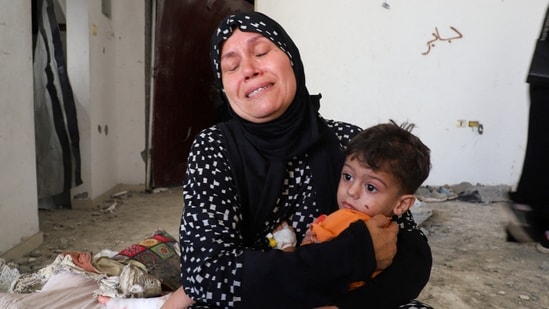
Sections of the city have already been designated as “red zones", and Palestinians have been ordered to evacuate these areas in anticipation of intense combat.
Speaking to Associated Press, a displaced Palestinian sheltering in Gaza City, Mohammed Alkrudi, said, “The Israeli forces, when they mark any area by red color and they request the people to leave, they really will destroy it... So it's like you decide whether to live or die. It's very simple like that.”
Since Israel declared Gaza City a combat zone last Friday, a small fraction of the nearly one million Palestinians in the area have fled their homes. As of Monday, approximately 14,840 people have left, with most heading south, according to the Site Management Cluster data, cited by the news agency.
'How are we going to all fit here?'
About 2,200 of those displaced have moved to other locations within Gaza City after being forced from their homes by Israeli attacks.
{{/usCountry}}About 2,200 of those displaced have moved to other locations within Gaza City after being forced from their homes by Israeli attacks.
{{/usCountry}}But, the challenges of relocation are immense. Moving costs thousands of dollars, and finding space in the already overcrowded southern region to set up a tent is nearly impossible.
Many of the people currently in the city had returned to the north during a ceasefire in January, hoping their homes would be intact.
Now, with new arrivals, Jamal Abu Reily expressed concern about the lack of space and basic hygiene. He questioned, "How are we going to all fit here? Where are they going to stay? In the sea?"
As Israeli military clear land in occupied areas and with political leaders supporting the relocation of Palestinians from Gaza, many locals fear that departing the city now could mean never returning back.
‘No Rafah. Almost no Khan Younis’
Amjad Shawa, director of the Palestinian NGO network, said his family would likely leave Gaza City if their area receives an evacuation order. Shawa, who had previously evacuated and returned to his home in the Rimal neighborhood, stated that leaving this time would be different.
“Gaza will be leveled and destroyed. Last time, I had my car. There was fuel. Everyone had his income, his money,” he said.
He noted that during the previous evacuation, the southern cities of Rafah and Khan Younis were still intact. Now, after months of bombardment, "there is no Rafah. Almost no Khan Younis," making it difficult to find a safe place to go.
Satellite images from early August and September reviewed by the Associated Press show that large areas of the city and the neighboring Sabra neighborhood have been flattened, with entire blocks bulldozed into empty, sandy lots.
For some, like medical staff, the elderly, and the sick, leaving Gaza City is nearly impossible.
(With AP inputs)