
By any yardstick, the terror attack on a mosque in Egypt’s Sinai province, where militants affiliated to both al Qaeda and Islamic State are active, was brazen and brutal.
What we know so far
Suggested For You
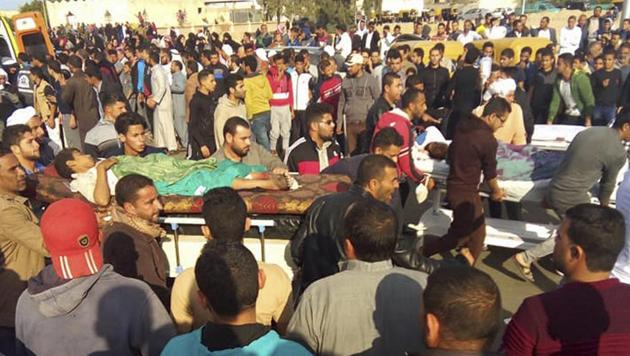
Dozens of militants travelling in four-wheel drive vehicles bombed al-Rawdah mosque in Bir al-Abd town, about 200 km northeast of the capital Cairo, and then opened fire on the worshippers when they tried to flee. The attackers blocked nearby roads by blowing up vehicles and also targeted ambulances and rescue workers who rushed to the mosque.
At least 235 people were killed and 120 injured, making it the deadliest attack of its kind in Egypt’s history.
Who was behind the attack
Though there has been no claim of responsibility, the finger of suspicion has been pointed at the Islamic State-Sinai Province, a local affiliate of the terror network led by Abu Bakr al-Baghdadi.
This group – earlier known as Ansar Beit al-Maqdis before it pledged allegiance to the Islamic State in 2014 – has claimed dozens of attacks, including the bombings of churches in Cairo and the downing of a MetroJet flight in 2015 that killed 224 people, most of them Russian tourists.
{{/usCountry}}This group – earlier known as Ansar Beit al-Maqdis before it pledged allegiance to the Islamic State in 2014 – has claimed dozens of attacks, including the bombings of churches in Cairo and the downing of a MetroJet flight in 2015 that killed 224 people, most of them Russian tourists.
{{/usCountry}}The Jund al-Islam, another group in the Sinai that is believed to have links with al-Qaeda and is opposed to the Islamic State, has issued a “statement of innocence”, saying it had no role in the attack on the mosque.
One reason for the attack being blamed on the Islamic State-Sinai Province is the target – al-Rawdah mosque was frequented by adherents of the more tolerant Sufi branch of Islam, whom the Islamic State describe as infidels and heretics who practice idolatry because of their custom of praying at shrines.
The Islamic State has targeted Sufis in several countries in an area ranging from the Middle East to Pakistan, where 83 people were killed in an attack on a Sufi shrine in Sindh province on February 16.
While Islamic State-affiliated groups in several other countries such as Libya and Algeria have suffered reverses in recent months, the group in the Sinai has retained its ability to strike almost at will largely because of the Egyptian government’s lack of control over the thinly populated peninsula that borders the Gaza Strip and Israel.
Why have terrorists become stronger in the Sinai peninsula?
The chaos that followed the Arab Spring and the ouster of Egypt’s first democratically elected president, Mohamed Morsi, by the military in 2013 emboldened the Islamic extremists operating in the Sinai region. The Ansar Beit al-Maqdis was formed in the aftermath of the Arab Spring in 2011.
In 2014, President Abdel Fattah el-Sisi declared an emergency in the Sinai after 33 soldiers were killed in a suicide attack and described the area as a “nesting ground for terrorism and terrorists”.
Options for the Egypt government
Shortly after President Sisi pledged to respond with “utmost force” in a televised address, combat jets targeted several locations in the region where the mosque is located.
But Egypt’s “scorched earth” strategy to go after militants and terrorists in the Sinai has been criticised by politicians and experts, who contend it leads to more violence. However, given the limited presence of the security forces and the government in the region, the president’s options are limited.
But Sisi received support from US President Donald Trump, who said on Saturday the world community cannot tolerate "barbaric terrorist" groups when he called the Egyptian president to offer condolences.
The international community, Trump said, “must strengthen its efforts to defeat terrorism and extremism in all its forms”.
Explore More
ABOUT THE AUTHOR
Follow the latest breaking news, major developments and agenda-setting stories from India and around the world with the newsdesk at Hindustan Times. Operating round the clock, the desk brings together experienced editors, reporters and correspondents to deliver fast, accurate and contextual reporting across subjects that influence public policy, governance, business, society and international affairs. The HT News Desk covers politics, elections, government policies, the economy, business and markets, science and technology, the environment, law and order, infrastructure, education, climate issues and geopolitics, while closely tracking developments across states, institutions and global capitals. The team also leads coverage of major breaking news events, policy announcements, court proceedings, natural disasters, public emergencies and significant international developments. Reports published by the newsdesk are based on information gathered from reporters on the ground, official statements, government agencies, court records, regulatory filings, recognised institutions and other authoritative sources. Stories undergo editorial scrutiny and verification processes to ensure accuracy, fairness and relevance, and are updated as events evolve and additional information becomes available. Whether covering a key political decision in New Delhi, an economic policy shift affecting millions, a landmark court ruling or a major global event, the HT News Desk aims to provide readers with reliable, fact-based journalism that delivers not only the latest developments but also the context and analysis needed to understand their wider implications.