
MADRID—On Wednesday morning at 8:30 a.m., six trains traveling on the Madrid-Seville high-speed line were forced to a halt.
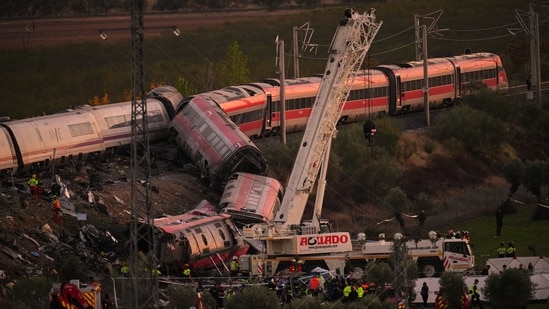
A signaling system had failed, a common problem in Spain’s sprawling, decades-old bullet-train network. A train operated by the company Iryo, carrying 147 passengers, stopped by an almond grove, its driver awaiting further instructions from a control center.
Waiting some 15 miles behind was another high-speed train, this one managed by national rail company Renfe. At 8:36 a.m., an operator gave
MADRID—On Wednesday morning at 8:30 a.m., six trains traveling on the Madrid-Seville high-speed line were forced to a halt.
A signaling system had failed, a common problem in Spain’s sprawling, decades-old bullet-train network. A train operated by the company Iryo, carrying 147 passengers, stopped by an almond grove, its driver awaiting further instructions from a control center.
Waiting some 15 miles behind was another high-speed train, this one managed by national rail company Renfe. At 8:36 a.m., an operator gave the Renfe train a green light to resume travel at full speed, even though the Iryo train remained stationary farther down the track.
The trains collided around 15 minutes later, killing at least 69 people and injuring dozens in one of the deadliest rail tragedies in modern European history.
It wasn’t an isolated incident. On the same line in January, a broken track caused a Madrid-bound train to derail and collide with a train traveling in the opposite direction, leaving 46 people dead.
Though different in cause, the two accidents reveal deeper, systemic shortcomings in Spain’s rail safety systems, where investment in modernization and maintenance have drifted since the boom years that saw its networks quickly expand.
Spain’s socialist government is now under pressure to explain how the same high-speed rail line produced two devastating crashes in less than a year. With general elections around the corner, rail safety has suddenly emerged as a campaign issue, with questions swirling as to whether the government of Prime Minister Pedro Sánchez failed to learn any lessons from the first accident.
Alberto Núñez Feijóo, whose conservative People’s party leads most opinion polls ahead of the Nov. 29 vote, called for a complete, independent review of the railroad network, saying it is long overdue. “Spain has the right to know what is going on with its infrastructure,” he said. The victims include a former labor minister from his party.
Sánchez pledged to investigate the causes of the crash. “It is clear that we have to further increase security, because this kind of tragedy can’t keep happening in a country like ours.”
Like other European countries, Spain built up its high-speed railroads starting in the 1990s, expanding them in the early 2000s. Spain—a country smaller in land area than Texas—now has one of the largest high-speed rail networks in the world. With over 1,880 miles of track, it is second only to China.
Many have struggled to continue funding the maintenance and upgrades of railroad lines, with investment in the sector staying relatively flat in recent years. In Spain, delays on the high-speed network have become longer and more common. The state-run railroad company in 2024 changed its compensation rules and now offers a full refund only if the delay exceeds 90 minutes, compared with 30 minutes in the past.
Wednesday’s collision occurred on Spain’s oldest high-speed line, which connects Madrid to Seville in the south.
Opened in 1992, that line uses old signaling technology known as LZB, which relies on a physical cable and is becoming increasingly obsolete. It is prone to breakdowns and difficult to fix, as replacement parts and specialized engineers are in short supply. LZB has been gradually replaced with a newer signaling system, an upgrade that was under way in the Madrid-Seville line.
Weeks before the crash, the chief executive of Iryo, Fabrizio Favara, told Spanish lawmakers that outages in the old signaling system were the main problem on the line, frequently causing trains to stop for long stretches.
“The most frequent issue, apart from extraordinary events such as a fire, is related to the LZB signaling system,” he told the Spanish Senate during a hearing about the January crash.
There are several layers of safety systems in place to prevent a collision. When signaling systems fail, trains stop and traffic controllers take over. If the signaling system isn’t fully operational, trains are supposed to travel at lower speeds. That wasn’t the case on Wednesday.
At 8:36, a control center operator told the Renfe train driver he could resume its journey with no speed restrictions. “Continue your journey and proceed under [LZB], at normal speed,” the operator told the Renfe driver, according to a recording of the conversation published by the Spanish daily El Pais.
The Renfe train, carrying around 400 people, traveled down the tracks for around 17 minutes, reaching 146 mph before braking and crashing into the rear of the Iryo train.
Transport Minister Óscar Puente pinned much of the blame on what he described as the “inexplicable” decision of the operator to allow the Renfe train to resume travel. But critics say there should be no such room for human error in the first place.
“There should be processes in place to prevent any one individual from putting hundreds of lives in danger,” says Gareth Dennis, a railroad engineer and author. For him, two large crashes in one year speak to a bigger problem.
“It’s not a coincidence. For massive events like this to happen it doesn’t matter if the cause is different,” said Dennis, who has written a book on the future of railroads. “To have two fatal crashes on the same line suggests there are management failings on the railways system in Spain.”
Write to Margherita Stancati at margherita.stancati@wsj.com
One Subscription.
Get 360° coverage—from daily headlines
to 100 year archives.
Archives
HT App & Website