In the early days of the US-China alliance against the then Soviet Union in the 1970s, Chinese leaders warned that the Soviet Union was “making a feint to the East while attacking the West”. The slogan was aimed at discouraging Western détente with Moscow, arguing that the latter was much more threatening on its western flank rather than on China in the East. Détente with the West would have freed up Moscow to increase its pressure on China and this was unwelcome. Times have changed. Russia and China today have convergent interests in confronting the US in the Indo-Pacific. There is the likelihood of the US, India, Japan and Australia crystallizing into a countervailing coalition against China, creating a barrier to its naval expansion into and domination of the ocean space along its eastern shores. While China has been increasing its naval presence in the Yellow Sea across Japan, in the Taiwan Straits and the South China Sea, it is encountering a crowded space with the US and other key countries on the littoral deploying substantial forces as well. This heightens Beijing’s sense of vulnerability as a large proportion of its overseas trade traverses this ocean space, in particular its energy supplies.
While the enhancement of Chinese economic and security capabilities in the east has been significant and visible, not much attention has been paid to its equally systematic expansion into its western flank, comprising Central Asia and Eastern Europe. Unlike in the east, its western expansion has met little opposition. Russia, the traditionally dominant power in this Eurasian zone has muted any concerns it harbours because it needs Chinese support in its confrontation with the West. It has also been co-opted to an extent by Chinese infrastructure and energy-related investment in Russia and its substantial purchases of Russian arms. The US had a more active Central Asian policy during the George W. Bush presidency early in this millennium. Currently, the US footprint in the region is much diminished and if the current US President Donald Trump follows through on his announced withdrawal from Syria and Afghanistan, then the only power of consequence in Eurasia would be China. All evidence points to China investing large resources to further expand and entrench its influence in the region. It is using the Shanghai Cooperation Organization (SCO), comprising Central Asian countries and the China+16 Forum, which brings together 16 East European countries in an annual summit with China., to advance its interests. Several East European countries are also members of the European Union (EU) and there are fears that China may sow division in the Union in the same manner as it has done in the Association of Southeast Asian Nations (ASEAN).
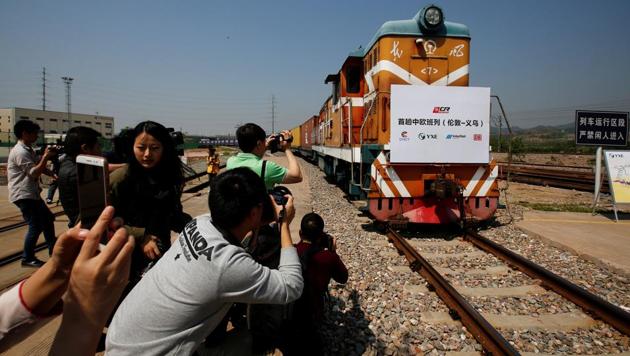
Eurasia is a key component of China’s Belt and Road Initiative. It is being crisscrossed today with Chinese built oil and gas pipelines and railroads linking western China with Europe. China has been steadily increasing its sourcing of oil and gas from adjacent countries like Russia, Kazakhstan, Turkmenistan and Tajikistan, progressively reducing its dependence on maritime supplies. Within the space of just a decade, there are now regular train services linking Chinese cities to several European destinations. There is a Suzhou to Łódź (Poland) service, a Chongqing to Duisburg (Germany) service. There are plans to join Beijing and London with a high speed rail link, which will facilitate a train journey in just 48 hours. There are rail services from China’s Xinjiang to Tehran in Iran and Mazar-i-Sharif in Afghanistan. A railway line is planned between Kashgar in Xinjiang to Pakistan’s Gwadar port. The purpose of all these projects is to reduce China’s dependence on maritime routes which may be vulnerable to interdiction. At the same time, these new economic corridors create opportunities for China’s inland provinces, such as Sichuan and Xinjiang, which are now linked to markets in Europe. Rail services are currently expensive. The rate for rail cargo is about 3 to 5 times of ocean freight but much cheaper than air transport. The train cargoes consist of high value but heavy items such as computers, 3-D printers, robots and similar gadgets . They bring back luxury European goods to a more wealthy Chinese consuming public. These include wines, cheeses and fashion goods. Return cargoes are still sparse at present. A major logistics and warehousing centre has been set up in Hungary. The border town of Khorgas, on the China-Kazakhstan border, has become a major gateway for Chinese transport and energy corridors into Central Asia and beyond.
{{/usCountry}}Eurasia is a key component of China’s Belt and Road Initiative. It is being crisscrossed today with Chinese built oil and gas pipelines and railroads linking western China with Europe. China has been steadily increasing its sourcing of oil and gas from adjacent countries like Russia, Kazakhstan, Turkmenistan and Tajikistan, progressively reducing its dependence on maritime supplies. Within the space of just a decade, there are now regular train services linking Chinese cities to several European destinations. There is a Suzhou to Łódź (Poland) service, a Chongqing to Duisburg (Germany) service. There are plans to join Beijing and London with a high speed rail link, which will facilitate a train journey in just 48 hours. There are rail services from China’s Xinjiang to Tehran in Iran and Mazar-i-Sharif in Afghanistan. A railway line is planned between Kashgar in Xinjiang to Pakistan’s Gwadar port. The purpose of all these projects is to reduce China’s dependence on maritime routes which may be vulnerable to interdiction. At the same time, these new economic corridors create opportunities for China’s inland provinces, such as Sichuan and Xinjiang, which are now linked to markets in Europe. Rail services are currently expensive. The rate for rail cargo is about 3 to 5 times of ocean freight but much cheaper than air transport. The train cargoes consist of high value but heavy items such as computers, 3-D printers, robots and similar gadgets . They bring back luxury European goods to a more wealthy Chinese consuming public. These include wines, cheeses and fashion goods. Return cargoes are still sparse at present. A major logistics and warehousing centre has been set up in Hungary. The border town of Khorgas, on the China-Kazakhstan border, has become a major gateway for Chinese transport and energy corridors into Central Asia and beyond.
{{/usCountry}}China is also extending land-based transport corridors into Southeast Asia. With the southern city of Kunming as the hub, high speed rail links are being put in place, connecting China with the Myanmar and Thailand, Indo-Chinese countries of Vietnam, Laos and Cambodia and through them down all the way to Singapore.
China has used the relative absence of the US and Western Europe in the Eurasian zone and Russia’s currently muted presence, to rapidly emerge as the dominant power in a strategically important region. It has thus made its own feint to the east while expanding in the west. The threat of India being consigned to the margins of the dense network of transport and economic corridors emerging around us is real. A comprehensive strategy which spatially encompasses India’s extended neighbourhood to its east, west and north, and which has a maritime dimension as well as land-based continental dimension, is urgently needed.
Shyam Saran is a former foreign secretary and is currently senior fellow, CPR
The views expressed are personal