India has to fend off interference from both friends and enemies, following our decision to change Jammu and Kashmir’s (J&K) constitutional status.
Given that it never accepted J&K’s accession to India, the presence or absence of Article 370 does not affect Pakistan’s fundamental position. Neither the Simla Agreement nor the United Nations (UN) resolutions on J&K contain any reference to Article 370 or J&K’s autonomy. Article 370 has not insured India against Pakistani-sponsored terrorism or military aggression in 1965, 1971 or 1999. Imran Khan’s argument that nullifying Article 370 is a provocative new step that will invite violence is, therefore, entirely spurious.
Pakistan distorts the two references to the UN Charter in the Simla Agreement to justify a UN role. These relate to maintaining durable peace and refraining from threat or use of force against each other’s territorial integrity. Both have been egregiously violated by Pakistan through physical aggression (Kargil) and jihadi terrorism (Pathankot, Uri, Pulwama, Nagrota, Mumbai, among other attacks). The Simla Agreement does not say that Kashmir has to be resolved according to the UN Charter. That a hostile China purveys this falsehood is understandable, but for the UN Secretary General to do so discredits him.
The Simla Agreement excludes the defunct non-binding 1948/49 UN Security Council resolutions on Kashmir . For these resolutions to be applicable today will require the status quo ante in the erstwhile J&K state to be restored, with Pakistan withdrawing fully from Pakistan-occupied Kashmir (PoK), undoing demographic changes, and eliminating terrorist presence there. China will have to transfer back the Shaksgam Valley, remove fully its civilian and military presence in PoK, and freeze the China-Pakistan Economic Corridor (CPEC). We could outline this officially to counter calls for “self-determination in Kashmir in accordance with the UN resolutions”.
India’s move to make Ladakh a Union Territory does not affect Aksai Chin and the Line of Actual Control (LAC). Our official maps that show Aksai Chin as part of India will continue to do so. India is not repudiating the LAC; the differing perceptions about it will continue to be handled as per agreed border protocols. China is insidiously questioning India’s sovereignty over the whole of Ladakh by asserting that J&K is internationally disputed territory, a position that implicitly puts into question its own sovereignty claims over Aksai Chin. If these claims are unquestionable, why did it offer at one time to accept the McMahon Line if India ceded Aksai Chin, and later proposed ceding territory in Ladakh in exchange for India ceding territory in the east? China accuses India of unilateral action in J&K but ignores its own unilateral occupation of Aksai China, unilateral claims over large parts of Arunachal Pradesh, and unilateral announcement of the CPEC through territory legally belonging to India.
{{/usCountry}}India’s move to make Ladakh a Union Territory does not affect Aksai Chin and the Line of Actual Control (LAC). Our official maps that show Aksai Chin as part of India will continue to do so. India is not repudiating the LAC; the differing perceptions about it will continue to be handled as per agreed border protocols. China is insidiously questioning India’s sovereignty over the whole of Ladakh by asserting that J&K is internationally disputed territory, a position that implicitly puts into question its own sovereignty claims over Aksai Chin. If these claims are unquestionable, why did it offer at one time to accept the McMahon Line if India ceded Aksai Chin, and later proposed ceding territory in Ladakh in exchange for India ceding territory in the east? China accuses India of unilateral action in J&K but ignores its own unilateral occupation of Aksai China, unilateral claims over large parts of Arunachal Pradesh, and unilateral announcement of the CPEC through territory legally belonging to India.
{{/usCountry}}China’s collusion with Pakistan to revive the Kashmir issue in the UNSC after 50 years exposes its unrelenting strategic hostility towards India. To offset the UNSC’s decision not to issue any outcome statement on its closed door discussion, China defiantly made an “outcome statement” as an additional propaganda salvo against India. It censured India on human rights, overlooking its own abysmal human rights record in Tibet, East Turkestan (Sinkiang) and mainland China. It criticises the West for adopting double standards on human rights, but applies them against India. If India has temporarily blocked the internet in Kashmir to prevent organised violence, China has permanently denied to its population access to uncensored information to muzzle internal political dissent. It seeks to throttle the rights of Hong Kong citizens. India’s temporary restrictions in J&K prevent violence, not inflict it. Contrast this with China’s unconscionable conduct in incarcerating a million Muslim Uighurs and Pakistan’s conduct in using air power and artillery and displacing a million locals in operations in its frontier areas.
Pakistan intends to raise the J&K issue at the Human Rights Council. We can use this occasion to expose its scandalous violation of the human rights of Baluchis, Ahmadis, Shias, Christians, and minorities in general, terrorised by its blasphemy laws and subjected to forced conversions.
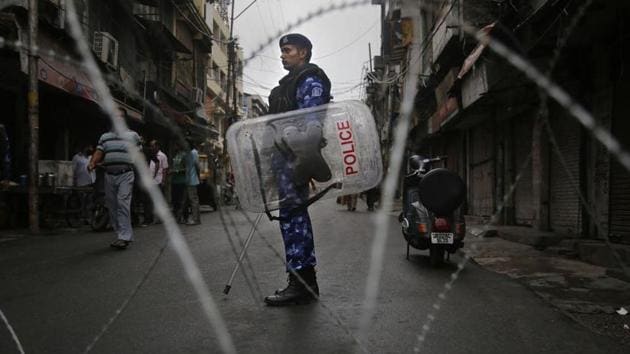
India has had to cope with US President Donald Trump’s disconnected prolixity on Kashmir. His mediation talk undermines India’s established position and plays into Pakistan’s hands, although Narendra Modi’s conversation with him at Biarritz has restrained him for now. The Kashmir situation is in a flux. A better understanding of India’s temporary lockdown to prevent street violence in Kashmir, incited by extremist elements instigated by Pakistan, is required. But we are faced with copy book human rights rhetoric, even from friendly countries, about Kashmiri rights and restoration of communications. This, though, facilitates declared Pakistani jihadi designs in J&K and boosts Khan’s hysterical efforts to internationalise the Kashmir issue, in collusion with the liberal western media. Those advocating an India-Pakistan dialogue overlook that his neurotic attacks against India, his encouragement to Kashmiris to rise against New Delhi’s decision, and his nuclear threats make any dialogue only a paper proposition.
.