
 E-Paper



Ecostani | Climate change and tourist rush pose challenges to pristine glacial-clad Kinnaur
Unexpected rainfall, heavy traffic jams in summer and plastic pollution plague the once pristine and remote parts of Himachal Pradesh

 Prefer HTon Google


An old monk in Nako village in Himachal’s Kinnaur district, Wanktoo Lama, wearing a traditional Buddhist robe and a green Himachali cap, is exasperated with the rise in temperature in this lake village in the upper Himalayas.
Standing outside the Buddhist monastery in Nako, Lama's wrinkled face showed signs of disbelief as he said that it had never been so hot in Nako. He predicted that the village could face a drinking water crisis if it continues to heat up the same way it did in the summer of 2024.
As per the India Meteorological Department (IMD), this summer, Kinnaur witnessed the highest maximum summer temperatures in the past 50 years.
The maximum temperature in Nako crossed 30 degrees Celsius this summer, melting the snow on the peak above the village and forcing locals to shun their light winter wear.
“It is so hot that we have dumped our jackets and pullovers,” said another villager, Recham Lama, who runs a utility shop with his mother on Nako highway which was brimming with tourists from across India.
The long-term impact of climate change can be seen in the tribal districts of Kinnaur and Lahaul/Spiti. The flat roofs of homes in Nako are being replaced with tin pent roofs as the region, which once only received snow, is now getting rain.
“When I was a young boy,” Wanktoo said, pointing at a young tourist at the newly built monastery with tin pent roof, “there was no rain here.”
“It only used to snow and the village was covered in snow for seven to 10 months in a year. We cleared snow from the roofs and the bright sun dried the (flat) roof in a day,” the 82-year-old monk, who has lived his entire life in the village, said.
That is not the case now. He said Nako now receives heavy monsoon rain and because of this water leaks from the stone and mud roofs, making traditional homes uninhabitable. “People are putting tinned roofs to deal with rains,” Recham said.
The rains have gifted the cold desert a rich cash crop of apples that has replaced the traditional crops of buckwheat locally called ‘ogla’ and ‘fafda’ in the past two to three decades and has brought economic prosperity for locals, who had to deal with harsh weather conditions.
The locals have developed apple orchards through terrace farming on the steep slopes near water sources such as rivers and streams. Most of the orchards survive due to irrigation from the Satluj river, its tributaries and local streams.
The apple orchards have also brought its ills such as hordes of pesticides and insecticides used to control farm diseases, which have emerged with higher temperatures. The high use of chemicals could also have polluted some of the rare water sources in the cold desert.
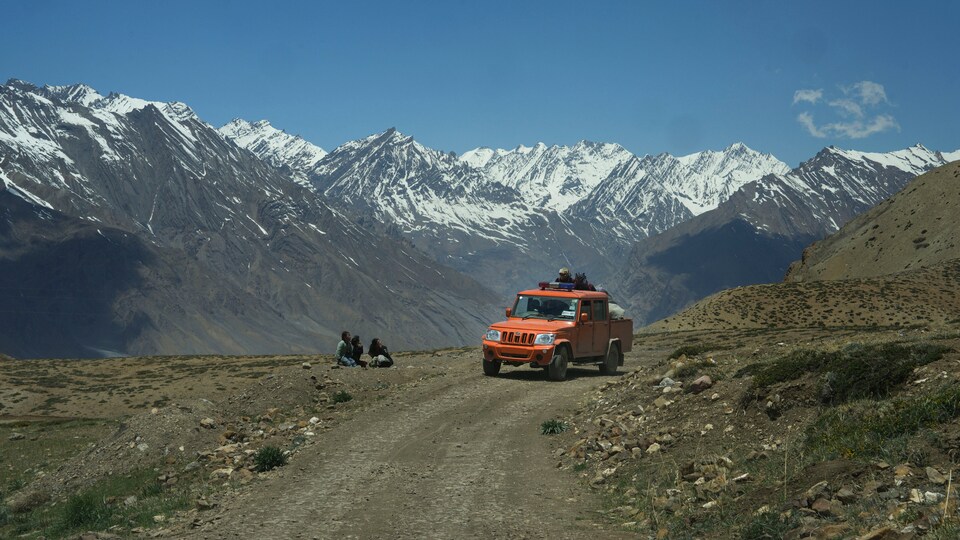
Better roads and demand for connectivity in recent decades have resulted in a high inflow of tourists into mountainous tribal areas. There was a traffic jam in Nako village – unheard of even a few years ago — caused by vehicles from other parts of Himachal, Punjab, Haryana, Delhi and even from far-off states Gujarat, Rajasthan and Maharashtra in the last week of June.
A local in Sangla, another tourist hotspot in Kinnaur district, said that there was a kilometre-long traffic jam on the narrow road to Chitkul, the last Indian village on the border with China, in the first week of June. “At some locations, police had to be deployed to manage haphazard parking of vehicles leading to jams. There was a very heavy rush of tourists this year,” he said.
The states of Himachal and Uttarakhand witnessed an unprecedented rush of tourists this summer as holiday-makers rushed to the mountains to escape heatwave conditions reported from many areas in the plains: Shimla, a town of a hundred thousand people recorded half a million tourist vehicles in the first week of June.
Over 2.8 million people have visited the sacred ‘Char Dham’ in Uttarakhand between May 7 and June 30, double the number that came for pilgrimage in the same period in 2023. A high tourist flow was also recorded in Nainital and Mussoorie, two popular hill stations, in Uttarakhand.
As the weather gets warmer, unprecedented numbers of tourists are reaching far-flung areas up the pristine upper Himalayas with scant respect for local ecology and environment. Many among them dump plastic along the way; small eateries that cater to them add to the pollution because they operate without waste disposal mechanisms.
One could see plastic waste strewn around the sacred Nako Lake, which many tourists, and along the highway between Nako and Pooh, especially at tourist spots such as ‘Khab Sangam’.
As the number of people visiting these places is increasing and the climate is slowly but surely changing due to global warming, the Union government needs to frame a tourist management and environment policy, working in tandem with the governments of Himachal, Uttarakhand and Jammu and Kashmir.
The policy needs to focus on regulating the flow of tourists to remote and pristine areas of the Himalayas to put new destinations on the map for tourists to explore and reduce the pressure on the usual tourist spots.
This would not only help local economies to flourish but also possibly prevent human-induced degradation of the Himalayas which is a young mountain range.
Chetan Chauhan, national affairs editor, analyses the most important environment and political story in the country this week


