As leaders of the four-nation Quadrilateral Security Dialogue, or Quad, hold their crucial meeting on Friday, the credit for creating the circumstances that led to the resurrection of the informal security dialogue in 2017 goes to China’s Xi Jinping. It was President Xi who turned Deng Xiaoping’s advice to “keep a low profile” on its head and ended up creating friction with the world in the name of ‘fortress China’.
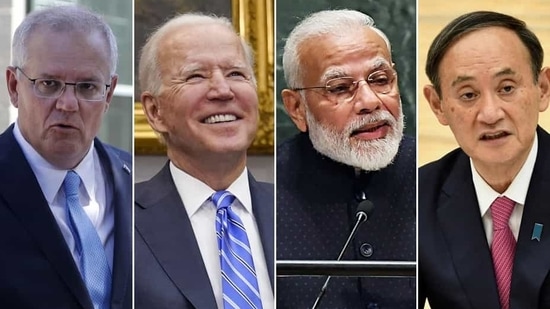
While the signals on the Quad virtual summit today are positive from Washington, one needs to understand why and how the informal grouping was resuscitated nearly a decade after it landed up in the intensive care unit, in a coma. The trigger was the 2007 Bay of Bengal Malabar naval exercises, which included participation from India, the US, Japan, Australia and Singapore.
Contrary to suggestions by some western commentators, the Quad was revived after both the US and Australia realised that China was not only rising power but also becoming a competitor, five decades after US President Richard Nixon opened the door for Beijing.
The rise of expansionist China coincided with the ascendance of paramount leader Xi Jinping in 2007. He got down to work soon after, shredding the advice - “observe calmly, secure our position, cope with affairs calmly, hide our capacities and bide our time, be good at maintaining a low profile, and never claim leadership” - articulated by Deng back in the 1980s.
But neither the US nor the Australians gave up hopes of co-opting China .
{{/usCountry}}But neither the US nor the Australians gave up hopes of co-opting China .
{{/usCountry}}Instead, when China served a demarche to all the participating navies under the Malabar banner to desist from its strategy to contain China, the then US under-secretary for political affairs Nicholas Burns wrote a letter to the then Indian foreign secretary that held one message: China should not be provoked. The Australians, under a self-avowed Sinophile, Kevin Rudd withdrew from Quad soon after. The Left-supported UPA I regime was shaken from within but put on a brave face. Only Japan and the city-state of Singapore, which had also participated in the Malabar exercises, were left standing. But this was not the end.
Just as Xi became the first secretary of the Chinese communist party and Vice President under the then communist party general secretary Hu Jintao, the crackdown in Lhasa was followed by a declaration of the nine-dash line in the South China Sea and renewed claims on the Senkaku Islands.
Under the Barack Obama administration, the Japanese were told to back down from a confrontation with the Chinese over Senkaku Islands in 2012, lest it harmed the reelection prospects of the Democrat government in power. When then Prime Minister Manmohan Singh went to Tokyo in 2013 after the Depsang incursions by the People’s Liberation Army, one of Japan’s senior-most ministers (still serving) told him in broken English that China has been “naughty” for the past 1,500 years and only close neighbours can understand each other’s concerns.
While there have been suggestions that India is the weakest link in the Quad chain due to its so-called non-alignment policy, it was the US that was dithering over China as it believed that Beijing could be co-opted within the western world through the World Trade Organisation.
In the meantime, with Xi becoming the paramount leader, the PLA virtually went on a rampage with transgressions on the Line of Actual Control in 2013, 2014, 2017 and 2020. Hong Kong was gobbled up and China next set its eyes on Taiwan, Senkaku Islands and the Sunni Uighur community in Xinjiang and Buddhists in Tibet who got the taste of the fire dragon. The US felt the pressure when the PLA Navy was on verge of breaching the first island chain with nuclear ballistic missile submarines and took on the military might of Washington by showcasing Ship killer and Guam killer missiles. And later, the right to navigation was threatened by Beijing in the South China Sea.
Today when the QUAD leaders meet virtually, they know the power of rising Communist China under President Xi. India, under Prime Minister Narendra Modi, is clear that Beijing’s reminders to Delhi about the non-alignment policy are an effort to ideologically cage India while it goes ahead to forge military alliances in South Asia specifically aimed at India. Australia, under Prime Minister Scott Morrison, has braved the wrath of China which has imposed restrictions on imports in some sectors. Eternal rival Japan under Prime Minister Yoshihide Suga is standing firm knowing that Beijing can exact military revenge based on past medieval Daimyo history. Now that President Joe Biden has also no illusions on China, the Quad meeting this evening will go beyond mere symbolism and take firm steps.