Ordinarily, a person — monk, nun, or laity — shunning food and drink and wasting away quietly in the corner of a Jain temple in small-town India would hardly merit the attention that Santhara practitioners have received recently since the Rajasthan high court banned the religious practice, and the Supreme Court promptly stayed the ban. Then why did the national —and international — media get into a near-frenzy over the issue? I submit six ponderables: One, the HC judgment was indeed historic. No other Indian court, in living memory, has criminalised a centuries-old ritual with a rejection of its theological rationale. Such a verdict was bound to stir a society like ours, with the Jains viewing it as an unjustified State intrusion into hallowed precincts of their cosmology.
Two, the extreme nature of the practice itself. Santhara represents the highest ideal of ahimsa (non-violence, the fundamental tenet of Jainism) but it also signifies the radical extent to which devout Jains can take their ideals of renunciation. No other world religion takes its fasts to this fanatical point; neither do any of them endorse the extinguishment of human life — even if voluntarily by the victim himself.
Three, its comparison with Sati. Reports — albeit unconfirmed — of elderly women, particularly widows, being coerced by relatives into taking Santhara, and the very public evidence of glorification of these “victims” with an eye towards economically exploiting their “sainthood” suggest a proximity with the abhorrent ritual of Sati. This partly explains the almost prurient interest in the Santhara controversy.
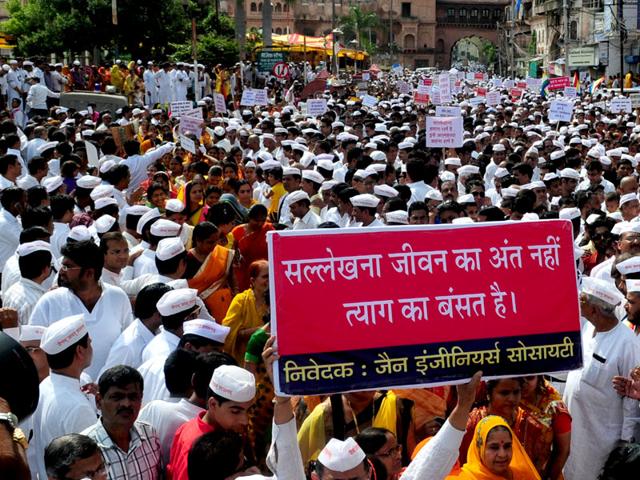
Four, the practitioners. While only a fraction of the Jain population actually undertakes Santhara, the practice finds unequivocal support within the community. And these followers, though numerically diminutive, wield disproportionate heft. Apart from influential top-line industrialists, they include the majority of petty traders and shopkeepers who keep the country’s economy ticking. Their impact was evident when they downed shutters nationwide to take their protest against the HC judgment to the streets. Little wonder that the UPA gave Jains official “minority” status on the eve of the 2014 general elections, and the BJP is bending over backwards to impose an meat ban during the ongoing paryushan season of fasting among Jains.
Five, coming as it did after nearly a decade of dithering by several judges, the Rajasthan HC judgment has opened a Pandora’s box of legal controversy. For one, the judgment brought into sharp relief the inherent incongruence between our legal system whose norms are derived from the Anglo-Saxon jurisprudence inherited from British colonialists of the Judeo-Christian faith, and our religious belief systems which, for the most part, stem from the world-view of Eastern philosophies. For another, the judgment proved that legal doctrines — debatable to begin with — applied mechanically without an adequate application of mind can result in the wrong questions being wrongly asked.
{{/usCountry}}Five, coming as it did after nearly a decade of dithering by several judges, the Rajasthan HC judgment has opened a Pandora’s box of legal controversy. For one, the judgment brought into sharp relief the inherent incongruence between our legal system whose norms are derived from the Anglo-Saxon jurisprudence inherited from British colonialists of the Judeo-Christian faith, and our religious belief systems which, for the most part, stem from the world-view of Eastern philosophies. For another, the judgment proved that legal doctrines — debatable to begin with — applied mechanically without an adequate application of mind can result in the wrong questions being wrongly asked.
{{/usCountry}}And six, what will the Santhara controversy — and its legal ramifications — mean to other religious practices that tend to push the limits of the law as it exists in our statute books? Let’s wait and watch.
Shekhar Hattangadi is a law professor and documentary filmmaker. The views expressed are personal.